


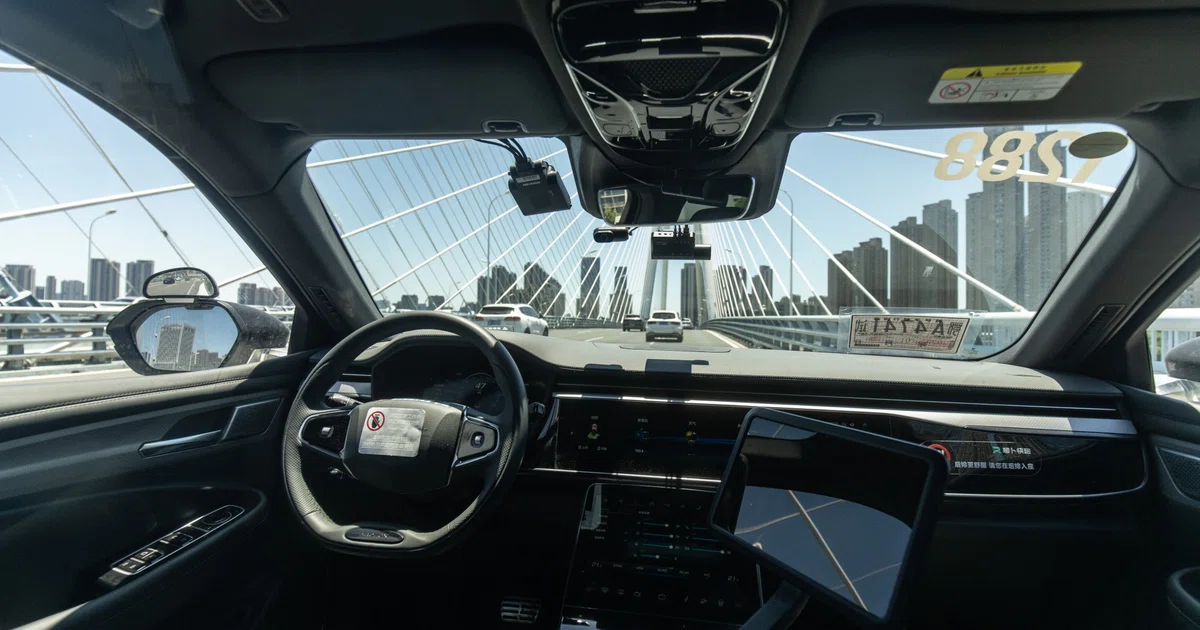
WeRide and Pony AI plan to launch limited service in Singapore as soon as this year with local partners including ride-hailing operator Grab Holdings and transport group ComfortDelGro
[HONG KONG] American companies led by Alphabet’s Waymo have drawn much of the limelight with driverless cars deployed almost entirely on home soil. Now that some are beginning to look abroad, they will have to share roads with Chinese companies quietly making plenty of progress.
Baidu’s Apollo Go, WeRide and Pony AI are outnumbering their American counterparts with more robotaxi projects progressing from testing to various stages of commercialisation, according to a BloombergNEF analysis. While much of that headway is being made domestically, the Chinese companies are standing up operations in places such as Dubai, Abu Dhabi and Singapore, and looking to launch in Germany, the UK and elsewhere in Europe.
Comparing autonomous vehicles companies’ progress is not a straightforward exercise, the industry has been synonymous with false dawns and unfulfilled promises. Players that have looked promising and raised billions at rich valuations have been doomed by singular crashes they never recovered from, or been cut off by benefactors that have lost patience.
But if the state of batteries and electric vehicles (EVs) proves anything, it’s that Beijing is willing to devote untold sums to strategic sectors that require fortitude to conquer. The dominant EV industry that China has built over decades is now among the potential advantages its autonomous vehicle companies may have over Waymo and US hopefuls, including Tesla and Amazon.com’s Zoox.
“In the US, it’s been more market-driven. In China, most of them are government-driven,” said Weisong Shi, a professor at the University of Delaware and director of its Connected and Autonomous Research Laboratory. “Technology-wise, it’s very difficult to say who is ahead or behind, but none are good enough” to operate in inclement conditions like significant snowfall, he said.
Autonomous-driving technology is considered a strategic sector by Beijing, which has set out a policy that aims for China to become the world leader in driverless vehicles by 2035.
BT in your inbox
Start and end each day with the latest news stories and analyses delivered straight to your inbox.
In one indication of the eagerness to meet that objective, the government has resumed issuing robotaxi testing permits, according to sources familiar with the matter, a step taken in part to stay competitive with the US.
Regulators had frozen approvals for new autonomous vehicles or for expansion into additional cities for several months in the second half of 2024, after an outcry about human taxi drivers potentially being forced out of work. Those complaints are now taking a back seat to Beijing’s national interest in a key emerging industry.
The Chinese Ministry of Industry and Information Technology, which regulates the autonomous vehicle sector, did not respond to a faxed request for comment.
SEE ALSO

Driverless cars remain a work in progress, and many experts say meaningful commercial deployment is still a distant goal. Operators must navigate complex regulatory approval processes and work through countless edge cases of unexpected driving phenomena.
Getting truly autonomous cabs on the road is an arduous task, particularly as robotaxi operators tend to face major backlash over glitches, and especially crashes.
In the US, Waymo is the clear industry leader, with fully driverless cars deployed in five cities and testing underway in at least 10 others, but even its technology has encountered issues. Earlier this month, the National Highway Traffic Safety Administration opened a preliminary probe into a report that a Waymo AV operating in Atlanta without a human safety driver failed to stop when approaching a school bus with its red lights flashing.
Tesla has rolled out a limited number of Model Ys with human supervisors in Austin. Zoox, whose shuttle has no steering wheel or pedals, is seeking wider clearance to expand services beyond its current limited offerings in Las Vegas and parts of San Francisco.
‘Catching up fast’
Fully autonomous services have meanwhile been popping up in some of China’s biggest cities. WeRide has launched a fully driverless service in Guangzhou, while Baidu has one in Wuhan. Pony AI takes passengers in cars without drivers around Guangzhou and Shenzhen, and also has permits for Beijing and Shanghai.
Pony AI, which is headquartered in Guangzhou and backed by Toyota Motor, is on track to increase its fleet size to 1,000 vehicles by the end of the year and has partnered with local authorities in Dubai and Qatar. Its American depositary shares have gained about 29 per cent this year.
“Our American peers started the development earlier, but we are certainly catching up really fast,” James Peng, Pony AI’s chief executive officer, said. “We have certain benefits.”
Peng points to advantages, including access to cheaper components such as sensors from China’s vast EV supply chain, and the pool of talented graduates from top Chinese science universities.
While Peng declined to discuss the cost of Pony AI’s vehicles, Baidu’s latest Apollo Go model, the RT6, costs around 204,600 yuan (S$37,296), the company said at an event in May last year. The four-seater manufactured by Jiangling Motors comes equipped with voice controls, a massage function on reclining seats and almost 40 onboard sensors, including eight lidar units and 12 cameras.
Tesla CEO Elon Musk unveiled a prototype Cybercab a year ago that he said could cost less than US$30,000 and “probably” will go into production in 2026, but the company has struggled to make good on his self-driving predictions and pricing pronouncements. The most affordable version of Tesla’s newest model, the Cybertruck, costs roughly twice what Musk touted when the company first unveiled an early build in 2019.
Chinese companies’ low-cost vehicles are attractive to service operators in global markets seeking a path to earning profits, said Ming Hsun Lee, the head of greater China auto and industrials at Bank of America.
“The US companies, it seems that they are not as aggressive as Chinese companies,” Lee said. “One of the reasons is because right now their bill of materials cost is very high, on a per-car basis.”
An ideal laboratory
Chinese robotaxi firms face little local competition in overseas markets because most of their American rivals aren’t yet prioritising global expansion. US companies keen to work with autonomous-car developers have, however, partnered with Chinese firms. Uber Technologies has joined forces with WeRide in Abu Dhabi, while Lyft has linked up with Baidu to launch robotaxi services in Europe starting next year, pending regulatory approval.
WeRide and Pony AI plan to launch limited service in Singapore as soon as this year with local partners including ride-hailing operator Grab Holdings and transport group ComfortDelGro.
The Middle East is shaping up to be ground zero for the scaled roll-out of state-of-the-art Chinese autonomous tech.
A sunny climate, well-developed road infrastructure and welcoming policy regimes are working in the region’s favour. Opposition from human drivers is also less of an issue in Gulf countries, where guest workers in service industry jobs hold little sway, according to Paul Gong, the head of China autos research at UBS.
“There’s less policy concern on employment compared to other regions,” he said.
Pony AI, WeRide and Apollo Go have all signed deals with Uber or local transport authorities in the region. Saudi Arabia’s Vision 2030 features a national network of autonomous vehicles, EVs and charging stations. Dubai has set a goal for 25 per cent of the city’s trips to be autonomous by 2030, while neighbouring Abu Dhabi aims for a similar target by 2040.
The most populous city in the United Arab Emirates previously had an exclusive partnership with General Motors-backed Cruise to deploy robotaxis from 2023, before the carmaker shuttered the business late last year.
After Cruise folded, the emirate struck deals with China’s Baidu, WeRide and Pony AI in quick succession early this year. By September, the three companies’ vehicles were testing on designated streets in Dubai.
On Abu Dhabi’s Yas Island, where Formula One drivers will conclude their season of racing in December, Chinese companies are showcasing their self-driving vehicle technology on public roads.
Every few minutes outside tourist attractions such as SeaWorld and Warner Bros World, autonomous SUVs with the words “Autogo” stamped on the side can be seen making frequent test runs. Uber customers in the capital of the United Arab Emirates have been able to hail WeRide minivans operating with safety drivers.
The region’s investment wealth and appetite for awarding autonomous innovation is also a draw. Abu Dhabi’s sovereign wealth fund Mubadala co-led a US$2.3 billion financing round for Waymo in 2020, and Saudi Arabia’s Neom project invested US$100 million in Pony AI in 2023. Dubai authorities have awarded around US$900,000 in prize money to WeRide for winning the 2025 World Challenge for Self-Driving.
For WeRide, the Middle East is a springboard for further global expansion that allows the company to prove its business case, according to chief financial officer Jennifer Li.
“We are really looking forward to have a few hundred robotaxis here very soon,” she said, adding that WeRide aims to turn profitable on a per-vehicle basis once the size of its fleet scales in the market. “It’s very exciting.” BLOOMBERG
