


AFP
Humanity’s failure to draw down planet-heating carbon dioxide emissions — 41 billion tonnes in 2022 — has thrust once-marginal options for capping or reducing CO2 in the atmosphere to centre stage in climate policy and investment.
Carbon capture and storage (CCS) and direct air capture (DAC) are both complex industrial processes that isolate CO2 but these newly booming technologies are fundamentally different and often conflated.
Here’s a primer on what they are and how they differ.
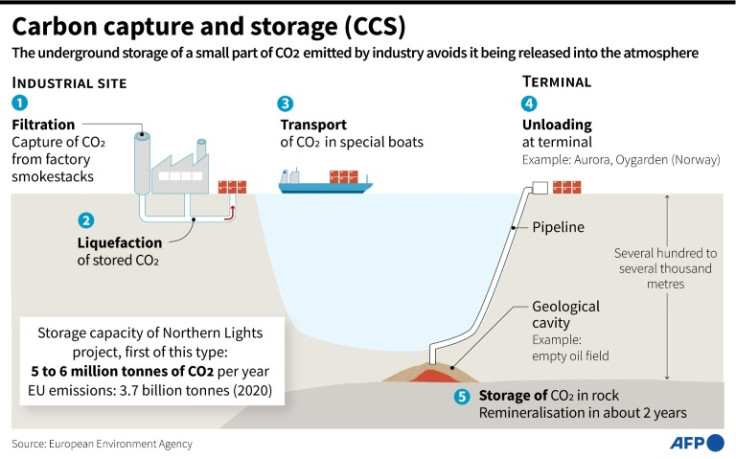
CCS syphons off CO2 from the exhaust, or flue gas, of fossil fuel-fired power plants as well as heavy industry.
The exhaust from a coal-fired power plant is about 12 percent CO2, while in steel and cement production it is typically double that.
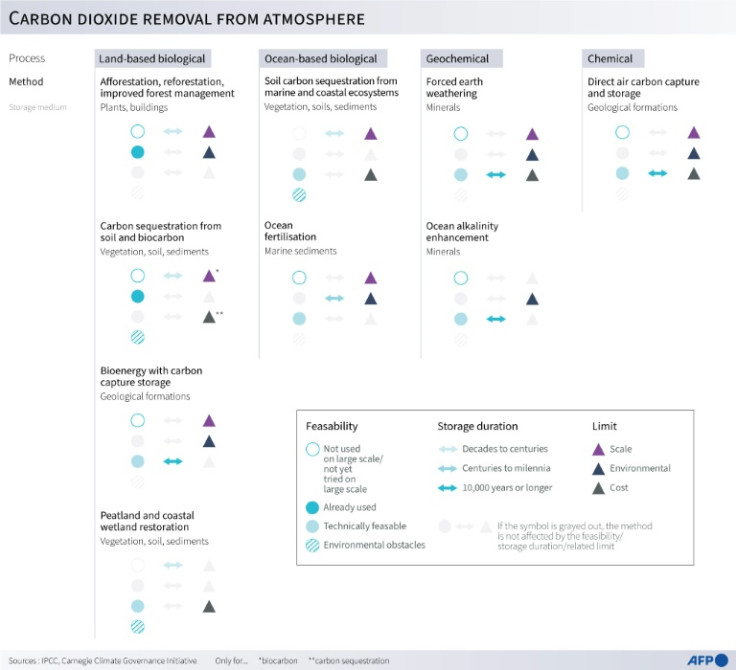
Unlike CCS, which by itself only prevents additional carbon dioxide from entering the atmosphere, DAC extracts CO2 molecules already there.
Crucially, this makes DAC a “negative emissions” technology.
It can therefore generate credits for companies seeking to offset their greenhouse gas output — but only if the captured CO2 is permanently stored underground, such as in depleted oil and gas reservoirs or in saline aquifers.
The concentration of carbon dioxide in ambient air is only 420 parts per million (about 0.04 percent), so corralling CO2 using DAC is far more energy intensive.
Once isolated using either CCS or DAC, CO2 can be used to make products such as building materials or “green” aviation fuel, though some of that CO2 will seep back into the air.
“If the CO2 is utilised, then it is not removal,” said Oliver Geden, a senior fellow at the German Institute for International Security Affairs.
The fossil fuel industry has been using CCS since the 1970s but not to prevent CO2 from leaching into the atmosphere.
Rather, oil and gas companies inject CO2 into oil fields to extract more crude more quickly.
Historically, bolting CCS facilities onto coal- and gas-fired power plants and then storing the CO2 to reduce emissions has proven technically feasible but uneconomical.
The world’s largest CCS plant, the Petra Nova facility in Texas, was mothballed three years after opening in 2017.
But the looming climate crisis and government subsidies have revived interest in CCS for the power sector and beyond.
At the end of 2022, there were 35 commercial-scale facilities worldwide applying carbon capture technology to industry, fuel transformation or power generation, isolating a total of 45 million tonnes (Mt) of CO2, according to the International Energy Agency (IEA).
DAC, by contrast, is very new.
A total of 18 DAC plants globally only captured about as much CO2 last year (10,000 tonnes) as the world emits in 10 seconds.
Both CCS and DAC must be massively scaled up if they are to play a significant role in decarbonising the global economy.
To keep the mid-century net-zero target in play, CCS will need to divert 1.3 billion tonnes a year from power and industry — 30 times more than last year — by 2030, according to the IEA.
DAC must remove 60 Mt CO2 per year by that date, several thousand-fold more than today.
But the nascent industry is burgeoning with new actors, and the first million-tonne-per-year plant is scheduled to come on line in the United States next year, with others following.
“It’s a huge challenge but it’s not unprecedented,” University of Wisconsin-Madison professor Gregory Nemet told AFP, citing other technologies, including solar panels, that have scaled up dramatically in a matter of decades.
Preparing a site to stock CO2 can take up to 10 years, so storage could become a serious bottleneck for both CCS and DAC development.
Carbon capture costs $15 to $20 per tonne for industrial processes with highly concentrated streams of CO2, and $40 to $120 per tonne for more diluted gas streams, such as in power generation.
DAC — still in its infancy — has much higher costs, ranging today from $600 to $1,000 per tonne of CO2 captured.
Those costs are projected to drop sharply to $100-$300 per tonne by 2050, according to the inaugural State of Carbon Dioxide Removal report, published earlier this year.
As countries and companies feel the pinch from decarbonisation timetables and net-zero commitments, more money — public and private — is flowing toward both CCS and DAC.
In the United States, the Inflation Reduction Act (IRA) earmarks billions of dollars in tax credits for CCS.
The earlier Infrastructure Investment and Jobs Act provides about $12 billion over five years.
Canada’s 2022 budget also extends an investment tax credit that cuts the cost of CCS projects in half.
South Korea and China are also investing heavily in the sector, with China opening a 500,000 Mt plant last month in Jiangsu Province.
In Europe, support comes at the national level and is oriented toward industry and storage, especially in the North Sea.
For DAC, a range of companies — Alphabet, Shopify, Meta, Stripe, Microsoft and H&M Group — have paid into a fund with a promise to collectively buy at least $1 billion of “permanent carbon removal” between 2022 and 200.
Last month, JP Morgan struck a $20 million, nine-year carbon removal deal with DAC pioneer Climeworks, based in Switzerland.
AFP
AFP

AFP
