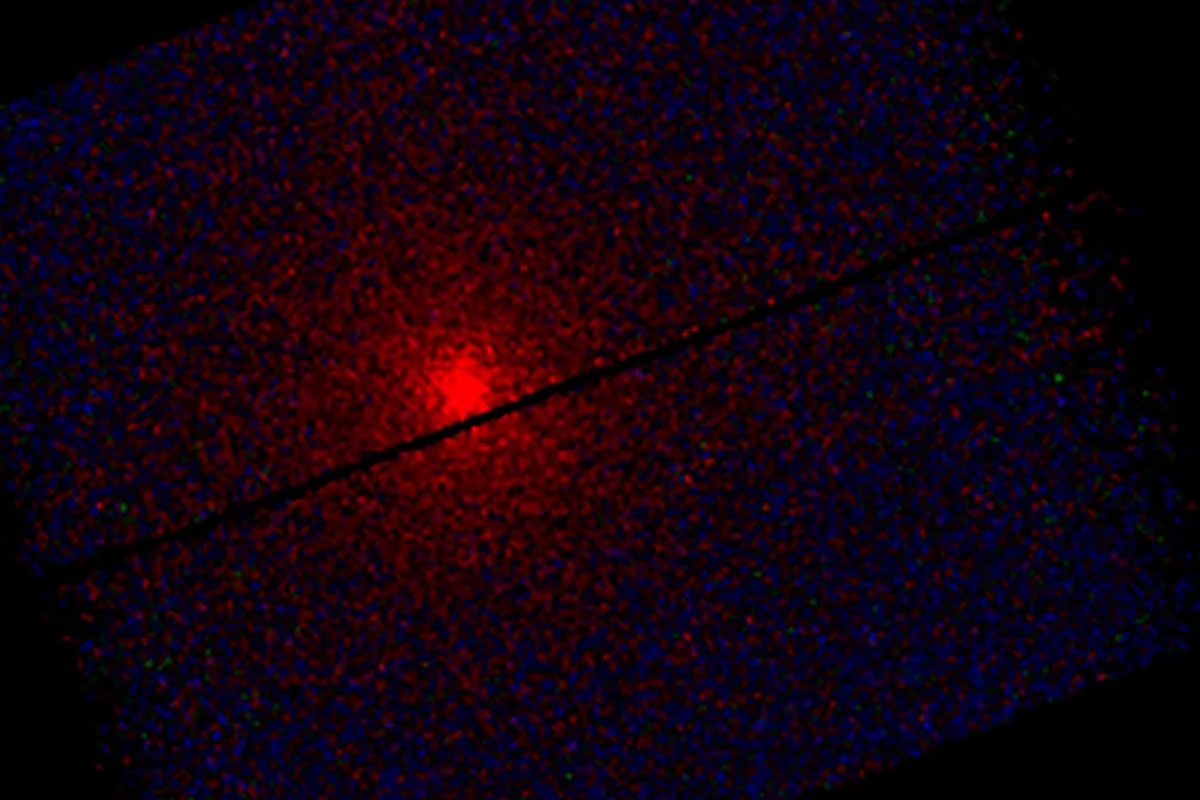
Even by the strange standards of interstellar visitors, 3I/ATLAS is turning into a real cosmic outlier. Discovered on July 1, 2025 by the ATLAS telescope in Chile, this Manhattan-sized interloper — roughly 20-40km across — hurtled into our solar system on a hyperbolic path at over 50km/s, confirming its origin beyond our sun. Fresh Hubble images revealing a wobbling ‘double jet’ have reignited speculation that the Manhattan-sized object might be more than just an exotic lump of ice and rock drifting in from another star.
3I/ATLAS Sparks Fears of Alien ‘Recon Craft’
The object, officially classified as 3I/ATLAS, is only the third known interstellar body to sweep through our solar system, after ʻOumuamua and 2I/Borisov — and it has already inspired far wilder theories than either of its predecessors. Unlike the cigar-shaped ʻOumuamua, which sparked similar debates in 2017, or the more comet-like 2I/Borisov, 3I/ATLAS showed no initial coma but developed one unusually late, after passing perihelion on Nov. 30, 2025 at 1.4 AU from the sun. Most astronomers say it is behaving like a comet that formed around another star, but a vocal minority suspects something more engineered may be at work.
Harvard astrophysicist Avi Loeb has become the most prominent figure arguing for a technological explanation. He previously suggested 3I/ATLAS could be an artificial alien probe on a reconnaissance mission, pointing to its glow, hyperbolic trajectory and unusual, sun‑facing ‘anti‑tail’ as reasons to keep an open mind.
Loeb has catalogued at least eight anomalies, including extreme brightness variations, a non-gravitational acceleration defying standard models, and this persistent tail pointed ‘the wrong way’ — towards the sun rather than trailing behind. Although the object passed Earth earlier this month on Dec. 19 at a closest approach of 1.35 AU, or about 200 million km — safely distant but close enough for detailed scrutiny at a safe distance and without any obvious interaction, Loeb insists that this does not rule out the possibility that it is a controlled craft using advanced propulsion or shielding.
The latest twist comes from newly processed Hubble Space Telescope images taken on Dec. 12 and 27, which reveal a persistent double jet structure emerging from the nucleus region of 3I/ATLAS. These jets extend up to 100,000 km, far brighter than typical for interstellar comets, and rotate with the object’s 8-hour spin period. One jet forms a striking anti‑tail pointed roughly towards the sun, while a second, weaker jet appears offset yet aligned with the earlier activity seen in mid‑year images.

Wobbling Jets of 3I/ATLAS Deepen the Mystery
In a recent blog post, Loeb notes that a prominent sunward jet — about 10 times longer than it is wide — was first captured in Hubble data on July 21. He calculates that this feature wobbles by around 7 degrees around the object’s rotation axis, implying that it ‘originated near the sun‑facing pole long before’ 3I/ATLAS reached its closest point to the sun.
This pre-perihelion activity is rare for comets, which usually activate closer to the sun; here, it suggests internal heat sources or deliberate venting. Now, in the December images, that earlier jet appears to line up with a weaker strand in the new double structure, while ‘a stronger sunward jet from the opposite side’ has switched on as the object recedes from the inner solar system.
Loeb lays out two broad possibilities. ‘One possibility is that the two jets are launched from opposite sides of the nucleus. This would make the post‑perihelion activity of 3I/ATLAS different than it was before perihelion’. For a natural comet, he argues, heat absorbed near perihelion could conduct from the dayside to the nightside, creating a weaker secondary jet in the darkness alongside a more powerful outflow facing the sun.
The second scenario, which he describes as more ‘technological’, assumes that both jets originate from the sun‑facing side but with different compositions and roles. ‘For a technological object, the sunward jet might be utilized for protection against the solar wind, coronal mass ejections or sunlight — given that the anti‑tail is marginally opaque,’ he writes, suggesting that a secondary jet could act as a forward‑facing shield against dust or debris in the craft’s path.
This ‘protection craft’ idea aligns with the headline’s thrust, implying engineered deflection of interstellar hazards during high-speed travel. In either case, he adds, ‘both jets are expected to show a high‑speed exceeding 1 kilometer per second at their launch points near the nucleus’ if they are being actively controlled.
To pin down which interpretation is closer to the truth, Loeb says astronomers will need spectroscopic measurements of the jets’ velocity profiles from major ground‑based facilities such as the Keck Observatory in Hawaii and the Very Large Telescope in Chile. Preliminary spectra already hint at exotic ices like CO or metal-rich silicates, but high-resolution data could reveal if velocities match artificial thrust patterns — expected soon as 3I/ATLAS brightens briefly in coming weeks. If both jets can be traced back to the sun‑facing side and seen to accelerate away from the sun, it would strengthen the case that their behaviour is not simply a matter of uneven surface ice boiling off.

3I/ATLAS: Alien Threat or Cosmic Visitor?
Named after the ATLAS survey that first spotted it, the interstellar wanderer has become a lightning rod for UFO enthusiasts and those worried that humanity might be sleepwalking into its first hostile encounter. Russian President Putin reportedly dubbed it ‘Russia’s secret’ in jest, fuelling global chatter.
A scientific paper co‑authored by Loeb even floated the possibility that 3I/ATLAS could be a hostile spacecraft, arguing that political leaders should at least consider how to respond to outcomes ranging from a benign close pass to an openly aggressive act.
Mainstream planetary scientists, however, continue to favour a natural explanation, pointing to growing evidence that 3I/ATLAS behaves like an unusually energetic but still physical comet, shaped by outgassing and rotation rather than intention. NASA’s latest analysis confirms non-gravitational forces from asymmetric outgassing, not deflection plates or sails.
For now, the object is heading back out into deep space, leaving behind a trail of data — and a debate over whether humanity has just watched an alien craft slip silently past, or simply witnessed the strange but natural physics of a visitor from another sun.
Originally published on IBTimes UK