The Chinese nation and the US are competing to become the first to exploit the military and strategic advantages of space dominance
Published Thu, Jan 29, 2026 · 09:17 PM
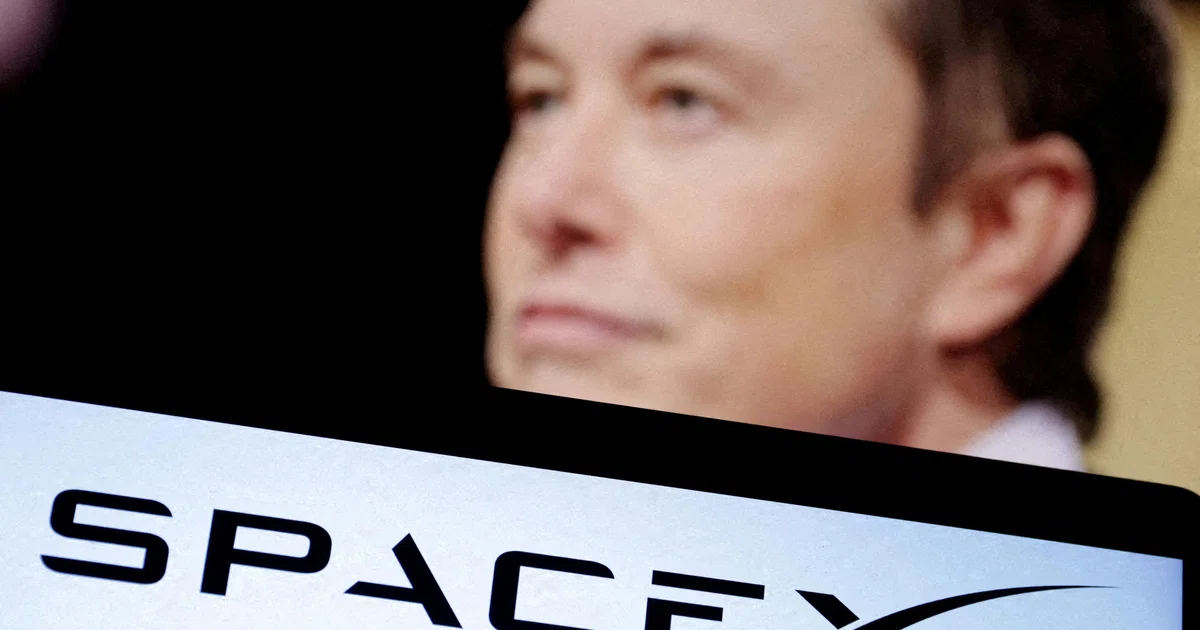
[BEIJING] China plans to launch space-based artificial intelligence (AI) data centres over the next five years, state media reported on Thursday (Jan 29), challenging Elon Musk’s plan to deploy SpaceX data centres to the heavens.
China’s main space contractor, China Aerospace Science and Technology Corporation (CASC), vowed to “construct gigawatt-class space digital-intelligence (infrastructures)”, based on a five-year development plan that was cited by state broadcaster CCTV.
The new space data centres will “integrate cloud, edge and terminal (device) capabilities”, and achieve the “deep integration of computing power, storage capacity and transmission bandwidth”, enabling data from earth to be processed in space, the report said.
US firm SpaceX expects to use funds from its planned US$25 billion initial public offering in 2026 to develop orbital AI data centres in response to terrestrial energy constraints.
It plans to launch solar-powered AI data centre satellites within the next two to three years, Musk said at the World Economic Forum in Davos, Switzerland, on Jan 22.
“It’s a no-brainer building solar-power data centres in space … the lowest-cost place to put AI will be space, and that will be true within two years, three at the latest,” he added.
Navigate Asia in
a new global order
Get the insights delivered to your inbox.
He noted that solar generation in orbit can produce 500 per cent more power than panels on the ground.
China also plans to shift the energy-intensive burden of AI processing into orbit, utilising “gigawatt-class” solar-powered hubs to create an industrial-scale “Space Cloud” by 2030, based on a December CASC policy document.
The document identifies the integration of space-based solar power with AI computing as a core pillar of the upcoming 15th Five Year Plan, China’s economic development roadmap.
The CASC plan also vowed to “achieve the flight operation of suborbital space tourism, and gradually develop orbital space tourism” in the next five years, CCTV reported.
China and the US are competing as they look to turn space exploration into a commercially viable business, similar to civil aviation, as well as becoming the first to exploit the military and strategic advantages of space dominance. CASC has vowed to transform China into a “world-leading space power” by 2045.
But Beijing’s key bottleneck so far is its failure to complete a reusable rocket test. US rival SpaceX’s Falcon 9 reusable rocket has allowed its subsidiary, Starlink, to achieve a near-monopoly on low earth orbit satellites, and it is also used for orbital space tourism.
Reusability is crucial to lowering the costs of rocket launches, and making it cheaper to send satellites into space. China achieved a record of 93 space launches in 2025, based on official announcements, buoyed by its rapidly maturing commercial spaceflight startups.
CASC’s plans were announced after China inaugurated its first School of Interstellar Navigation, housed in the Chinese Academy of Sciences, on Jan 27, aiming to foster the next generation of space talent in frontier fields, including interstellar propulsion and deep space navigation.
The new institution signals China’s ambitions to strategically transition from near-earth orbit operations to deep space exploration.
“The next 10 to 20 years will be a window for leapfrog development in China’s interstellar navigation field. Original innovation in basic research and technological breakthroughs will reshape the pattern of deep space exploration,” news agency Xinhua wrote on the inauguration.
The US faces intense competition this decade from China in its effort to return astronauts to the moon, where no humans have gone since the final US Apollo mission in 1972. REUTERS
Decoding Asia newsletter: your guide to navigating Asia in a new global order. Sign up here to get Decoding Asia newsletter. Delivered to your inbox. Free.