


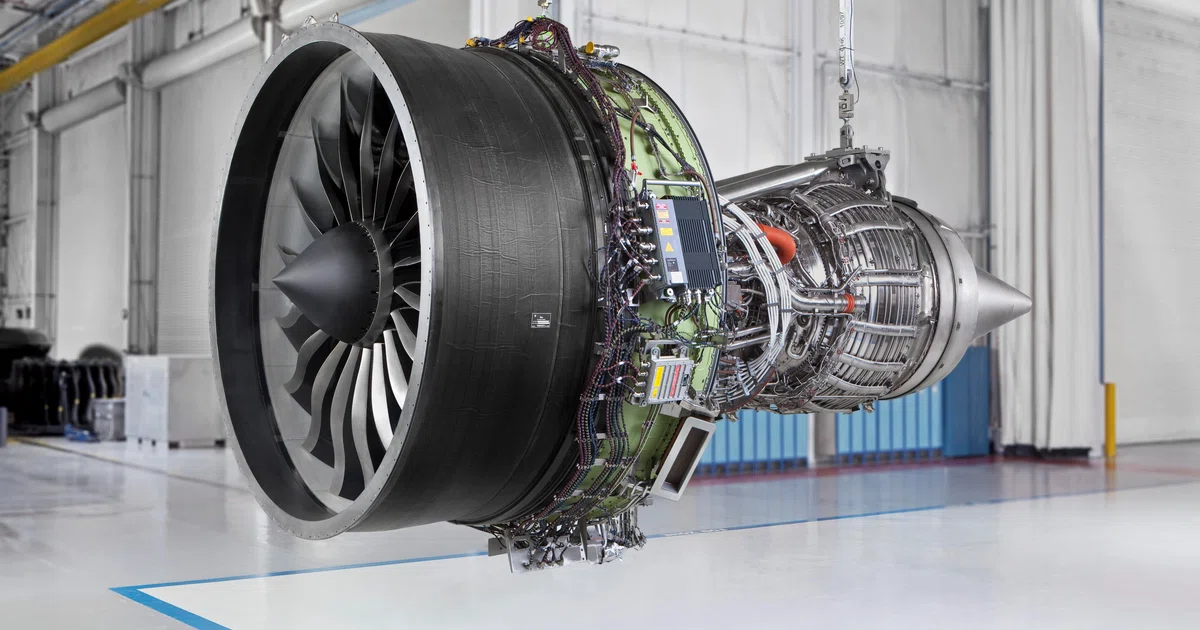
GE Aerospace will expand its Singapore presence beyond maintenance, repair and overhaul under a new R&D partnership
[SINGAPORE] The Civil Aviation Authority of Singapore (CAAS) and the Economic Development Board (EDB) have signed a memorandum of understanding with GE Aerospace to collaborate on next-generation aviation technologies.
These will range from artificial intelligence (AI) to novel aircraft engine designs, said the three parties and the International Centre for Aviation Innovation (ICAI) on Monday (Feb 2). Together, they will establish the Singapore Partnership for Aviation & Aerospace Research and Capability (SPAARC).
“Through public-private research partnerships such as this, we hope to establish and offer new innovation pathways that are more efficient and effective than what are available currently,” said CAAS director-general Han Kok Juan.
The move marks a significant expansion for GE Aerospace in Singapore, extending its footprint beyond its existing maintenance, repair and overhaul (MRO) operations to include advanced research and development.
GE Aerospace Engine Services Singapore is the company’s largest site for engine component MRO and is responsible for more than 60 per cent of its global repair volume.
Established in 2023, the ICAI connects governments and companies to develop technologies that address industry challenges such as manpower shortages and decarbonisation. Its role in the partnership is to translate research into operational capabilities.
Navigate Asia in
a new global order
Get the insights delivered to your inbox.
Safety, efficiency and resilience
Under SPAARC, AI applications will help enhance aviation safety and operational effectiveness across maintenance, flight operations and airspace management, said the four parties. They will include AI governance frameworks that “ensure these systems meet aviation’s rigorous safety standards”.
Airspace modernisation solutions developed under the pact will help improve safety, efficiency and resilience of airspace operations. These will include advanced analytical systems that support better planning of flight routes to optimise airspace flows and improve airspace capacity.
Additionally, advanced aerodynamic research under the pact is aimed at supporting “next-generation propulsion systems” and enhancing aircraft performance and efficiency. This will include researching “novel engine designs” and ensuring these advanced engines can be “effectively integrated” with current aircraft designs and airport infrastructure.
The four parties said that they will also establish a collaborative framework to identify research and development opportunities, coordinate joint efforts and facilitate knowledge sharing.
Through the agreement, Singapore’s workforce will “have opportunities to develop advanced technologies that will drive Singapore’s continued growth as a global aviation and aerospace hub”, said EDB managing director Jermaine Loy.
Decoding Asia newsletter: your guide to navigating Asia in a new global order. Sign up here to get Decoding Asia newsletter. Delivered to your inbox. Free.
