


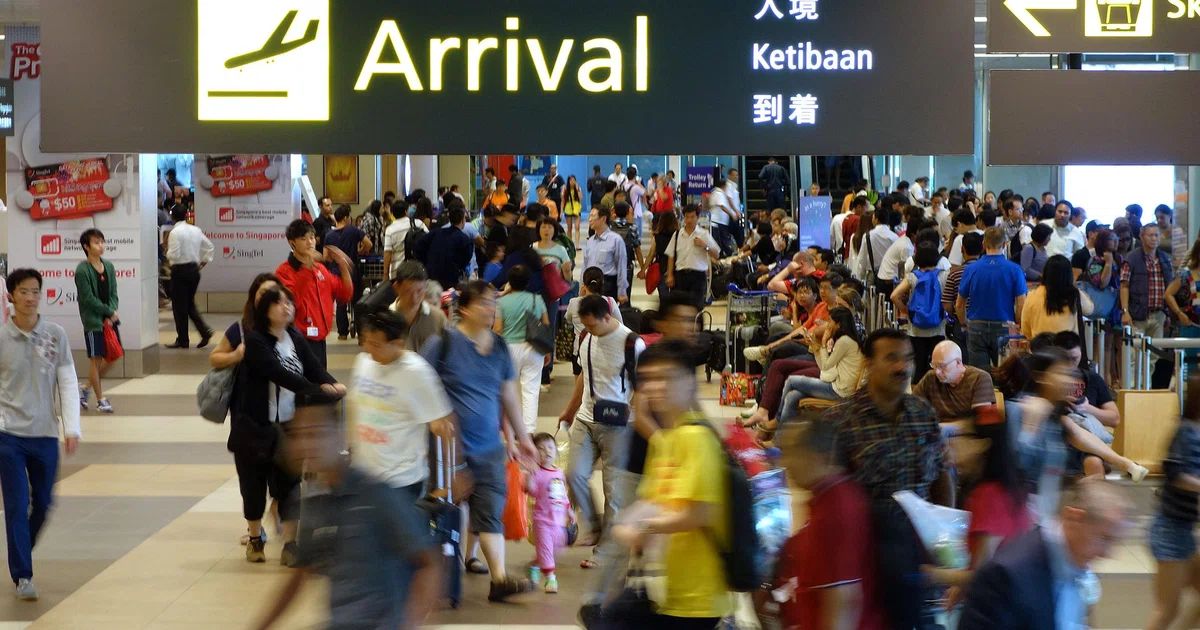
Japan, South Korea, China see strong inbound travel amid demand for pop culture tourism
[SINGAPORE] Asia-Pacific economies exposed to the artificial intelligence (AI) boom drove outbound spending in 2025, amid an increase in their strength, data by Visa indicated.
In the region, AI investment is largely into semiconductor manufacturing and data centres, and economies exposed to these – such as Taiwan, South Korea, Singapore and Malaysia – are “doing really well”, said Simon Baptist, principal economist for Visa Asia-Pacific.
“Where there’s people making money from the AI investment boom, they are spending a bunch of it on travel,” Baptist said on Thursday (Feb 5).
Travel was “the stand-out category” in 2025, with travel merchant spend growing 2.5 times more than the average spend, while cross-border spending boomed.
This trend will likely continue going forward, as Baptist noted a permanent change in consumer preferences towards travel since the Covid-19 pandemic.
“Now, it’s the thing that everyone is protecting: even in difficult times, people do cut back on other discretionary spending to try and protect the travel budget,” Baptist said.
Navigate Asia in
a new global order
Get the insights delivered to your inbox.
Key beneficiaries for inbound travel include Japan, Korea and China, driven by culture tourism.
Travel patterns are also increasingly driven by currency fluctuations and geopolitics – for example, Japan and South Korea benefited from weaker currencies, while it is currently easier to travel to China due to easing visa restrictions.
Meanwhile, affluent travellers are becoming “really, really critical”, with three quarters of the additional spending in 2025 coming from markets where affluent travellers are from, such as Australia, Hong Kong and Singapore.
AI is also set to change spending in e-commerce, which is the segment with the largest spending in the Asia-Pacific region.
Visa defines e-commerce as spending where a physical card is not required at the point of sale.
While it is still too early to tell, Agentic AI might move some spending that is currently done in person online, and it is possible that e-commerce websites no longer need to exist.
Baptist said: “Your agent is just reading the code behind and so all traditional things like online ad spending could be completely revolutionised.”
Baptist expects this will take off first in more tech savvy economies such as India and Vietnam.
Diving into specific markets, Baptist noted increasing discretionary spending in Hong Kong, Singapore and Malaysia, as trade volumes stabilised.
But for emerging markets in Asia, spending momentum has been weak, in part due to manufacturing uncertainty as well as inequality.
While overall spending is mostly up, the typical card is not spending as much, which suggests that the affluent are doing better than mainstream consumers.
“This matches a lot of the disconnect we’ve seen in places like Indonesia, China and India, when middle classes are not seeing the benefits of that top level growth.”
Baptist noted that growth in these three markets is not very consumer intensive, such as mining in Indonesia that creates money but not jobs. In China, a lot of the economy is also focused on investments and exports, rather than on consumers.
“That’s an issue for Asia-Pacific in the year ahead, for the policy makers to think about, how we rejuvenate that core market,” he said.
Decoding Asia newsletter: your guide to navigating Asia in a new global order. Sign up here to get Decoding Asia newsletter. Delivered to your inbox. Free.
