


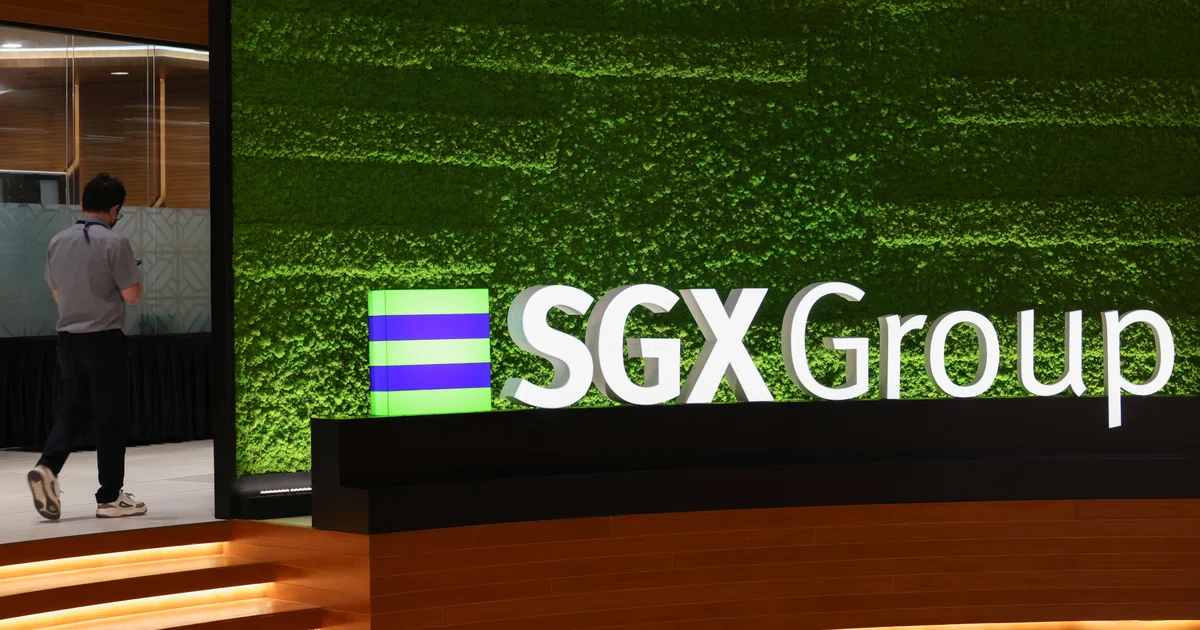
SGX leads gainers on blue-chip index; best performer on iEdge Singapore Next 50 Index is UOB Kay Hian
[SINGAPORE] Singapore stocks ended higher on Wednesday (Feb 11), tracking regional indices.
The benchmark Straits Times Index (STI) gained 0.4 per cent or 20.33 points to finish at 4,984.58. Meanwhile, the iEdge Singapore Next 50 Index gained 0.5 per cent or 8.28 points to 1,518.23.
Across the broader market, gainers outnumbered losers 374 to 230, after 1.5 billion securities worth S$2.4 billion changed hands.
Singapore Exchange led the gainers on Singapore’s blue-chip index, rising 5 per cent or S$0.90 to end at S$19.07.
The worst performer among STI constituents was CapitaLand Investment , which fell 3.5 per cent or S$0.11 to close at S$3.06 on the back of reporting a loss for the second half of 2025.
The three local banks ended mixed on Wednesday. OCBC rose 0.1 per cent or S$0.03 to close at S$21.35; DBS finished 0.5 per cent or S$0.30 lower at S$57.50, and UOB closed 0.1 per cent or S$0.02 lower at S$38.90.
Navigate Asia in
a new global order
Get the insights delivered to your inbox.
The best performer on the iEdge Singapore Next 50 Index was UOB Kay Hian; the counter rose 5.4 per cent or S$0.17 to S$3.32 on Wednesday. The worst performer was ESR Reit , which closed 5.2 per cent or S$0.14 lower at S$2.53.
Across the region, benchmark indices closed higher on Wednesday. The Kospi gained 1 per cent, the Hang Seng Index rose 0.3 per cent, and the FTSE Bursa Malaysia KLCI added 0.5 per cent.
In the US, equity investors appear to be more selective and fragile in their convictions, said Stephen Innes, managing partner of SPI Asset Management. The market is no longer responding uniformly to the idea of stocks seeing an uplift from weaker economic data, he said.
“Early gains faded, Nasdaq struggled to hold technical support, and leadership narrowed as defensives and value-oriented segments quietly outperformed growth-heavy indices.”
Decoding Asia newsletter: your guide to navigating Asia in a new global order. Sign up here to get Decoding Asia newsletter. Delivered to your inbox. Free.
