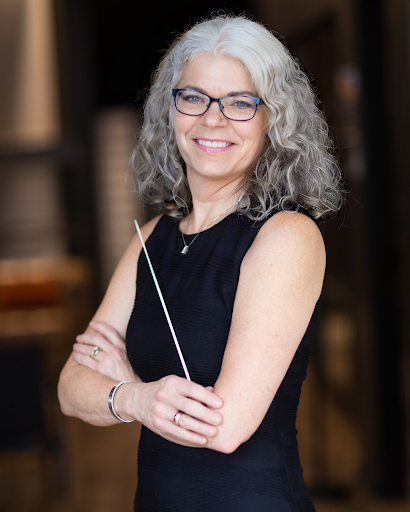
Lesley Moffat, an educator-turned-efficiency expert and founder of mPowered Music Educator Academy, has led a career guided by the observation that administrative tasks have expanded inexplicably, consuming the margins of educators’ time, attention, and health. An OECD 2024 study revealed that across 55 education systems, half of the teachers reported excessive administrative work as a source of work-related stress. From Moffat’s perspective, burnout follows not from a lack of passion but from the unsustainable architecture surrounding the world, and her own life experiences have informed that belief.
A band director for 38 years, Moffat was raised in a family of music educators. She spent decades balancing a demanding program, three children, and the invisible administrative load that accompanies modern teaching. Ten years ago, her mental and physical health collapsed under the strain. Twelve major surgeries, 14 daily prescriptions, and a complete inability to make even simple decisions forced her to step away from work and confront a painful reality. “I loved the job,” she says. “But the way I was doing it was destroying me.”
Moffat’s breaking point arrived at yet another medical visit when a doctor reached for the prescription. “He handed it to me, and I tore it up and walked out,” she recalls. “It was in that moment that I knew something fundamental had to change.” Her search for answers became less reliant on healthcare and more directed toward self-redirection. As Moffat says, “I began questioning how I could redesign my life and work so they could be sustained.” The mPower Method became the result of those questions, built around a mindful approach to meals, movement, and music, and later expanded into a broader system for educator sustainability.
Burnout, Moffat observed, is driven by decision fatigue, administrative sprawl, and the absence of systems that protect time and energy. Her response was to document the recovery process through writing. One of her books, I Love My Job But It’s Killing Me, guides educators through diagnosing the root causes of their stress and mapping a path back to personal wellness. The other, The Balanced Band Director, translates that personal stability into classroom sustainability through what she calls the PSA system: Prioritize, Simplify, Automate.
The framework further shapes her speaking engagements, where she focuses on two core topics. The first addresses personal wellness, helping educators identify hidden contributors to burnout and rebuild foundational habits that support cognitive and physical health.
The second introduces practical tools and workflows that reduce administrative friction. These include structured prioritization methods, automation strategies, and even custom AI tools that are designed to eliminate hours of repetitive tasks each week. “The goal is to help them save over 10 hours a week from administrative work, which they can then use to do other important things within their actual scope of work,” she says.
Group consulting sessions extend these principles across departments and schools, offering broad frameworks for sustainable practice. One-on-one consulting goes deeper. Using diagnostic tools, such as quizzes from her books, Moffat works directly with educators to map their exact stress points, redesign workflows, and tailor systems to their specific environment.
“We work through that individual’s exact scenarios, digging into their personal matters and offering personalized insight,” Moffat explains.
Furthermore, through her podcast, Band Director Boot Camp, Moffat shares short, actionable insights with guests who bring solutions born from their own burnout experiences. Now in its fifth season, the podcast underscores Moffat’s principles of integrative productivity strategies into wellness practices to enable sustainability in health and work.
Moffat now sees clear parallels with the corporate environment, where administrative overload, constant communication demands, and decision fatigue often create similar patterns of burnout. “Burnout is universal,” she says. “Any workplace that adds tasks without redesigning systems will see the same outcome.”
In the future, Moffat plans to expand her speaking engagements, host retreats, and reach audiences beyond education. As she focuses on helping individuals recover from burnout, her broader objective lies in positioning sustainability as a structural imperative within organizations.
“Burnout is not a failure of will, but a flaw in design,” Moffat remarks. “True sustainability can only come when we devise systems that preserve our spirit for the work that matters most.”