


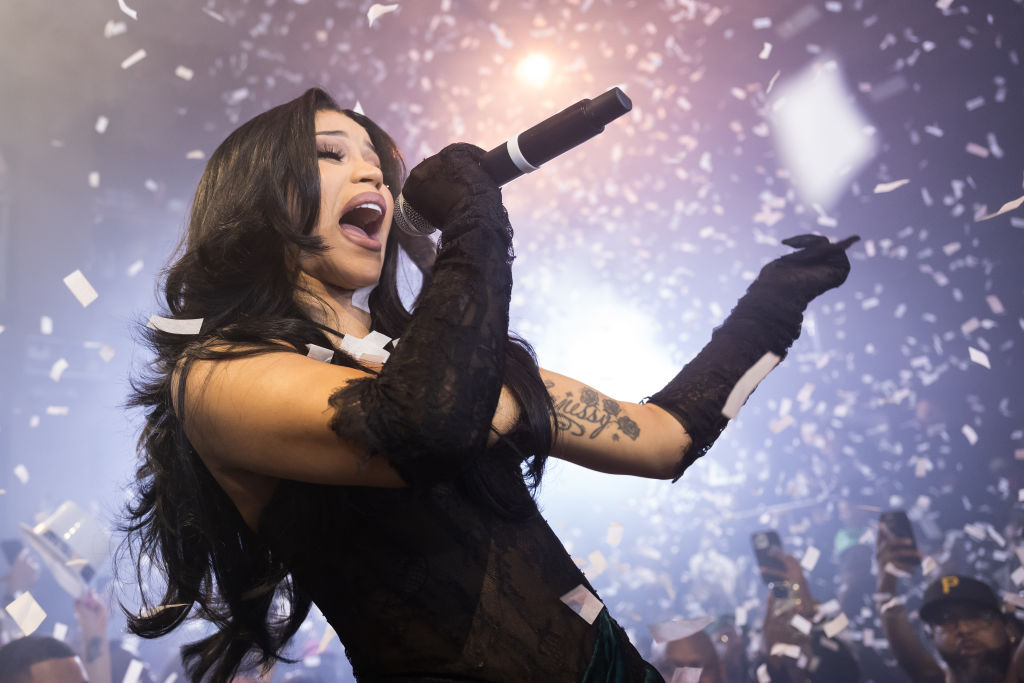
Rapper Cardi B launched her Little Miss Drama Tour last night in California, but in true Cardi fashion, she didn’t do just that. The Latina artist turned her return to the stage into a cultural flashpoint, issuing a fiery, crowd-igniting warning to U.S. Immigration and Customs Enforcement(ICE) that quickly spread across music feeds and social video timelines.
On February 11 in Palm Desert, California, the Grammy-winning rapper paused during her arena-scaled show and addressed the audience with a direct message to ICE: “If ICE come in here, we gon’ jump they asses,” she said over pulsing lights and chants from the packed crowd. She followed that with a cheeky remark about having “bear mace in the back” and that “they ain’t taking my fans.” The line became the stand-out moment of Act III of her performance, which also featured her belting a lyric from Selena Quintanilla’s Como La Flor right before launching into crowd favorites like I Like It.
This wasn’t a random aside. Cardi B’s Little Miss Drama Tour, her first headlining trek in years, is tightly linked to her sophomore album Am I the Drama? and spans 35 arena dates across North America through April 18, from Las Vegas and Los Angeles to New York City and Toronto, before finishing in Atlanta. The start date, Feb. 11, landed right after Super Bowl weekend, where Cardi shared the spotlight, if not the stage, with industry peers tied to immigration discourse.
Just days earlier, at Super Bowl LX in Santa Clara headlined by Bad Bunny, Cardi B praised the Puerto Rican star for speaking out about ICE and immigration during Grammy season. Bad Bunny’s historic halftime show was the first mostly Spanish-language performance in Super Bowl history, and Cardi leveraged that momentum, publicly calling him “proud” of his stance against the immigration agency and applauding the visibility for Latino and Hispanic fans.
From Stage to Politics: A Consistent Theme
Cardi B’s onstage commentary on immigration is not out of left field. Born Belcalis Marlenis Almánzar in Washington Heights and raised in the Bronx, she has long spoken about her family roots, her father is Dominican and her mother is Trinidadian , and used her platform to highlight issues affecting immigrant communities.
In 2025, Cardi revealed publicly that a close family member had been deported, linking personal experience to broader debates over immigration enforcement and policy. In clips shared during an Instagram Live, she said that her uncle was “deported,” a statement that circulated widely across music and cultural outlets amid discussions of enforcement activity nationwide.
Her political commentary has spanned years. During earlier election seasons, she weighed in on immigration policy and candidates, once warning fans about the potential impact of federal immigration stances and later praising politicians whose platforms aligned with her views on economic and social issues.
What changed on Feb. 11 was the context: Cardi didn’t just speak about immigration policy, she redirected the energy of her concert, a high-production spectacle designed to break arenas, into a rallying cry. The reaction was immediate, with fan videos and clips spreading on platforms like TikTok and X as soon as the performance segment aired online.
Tour Energy, Latino Culture and Concert Politics
The Little Miss Drama Tour has been described by fans and outlets as a mix of high-energy hits, salsa-inflected dance breaks, and cultural celebration. On opening night, Cardi brought out flags representing Mexico, the Dominican Republic and Panama, weaving Latino cultural pride into the visuals alongside her music.
Her choice to make such a bold statement in California, a state with a large Latino audience and ongoing immigration debates, ensured that Wednesday’s moment wasn’t just another concert anecdote. Whether she intended it as playful bravado or serious politics, the message reverberated far beyond the arena walls.
Critics and commentators have already begun unpacking Cardi’s remarks: some see her as protecting her fanbase and reclaiming space for minority audiences often targeted by enforcement actions, while others question the merging of performance and political warning. Either way, the moment has dominated music news cycles and sparked discussions in entertainment and political corners alike.
As Cardi B continues her tour across North America, that Feb. 11 moment will likely be replayed, debated and shared not just as a highlight of a concert set list but as a defining cultural moment that blended music, identity and a hot-button issue in America in 2026.
Originally published on Latin Times
