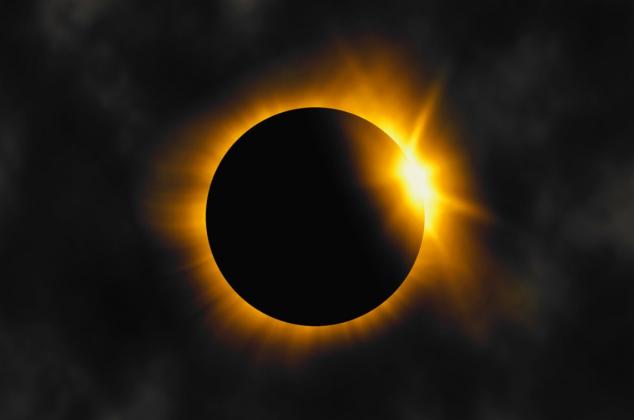
Today’s annular solar eclipse, peaking around midday UTC Tuesday (February 17, 2026), turned heads across the globe, even though its full “ring of fire” spectacle was confined to remote Antarctic vistas where hardly any of them could witness the sky spectacle.
While the event itself is a precise alignment of celestial bodies, the real show unfolded on platforms like X, where posts ranged from factual breakdowns to speculative ties with tech booms, cultural festivals, and even karmic shifts. This isn’t just a shadow play in the sky; it’s a mirror to how we interpret the universe in the digital age.
Imagine the Moon sliding between Earth and the Sun, but at just the right distance to leave a glowing halo of sunlight peeking around its edges, that’s the annular eclipse, or “ring of fire.”
Unlike a total eclipse where darkness fully descends, this one creates a dramatic annulus because the Moon is farther from Earth (near its apogee), appearing slightly smaller and unable to blot out the Sun completely.
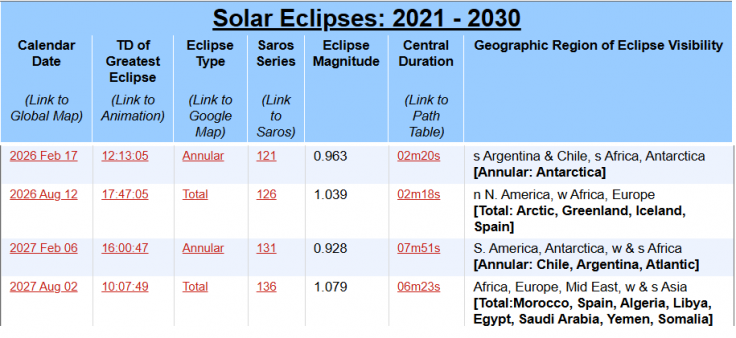
The peak lasted up to 2 minutes and 20 seconds, with annularity visible only over Antarctica’s icy expanses, home to research stations like Concordia where 96% of the Sun was obscured.
Partial views were graced from southern South America, Africa, and the Southern Ocean, but for most of the world, it was a virtual event streamed and shared online.
X Ignites Debate From Facts to Fantasies
On X, the eclipse sparked a flurry of posts, turning a remote astronomical event into a global talking point. Users shared quick facts, like @CarolynKWalker1 detailing the timing (9:56 to 14:27 GMT) and visibility limited to Antarctica and partials in southern regions.
Another X user with handle @astrophilesz unveiled the science behind it, noting the ‘ring of fire’ effect is from the Moon’s partial block. Excitement built around visuals, with @InsideOurBodies describing how the Sun transforms into a fiery ring due to the Moon’s elliptical orbit.
Others, like @arbindtiwariT and @SunilChauhan80, hyped the striking silhouette, emphasizing it’s not a full blackout but a slim, glowing outline. But the X conversation didn’t stop at science as financial, astrological and cultural spins added flavor.
On financial front, one user @AstroTrader07 clearly sees a warning signal to markets. “Uranus had already started to shake the financial systems in the bull transit, now when combined with the eclipse energy, a harsh correction for nasdaq may be at the door,” he wrote on X.
Another user @Astrovibes speculated on worldwide influence, linking it to the 121 Saros Cycle and potential “cracks” in safe structures like AI, housing, and crypto bubbles.
On the other side, @RoshanBunny88 tied it to tech optimism, suggesting Aquarius energy could accelerate innovations in AI and energy. Dramatic flair came from @om_ean, framing it as a “celestial anomaly” in Sector 29 Aquarius.
Coincidences amplified the buzz as @garin_ker pointed out that it’s also the start of Ramadan, Mardi Gras, and Lunar New Year, the first such overlap in over a century, plus the Year of the Horse, heightening the eventual coicidence to faiths across different religions.
One user, @XRPBagHodler, quoted wisdom like “When the student is ready, the teacher will appear,” blending eclipse timing with numerology.
Overall, X threads revealed a blend of education, hype, and whimsy, showing how eclipses bridge hard facts with human imagination ever since the ancient days of Mayan in the US, Puranas in India and Biblical or Greek mythology elsewhere.
Zodiac Vibes Echo Online, But With a Twist
While the original buzz leaned heavily on astrology, X users echoed similar themes of transformation without diving deep into signs. Posts hinted at “shake-ups” and “new beginnings,” mirroring claims that the eclipse in Aquarius urges innovation and reflection.
zodiac
For instance, Aries might feel rooted, Taurus career-driven, Gemini bold, and so on, up to Pisces embracing nostalgia for closure. But on X, these were less personalized and more tied to broader shifts, like tech leaps or societal cracks, suggesting the event’s “energy” as a catalyst for collective change rather than individual horoscopes.
Expert Opinions: Astrologers vs. Skeptics
Astrologers like tarot reader Kishori Sud, as per a Hindustan Times report, viewed this eclipse as a “powerful karmic reset,” amplifying Aquarian themes of societal breakthroughs and exposing instabilities. Hillary Coke calls it an “amplified New Moon” for fresh starts, especially in love and personal paths, acting as a “course-correction portal.”
GSFC-NASA
Others, such as those cited in CBC Life, see solar eclipses revealing inner changes and lunar ones shedding emotional light, boosting determination across signs. Jessica Lanyadoo notes eclipses “reveal and obscure,” spiking emotional outreach during such seasons.
On the flip side, skeptics and historians like Laura Smoller highlight that medieval astronomers predicted eclipses mathematically without mystical baggage, viewing them as natural philosophy rather than omens. Reddit discussions suggest some see eclipses as disrupting “spiritual intelligence,” but this lacks empirical backing.
But experts in psychology beg to differ and attribute it to “effects” stemming from placebo or heightened awareness, not cosmic forces.
Pure Astronomy, No Magic
Scientifically, this eclipse is a straightforward orbital dance: the Moon, at about 238,000 miles from Earth but farther today February 17, 2026, casts a shadow that’s too small to fully eclipse the Sun’s 865,000-mile diameter.
Essentially, this element creates the ring effect, visible briefly due to Earth’s rotation and the bodies’ alignments. No evidence supports astrological influences, eclipses don’t alter luck, tech, or emotions beyond inspiring wonder or cultural rituals. It’s beginning part of a “golden age” of eclipses from 2026-2028, driven by Saros cycles (repeating every 18 years), purely gravitational and predictable.
(Safety Note: In case you want to view, never do it directly but use protective glasses as the Sun’s rays can cause eye damage.)