


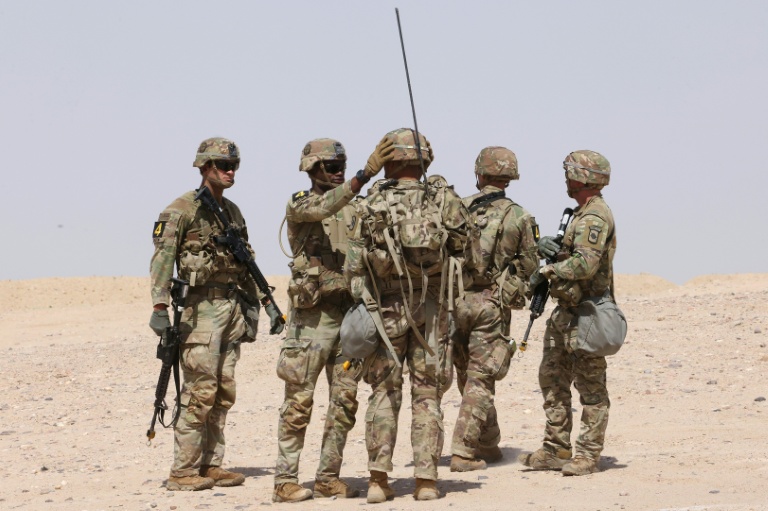
The U.S. has evacuated hundreds of troops from Al Udeid base in Qatar, the largest in the Middle East, as the standoff with Iran continues.
The New York Times detailed that there have also been evacuations in Bahrain, which houses the Navy’s 5th Fleet.
Details about U.S. movements in the region continue to surface as President Donald Trump considers the possibility of striking the country if a nuclear deal is not reached.
The outlet noted that the sheer size of assets that have been moved to the region show that the Pentagon believes an eventual conflict could extend much longer than last year’s 12-day war.
Katherine Thompson of the Cato Institute, who was a senior policy official at the Defense Department during the first year of the Trump administration, told the NYT that the Pentagon appears to be “anticipating an Iranian response that could be a significant risk to American bases in the region.”
The U.S. is deploying two aircraft carriers in the region, but at a considerable distance from Iran to prevent them from becoming targets. An official said it is difficult to hit them when traveling at full speed and noted they are escorted by destroyers, which can shoot down ballistic missiles.
However, Thompson noted that the U.S. has a limited supply of interceptors and that an extended conflict may lead officials to have to prioritize.
Another former official said a conflict may not extend for long considering the might of U.S. forces. Vice Admiral (Ret.) Bob Harward, the former deputy commander of the US Central Command, told the Jerusalem Post that the assets amassed in the region could wipe out Iran’s power structure in a matter of hours.
Harward said President Donald Trump has “illustrated” that he “does what he says,” and “now he has positioned the assets for a military action.” “If he cannot meet the objectives regarding the nuclear and ballistic missile program, he’s willing to go beyond mediation and act,” he added.
Trump said on Thursday that he will make a decision regarding whether to strike Iran“over the next probably 10 days.” “We may have to take a step further or we may not,” Trump said during an address at an event inaugurating the Board of Peace.
Elsewhere in the interview, Harward detailed how strikes could be conducted if the order is given. He said the priority would be “bottom-up,” meaning that the first wave would target strategic missile locations and launchers, which are the direct threats to U.S. forces and Israel.
They would go on to neutralize targets outside the country that could also pose a risk of retaliation and then aim at the Islamic Revolutionary Guard Corps.
“Where previously you could do 40 or 50 strikes a day, we now have the ability to conduct hundreds of strikes a day. That in itself changes the equation completely for the regime,” he added.
Originally published on Latin Times
