Over the past five years, valuations of its assets in the country were down about S$1.6 billion
[SINGAPORE] CapitaLand Investment (CLI) was dragged into the red for the second half of 2025, as China’s property woes continue to hit companies with exposure there.
For the six months ended December, one of Asia’s biggest property groups reported a net loss of S$142 million, reversing from a S$148 million profit a year earlier.
The loss was driven primarily by significant non-cash revaluation losses within its China portfolio that pushed full-year overall revaluation loss to S$439 million, up 68.2 per cent from 2024’s S$261 million.
Over the past five years, China valuations were down about S$1.6 billion from cumulative write-downs, with an average decrease of 12 per cent, CLI group chief financial officer Paul Tham said at the company’s latest earnings last week.
In the past financial year alone, the valuation of CLI’s China assets was down 5 per cent or S$545 million, with offices and business parks hardest hit, said Tham. This came amid challenging market conditions, which continued to weigh on rental rates and occupancies.
China’s property market has been in a downward spiral since 2020, when the government introduced “three red lines” as a key part of Beijing’s attempt to clamp down on a housing boom.
Navigate Asia in
a new global order
Get the insights delivered to your inbox.
The measures worsened a credit crunch and ultimately triggered around US$130 billion of defaults.
China Evergrande, once the country’s largest developer, was ordered to liquidate in 2024. Country Garden, another big name, recently completed a restructuring of its offshore debt.
Vanke, one of China’s best-known real estate developers, with a crushing US$50 billion in debt, has also been at the centre of the country’s protracted property sector crisis.
Property investment in the world’s second-largest economy tumbled 17.2 per cent in 2025 while home sales by floor area decreased 8.7 per cent.
Despite the valuation winter, analysts at UOB Kay Hian kept a “buy” rating and raised their target price to S$4.05 from S$3.49 on Feb 12, as the valuations had masked “resilient operating performance”.
“Fee-related businesses and private funds supported recurring income growth, while lodging expansion strengthened long-term visibility,” they added. H2 group operating profit rose 30 per cent to S$279 million, from S$214 million in the prior year.
The Business Times looks at CLI’s China portfolio to see which properties took a hit while others kept their value.
Inside the portfolio: the China downturn
Offices:
- Innov Center, Shanghai: Reflecting the cooling office sector in China’s financial hub, this commercial property (held through a private fund with a 51.1 per cent effective stake) saw its valuation dip from 3.1 billion yuan (S$569 million) in 2024 to 2.9 billion yuan in 2025.
Lodging:
- Somerset Riverview Chengdu: The lodging segment, too, felt the squeeze. The 200-unit serviced residence, in which CLI holds a 100 per cent stake, was written down from 190 million yuan to 170 million yuan.
Integrated developments:
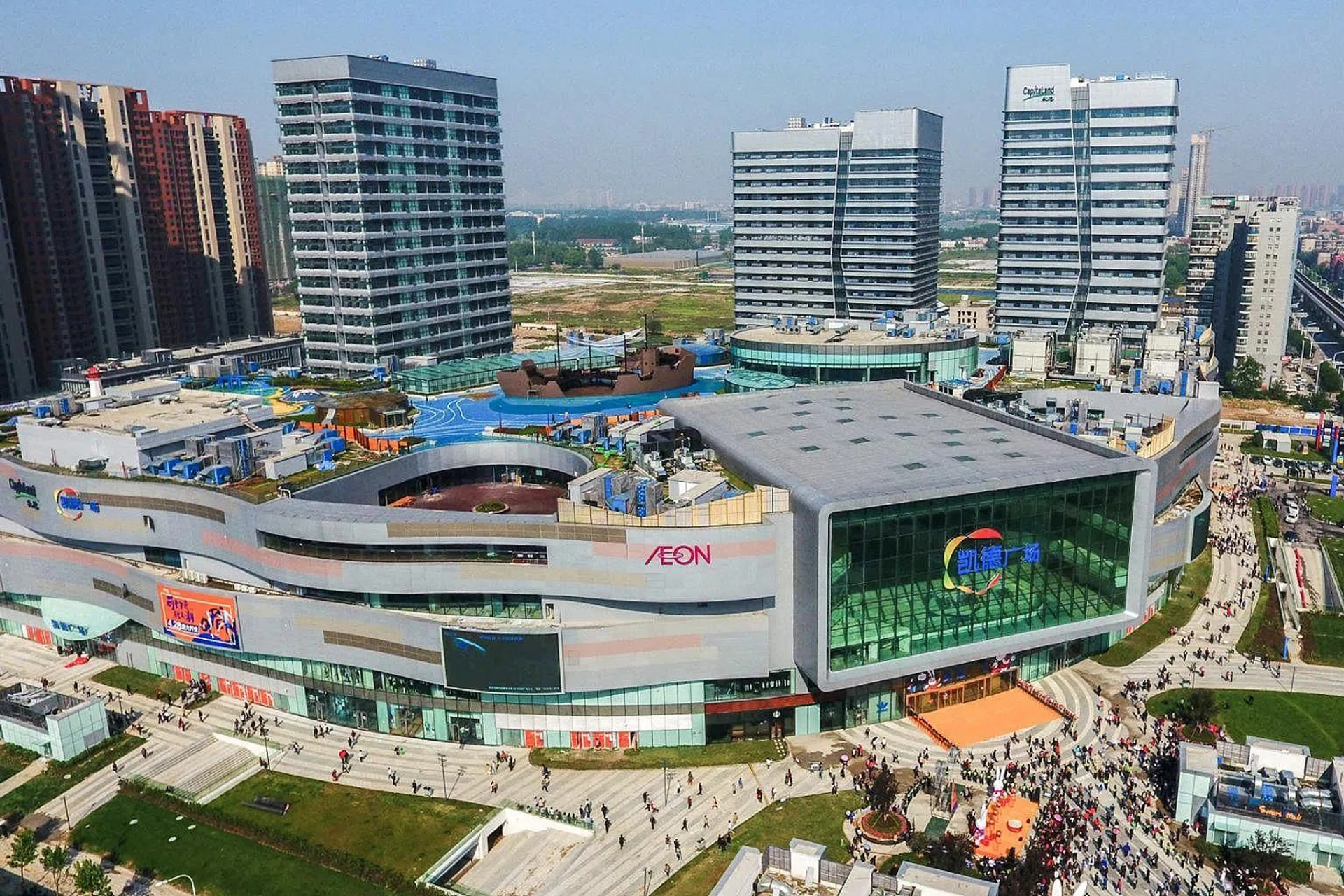
- CapitaMall Westgate, Wuhan: This asset, a 217,556 square metre (sq m) development for commercial integrated use, saw its valuation fall to 1.7 billion yuan as at end-2025, from 1.9 billion yuan in 2024. The property has leases expiring in 2053 and 2063 respectively. CLI has a 100 per cent effective stake.
- Tianjin International Trade Centre: Standing out as a pocket of stability, this 77,374 sq m development maintained its valuation at 828 million yuan. CLI has a 100 per cent effective stake.
Retail:
- CapitaMall Daxing, Beijing: A 100 per cent owned retail landmark in the capital, its fair value was adjusted downward from 1.6 billion yuan to 1.4 billion yuan over the year.
Business park, industrial, logistics and data centre assets:
- Projects in the Beijing Economic Technological Development Area: Consisting of industrial and logistics leases, the valuation of this asset remained at 1.3 billion yuan from end-2024 to end-2025.
- Shanghai Zhuanqiao Data Centre: Bucking the downward trend entirely, this data centre saw its valuation climb from 2.9 billion yuan to 3.2 billion yuan.
The road ahead
While the revaluation losses remain a drag on the headline numbers, excluding these non-cash items, operating profit rose 30 per cent to S$279 million in H2, from S$214 million in the prior year.
“Private funds were one of the stronger growth drivers in 2025 versus 2024, with the outlook remaining robust in funds focused on the lodging and living, logistics and self-storage, credit and opportunistic sectors,” UOBKH analysts said.
“The company maintains its confidence that it will be able to deliver a minimum level of DPS (distribution per stapled security) at S$0.12 for 2026, thus implying a 3.9 per cent yield based on yesterday’s (Feb 11) closing price,” they added.
For investors, a potential Temasek-led “re-rating-focused combination” with Mapletree Investments remains a closely watched catalyst for the stock.
Decoding Asia newsletter: your guide to navigating Asia in a new global order. Sign up here to get Decoding Asia newsletter. Delivered to your inbox. Free.