


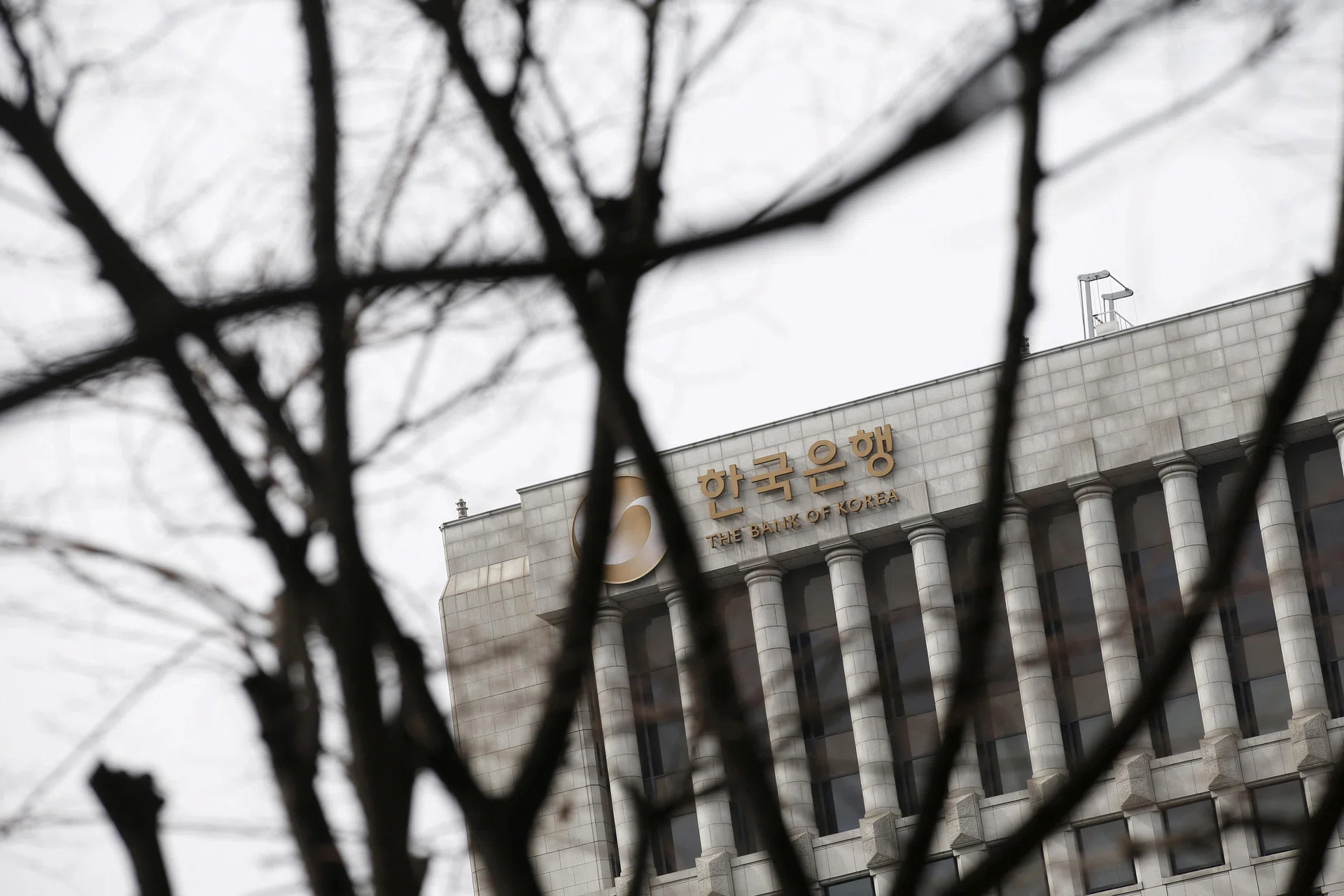
Headline inflation is breaching the central bank’s 2% target with the 2.6% April rate marking the fastest gain in almost two year
Published Thu, May 28, 2026 · 10:44 AM
[SEOUL] The Bank of Korea (BOK) kept its benchmark interest rate unchanged on Thursday (May 28), while a hawkish split within its seven-member board signalled an imminent turn towards a more restrictive policy stance to curb inflation and support a slumping won.
Five of the seven members on the central bank’s monetary policy board voted to keep its benchmark interest rate unchanged at 2.5 per cent, while two dissenters voted for a hike.
The decision to hold was expected by 30 of 32 economists polled by Reuters. The two outliers forecast a rate rise.
The meeting also marked the policy debut of new central bank governor Shin Hyun Song.
The central bank revised up this year’s inflation estimate to 2.7 per cent from the 2.2 per cent projected before the Iran war started, factoring in the spillovers from rising oil prices. It raised this year’s growth forecast to 2.6 per cent from 2 per cent previously, reflecting the robust first-quarter expansion of 1.7 per cent, the fastest in nearly six years.
Complementing this hawkish shift, the bank’s updated dot plot, which charts policy rate projections over the next six months by board members in 21 dots, revealed a bias towards taking rates higher to 3 per cent in the next six months. Two dots even predicted the rate rising to 3.25 per cent.
South Korea’s policy-sensitive three-year treasury bond futures turned down sharply after the dot plot and policy statement were released, erasing early gains.
The hold reflects a cautious approach by new governor Shin, who is due to give his first news conference at 0210 GMT to communicate whether the central bank is ready to take interest rates higher as inflationary pressures broaden further.
Analysts expect Shin to be more hawkish than his predecessor Rhee Chang-yong and to prioritise price stability and currency defenses over supporting growth.
“We expect the BOK will hike its policy rate to 2.75 per cent at the next meeting in July, followed by another rate hike in October, pushing the rate towards 3 per cent by the end of the year,” said Stephen Lee, an economist at Meritz Securities in Seoul.
“Inflation figures are not high but the positive output gap, rising inflation expectations, and rising housing prices will be the main reasons behind the hikes.”
Headline inflation is breaching the central bank’s 2 per cent target with the 2.6 per cent April rate marking the fastest gain in almost two years.
A weakening won, down 4.5 per cent this year against the US dollar, is also effectively bringing inflation into domestic supermarkets and factories, adding further price pressure for a nation dependent on Middle Eastern energy imports.
An insatiable global appetite for semiconductors is drumming up the nation’s phenomenal export cycle, helping to almost double the benchmark Kospi this year and generating spillover benefits for local suppliers and factories.
Markets have been wagering on a hike.
Around two-thirds of the economists polled predicted at least one rate hike by the end of September, a sharp shift from last month’s survey, when only three of 30 economists expected a quarter-point hike. REUTERS
Decoding Asia newsletter: your guide to navigating Asia in a new global order. Sign up here to get Decoding Asia newsletter. Delivered to your inbox. Free.
