


this year, I had visited Colombo for what I thought would be a fairly regular trip, the kind where you check into a hotel, drop your bags, and think little more of the building itself. Cinnamon Life at City of Dreams had other plans for me. I have stayed in a fair number of luxury hotels around the world, and I can say without exaggeration that nothing quite prepared me for the sheer theatre of arriving at this one.
An Entrance Built Like a Piece of Art
You spot Cinnamon Life long before your car actually reaches it. The building doesn’t so much sit on the Colombo skyline as lean into it, great angled shelves of glass and concrete jutting out toward the water, the Indian Ocean on one side and Beira Lake on the other, as though the whole structure were caught mid-stride. The architect, Cecil Balmond, is British-Sri Lankan, and the shape apparently traces back to something much older and smaller: the carved guardstones and moonstones once set into the doorways of ancient Sinhalese temples and palaces, symbolic markers meant to bless whoever walked through them. Balmond took that quiet, sacred geometry and scaled it up into a skyscraper.
The drama doesn’t stop at the entrance. There’s no check-in desk waiting for you at ground level, instead you’re taken straight up to the 24th floor, where reception opens into a wall of glass, with Colombo spread out below and the city’s Lotus Tower rising to meet your eyeline in the distance. I remember standing there with a welcome drink in hand, genuinely a little stunned, watching the ocean catch the last of the afternoon light. It’s one of the most memorable hotel arrivals I’ve had anywhere.

Living Gallery, Not Just a Lobby
What struck me almost as much as the architecture was how much of an art institution this hotel quietly is. Somewhere north of a thousand pieces of art are scattered across the property, each one commissioned specifically for Cinnamon Life from a Sri Lankan artist, and each treated with real curatorial care rather than being hung up as an afterthought. This isn’t the kind of art you walk past without noticing. Getting from my room to breakfast each morning felt like a small gallery crawl.
Past the lobby entrance stands a piece by the artist Muvindu Binoy, made specifically for that spot, a quiet study of the strange in-between moments that happen in a lobby, people arriving and leaving and simply waiting. Further along, I came across a work by Gayan Prageeth that stopped me completely: an oversized bucket, turned upside down, which turns out to be a deceptively simple comment on a specific and painful chapter of the country’s ethnic history. There’s also a half-invented map of Slave Island, one of Colombo’s oldest, most mixed neighbourhoods, by the artist Firi Rahman, treated more like folklore than geography. Elsewhere in the hotel I noticed work by Chathurika Jayani, Anoli Perera, Chandraguptha Thenuwara, Jagath Weerasinghe, Pala Pothupitiye, Anoma Wijewardene, Chudamani Clowes, Abdul Halik Azeez and Hema Shironi, among others, a genuine cross-section of contemporary Sri Lankan art rather than a handful of safe, decorative choices. It’s rare to find a commercial hotel treating art this seriously, using it to tell a real story about a country’s history and identity rather than simply filling wall space.
The detail that delighted me most, though, was something as small as my room key. Even the key cards here carry original illustrations by local artists, so the first physical object handed to you at check-in is, in its own small way, a piece of Sri Lankan art. And the art doesn’t stop at the lobby or the hallways, every guest room has its own original piece too, a single work chosen for that specific room and made by a Sri Lankan artist, so the collection follows you all the way into your own private corner of the hotel.
And for all this gallery-like restraint, Cinnamon Life has a livelier, glitzier side as well. As part of the wider City of Dreams Sri Lanka development, the hotel sits alongside a full casino and entertainment complex, run in partnership with Melco Resorts & Entertainment. It’s an odd but strangely workable duality: one moment you’re standing in front of a quietly devastating painting about the civil war, and a few floors away there’s the buzz of a gaming floor. At Cinnamon Life, both identities somehow sit comfortably side by side.
Food and Beverage Scene: A Passport in One Building
If the art at Cinnamon Life is its soul, the food and beverage programme is its pulse. The hotel runs more than a dozen restaurants and bars, and what genuinely surprised me is the international range on offer, for a single hotel in Colombo to house this many globally-minded kitchens, several helmed by chefs brought in from abroad, felt like a small culinary miracle. It’s the kind of dining line-up I’d expect from a resort in Singapore or Dubai, not necessarily from one property in Sri Lanka, and it says a lot about how ambitious this project set out to be.
Breakfast, lunch or dinner, I kept finding my way back to Quizine, the hotel’s all-day dining restaurant, which runs a string of live cooking stations covering Sri Lankan, Japanese, Chinese, Indian and Western food, capped off by a dessert counter that could hold its own as a standalone bakery. For something more theatrical, Sapphire Dragon leans into an entirely different mood, a moody, old-world Hong Kong feel, serving Cantonese cooking with a confident, modern edge.

At Indiya, regional Indian food is handled with real precision, built around handcrafted spice blends that feel rooted in tradition even when the plating is thoroughly contemporary. I also loved an evening at Yoroko, the hotel’s Japanese restaurant. Dinner here is built around a robata grill and a sushi counter, and the whole experience felt more meditative than showy, helped along by a room that’s been broken up into smaller, more private corners, so you never quite feel like you’re eating in a big restaurant. For something lighter, Bistro Des Marées, a Mediterranean-leaning seafood restaurant, was an unexpected favourite for an easy, unhurried lunch.

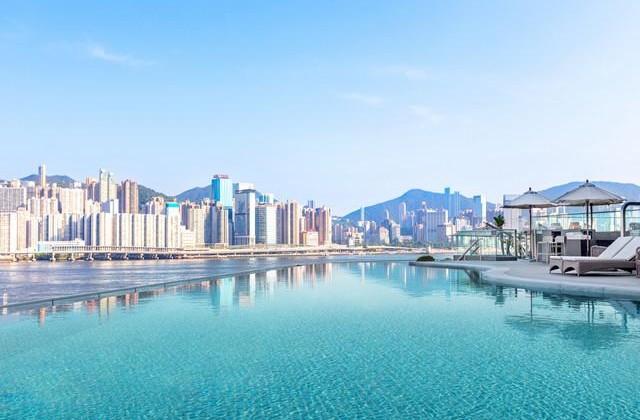
The bar scene deserves its own mention entirely. Gatz, spread across the 23rd and 24th floors, and Flux, the rooftop lounge one floor up, both hand you sweeping views of the Indian Ocean along with well-made cocktails, sunset here comes with a full skyline and a soundtrack, and it’s genuinely one of the best perches in the city. By the pool, Dreams & Beats keeps things breezier, mixing Sri Lankan-inspired cocktails with a livelier, DJ-driven energy. And tucked away is Cloud Wine, an intimate wine bar where most of the bottles on the list, I was told, can’t be found anywhere else in the city, a lovely, quiet spot to end an evening.

What ties all of this together is the calibre of the teams behind each kitchen. Cinnamon Life has deliberately pulled together both Sri Lankan and international culinary talent under one roof, and that global fluency comes through in every restaurant, nothing here feels like a watered-down “hotel version” of a cuisine. It’s confident, specific cooking, and it made the idea of leaving the hotel to eat elsewhere in Colombo feel almost unnecessary, however unfair that is to the rest of the city’s food scene.
An Extraordinary Setting for Weddings and Events
If Cinnamon Life’s art collection is its quiet triumph, its event spaces are its showstopper. This is, by a wide margin, the biggest event venue anywhere in Colombo, with tens of thousands of square feet of banquet and ballroom space spread across several architecturally distinct rooms , and having walked through a number of them, I’d say they’re genuinely among the most striking function spaces I’ve come across anywhere in South Asia.

The Podium
The two showpiece venues are the hotel’s cantilevered ballrooms, both perched high above the city. Cumulus Ballroom, up on the 22nd floor, is essentially a glass box hanging in mid-air over a hundred metres up, with a ceiling built to mimic drifting clouds and windows that wrap almost the entire way around, ocean on one side, lake and skyline on the other. It genuinely feels like getting married inside a cloud. Just as striking is Celestine Ballroom, also floating high above the city, column-free and lit with soft daylight, better suited to a more intimate wedding that still wants that same dramatic backdrop.

Stunning Venues at Cinnamon Life
For bigger celebrations, Lumina Ballroom is the true showpiece, an open, column-free hall lit by chandeliers that can be programmed through thousands of different colour moods, with enough room to comfortably host anything from a few hundred guests up into the thousands, depending on how the celebration is laid out. The Studio offers something more flexible, able to be folded down into smaller sections when a couple wants something lower-key, a family lunch, say, rather than a five-hundred-person reception, while The Forum is airy and modern, with an entrance sequence deliberately staged so that walking in feels like its own small event before the ceremony even starts. For couples who’d rather say their vows outdoors, The Podium is a huge, open-to-the-sky space where you can genuinely see the ocean while you exchange rings, and the Garden Terrace offers a softer, more relaxed outdoor setting looking out over the city.
Together, these venues mean Cinnamon Life is properly equipped to handle everything from a medium-sized, intimate wedding to an enormous, multi-day celebration for thousands of guests and I say that having seen very few hotels manage that entire range with equal confidence. The hotel also brings in dedicated wedding planners alongside its own culinary team to build fully bespoke menus for each celebration, and there’s clearly real institutional experience already in handling both contemporary destination weddings and more traditional Sri Lankan ceremonies, poruwa setups included. It’s easy to see why so many couples, from Colombo and increasingly from across South Asia, are choosing this as their venue of the moment.
With Grace
By the time I checked out, what stayed with me wasn’t just the size or the spectacle of Cinnamon Life, impressive as both are. It was the sense of care running underneath it all, in the way a doorman remembered my name by day two, in the quiet elegance of a keycard designed by a local illustrator, in a painting in a hallway that made me stop mid-stride and actually think. Hospitality here never feels like performance. It feels considered, warm, and, at its best moments, genuinely artful.
Colombo has no shortage of beautiful hotels, but few of them ask you to think about art, history, architecture and celebration all in the same visit. Cinnamon Life does, gracefully, and without ever losing sight of the fact that, first and foremost, it wants you to feel looked after. I left already looking forward to going back.
