


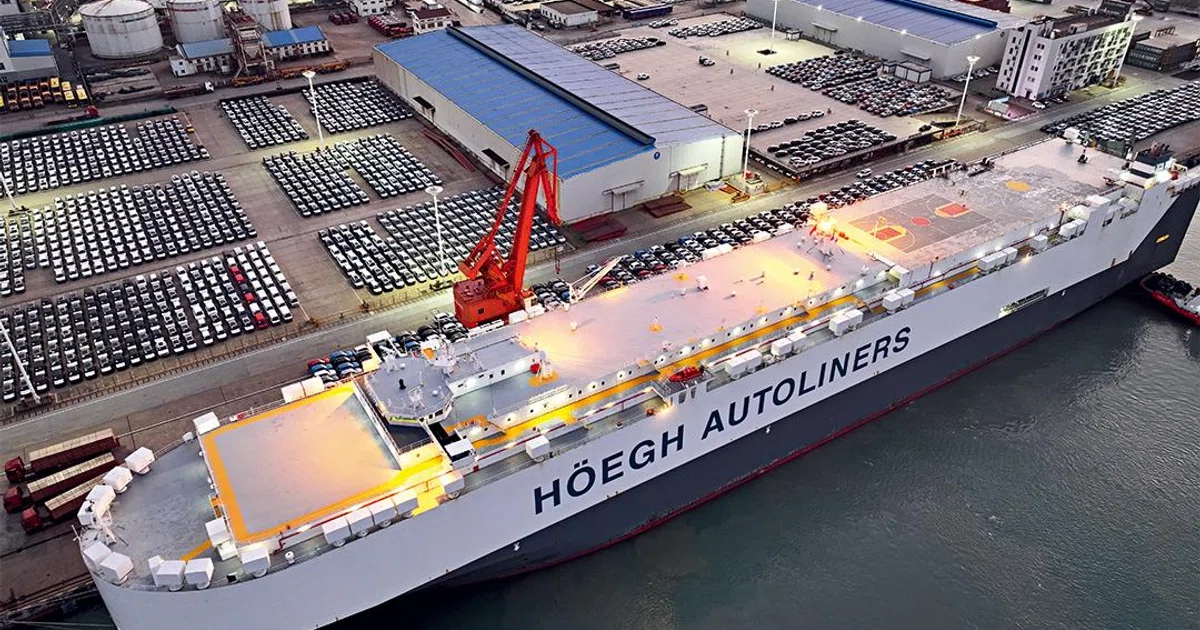
China exported a record 7.1 million cars in 2025, buoyed by growing demand for new-energy vehicles (NEVs) as the global shift toward electrification gathered pace, allowing the country to keep its position as the world’s largest auto exporter.
As NEVs become more widespread, industry insiders and analysts are pointing to autonomous driving as the next driver of auto export growth, with rising interest from overseas consumers in the technology many believe could reshape driving habits.
European consumers expect autonomous vehicles to account for a quarter of total auto sales in Europe by 2035, said Guan Mingyu, managing partner of McKinsey & Co Inc’s Beijing office, citing a survey. This bodes well for Chinese automakers and smart car technology providers looking to expand their global influence.
Chinese NEV-makers are at the forefront of smart car technology development, with companies such as XPeng Inc and Nio Inc already building an overseas presence with vehicles equipped with Level 2 assisted driving capabilities. Some Chinese self-driving system developers have also forged partnerships with established foreign auto-parts makers to help navigate local regulations.
Many foreign governments have introduced stringent rules targeting smart vehicles — spanning data security, road safety and export controls — that could prove troublesome for Chinese firms.
Smart vehicles need to collect various types of data to train their driver assistance systems, raising the bar for Chinese carmakers doing business in foreign countries, where data security, data storage and cross-border data transfer are top concerns of local regulators, said Chang Yanning, a smart car expert at the China Automotive Standardization Research Institute.
Navigate Asia in
a new global order
Get the insights delivered to your inbox.
Overseas demand takes shape
An S&P Global Mobility survey of 8,000 consumers in eight countries including Brazil, Germany, Japan and the US found that over half of the respondents had some level of understanding of driver assistance technology and autonomous vehicles. The survey results also indicated that consumers are willing to pay extra for autonomous driving technologies that can improve driving safety.
Regulators in the EU have recognised the role of assisted driving technology in road safety, having made several advanced driver assistance systems mandatory for all new passenger and commercial vehicles starting July 2024, including alertness warning, blind spot and speed assistance systems.
In December, Waymo LLC, the Alphabet Inc-owned robotaxi service provider, announced that it had provided more than 14 million paid driverless rides in 2025, more than tripling the number year-on-year. Currently, Waymo operates in several US cities including Phoenix, San Francisco and Austin, with plans to expand into the U.K. and Japan.
Meanwhile, Israeli self-driving tech specialist Mobileye Global Inc in January announced a deal that will see the company deploy one of its most advanced system-on-a-chip platforms in advanced driver assistance systems for an estimated 9 million vehicles produced by a US automaker.
Together, these developments indicate rising confidence among foreign consumers, regulators and carmakers in smart driving technology. Tang Haiyi, general manager of Aptiv PLC’s active safety and user experience division in China, estimated that nearly half of Chinese cars exported were preinstalled with assisted driving systems.
In the first nine months of 2025, more than 60 per cent of new passenger cars sold in China were equipped with Level 2 assisted driving systems, according to data from industry association China EV100, which expects the share to reach 70 per cent in 2026. The high penetration rate reflects a mature supply chain for assisted driving systems, whose costs have been reduced from tens of thousands of yuan to thousands of yuan, an advantage that could support exports of Chinese smart cars, said Zhang Yongwei, secretary-general of China EV100.
US engineering standards group SAE International classifies autonomous driving from Level 0, no automation, to Level 5, fully automated driving, with Level 1 and Level 2 considered driver assistance technology that requires a human to be in control of the car at all times. In China, some carmakers are touting Level 2+ technology, which they say is an improved version of Level 2 that adds a navigation-assisted feature for highways and urban roads beyond basic functions like self-adaptive cruise control and automatic emergency braking.
McKinsey’s Guan echoes Zhang’s view, believing that the cost advantage could help Chinese automakers win a foothold in Europe’s upscale smart car market.
International collaboration
Chinese developers of assisted driving systems are increasingly reliant on established multinational auto-parts makers, who are deeply familiar with local regulations, for their overseas expansion.
Germany’s Robert Bosch GmbH and China’s self-driving tech specialist WeRide Inc have partnered to develop a high-level assisted driving system using Nvidia Corp’s chips. This could help the Chinese firm grow its international footprint, if the jointly developed system is adopted by Bosch’s global automaker clients.
Partnering with multinational auto-parts makers that have rich experience in globalized operations, product compliance and risk management will make it easier for Chinese smart car tech firms to earn the trust of overseas customers, said Aptiv’s Tang.
China EV100’s Zhang also predicted that the global competitiveness of China’s auto industry will hinge on how many Chinese-developed components and technologies are used in vehicles sold overseas.
However, while cooperating with multinational suppliers can help address foreign compliance challenges, Chinese companies will need to build their own compliance capabilities, McKinsey’s Guan said.
China Automotive Technology and Research Center Co Ltd is working with global partners to create multiple standards for smart vehicles in line with International Organization for Standardization and United Nations norms, according to Chang at the China Automotive Standardization Research Institute.
Regulatory hurdles
Yet, the use of Chinese-developed autonomous driving technology is drawing increasing scrutiny from governments around the world, especially in the West.
In January 2025, the US government finalised rules barring the sale of smart vehicles containing Chinese software and hardware, with the prohibition on software set to take effect in the 2027 model year and 2030 for hardware.
In December, the US Congress held a hearing on the perceived threat Chinese carmakers pose to the American auto industry, with some lawmakers threatening to turn the ban on Chinese smart vehicles into law. Two congressmen proposed banning sales of Chinese-developed cellular communication modules and laser-based radars, arguing the technologies could be used for spying.
The mounting regulatory pressure will hamstring Chinese smart car technology, with multinational carmakers less likely to select Chinese-developed components for cars sold in the US market, an industry expert said.
The EU recently signaled a comparatively positive attitude toward Chinese auto exports, issuing new guidance that could allow Chinese electric-vehicle makers to replace anti-subsidy tariffs with minimum price commitments. However, the bloc also has the world’s strictest rules on data and privacy security, which could be a major stumbling block for Chinese carmakers looking to enter the market with smart tech onboard.
The EU’s Data Act took effect in September 2025, establishing strict rules for accessing, sharing and using data generated by connected products like smartwatches and vehicles. This added to the existing General Data Protection Regulation, under which companies violating privacy and security standards can face fines reaching tens of millions of euros.
Regulatory barriers are increasingly shaping how multinational automakers choose smart driving system suppliers. Japan’s Toyota Motor Corp, for example, uses systems developed by Chinese startup Momenta in its cars sold in China, but for its vehicles sold outside China, it uses a rival product from Bosch, which has deep roots in global markets and a stronger grasp of local laws and regulations.
To address regional regulatory challenges, Chinese firms need to localize research and development, testing and operations in overseas markets, according to analysts. However, this would be a costly endeavour and a major test of Chinese companies’ global operational capabilities. Caixin Global
Decoding Asia newsletter: your guide to navigating Asia in a new global order. Sign up here to get Decoding Asia newsletter. Delivered to your inbox. Free.
