Climate crises, nuclear Armageddon, or a sudden meteor strike — it’s clear humanity could do with Planet B. But first we need to learn to reproduce safely in space, says Dutch entrepreneur Egbert Edelbroek.
Edelbroek’s firm, Spaceborn United, is pioneering space sex research, with the eventual aim of natural conception and birth in the partial gravity environment found on Mars.
The challenges of achieving safe space sex are galactic, but the ambitious Dutchman is confident he will see an extraterrestial human child born within his lifetime.
“It’s important that the Earth and humanity can become a multiplanetary species,” Edelbroek told AFP.
“If you want to have independent human settlements beyond Earth, and if you really want them to be independent, you also need to address the reproductive challenge,” said the entrepreneur.
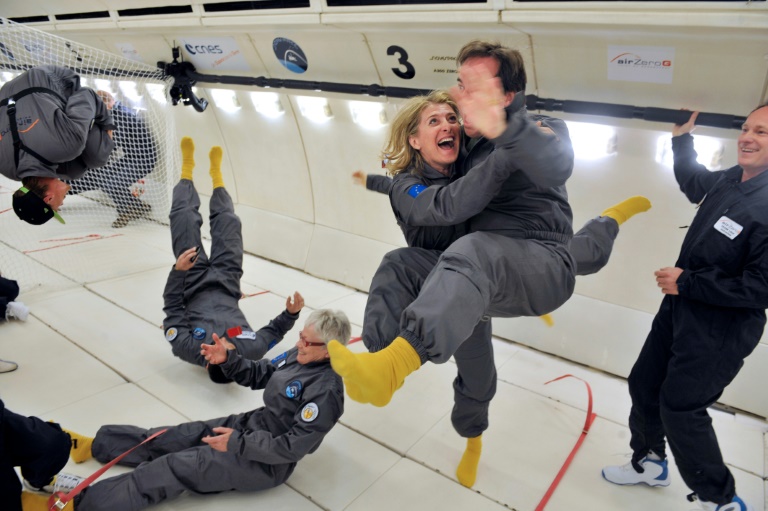
Actual sexual intercourse in space presents many difficulties, chief among them the lack of gravity — a couple would drift away from each other — so Spaceborn United is first trying to conceive an embryo in space.
Starting with mice, before eventually moving to human sperm and egg cells, the firm has created a disc that mixes the cells together, with the aim of producing a viable embryo.
It’s like a “space station for your cells”, said Aqeel Shamsul, CEO of the UK-based Frontier Space Technologies, which is working with Spaceborn on the project.
This embryo is then cryogenically frozen, to pause their development, but also to protect them during re-entry — “It’s a lot of shaking, a lot of vibration, a lot of G-forces. You don’t want to expose embryos to this,” said Edelbroek.
Research is currently under way in simulated partial gravity laboratory conditions but Edelbroek said a launch with mice cells was planned for the end of next year, with a timeline of “about five or six years” for the first launch with a human embryo.
But that’s only one small step. A giant ethical leap remains before such an embryo could be implanted back into an Earthling woman to give birth to the first child conceived in space.
“It’s a delicate topic. You’re exposing vulnerable human cells, human embryos, eventually, to the hazards of space, to radiation that is much higher than on Earth, to different gravity environments that embryos are never designed for,” said Edelbroek.
Such ethical issues are one reason why research into space reproduction has generally been left to private firms like Spaceborn, rather than NASA, which is queasy about spending tax dollars on such sensitive topics.
Edelbroek said his firm was the only one looking to develop a human embryo in space.
Bodily fluids that are pulled down on Earth would be drawn upwards in a low-gravity environment, posing several challenges for the human body.
“An adult body can handle some differences, but you don’t want to expose a growing, more vulnerable, foetus to these different variables. So you need to create the perfect environment first,” he said.
One new factor in space reproduction is the growth of space tourism, fuelled by companies like SpaceX and Virgin Galactic.
Couples on a space tourism flight might want to go down in history as the first to conceive, warned Edelbroek, adding that he was consulting with the sector to make them aware of the risks.
Spaceborn’s research — which replicates the IVF process but in space — is also helping people closer to home to conceive, said Edelbroek.
The Dutchman said he had been forced to scale back his plans — “we’ve gone from crazy ambitious to just very ambitious” — as the scale of the challenges became clear.
Nonetheless, he is sure that a baby will be born in space within his lifetime.
“I expect to be at least 100 years old,” the 48-year-old said. “So that should give us enough decades to achieve that, absolutely.”
“Eventually, humanity — hopefully with us — needs to achieve childbirth in space.”