[CHONBURI] Just over a year after Chinese auto giant BYD invested nearly half a billion dollars in a new plant in Thailand’s Rayong province, the company has shipped its first 900 made-in-Thailand Dolphin models to Europe – a move spurred by government efforts to position Thailand as a regional EV hub.
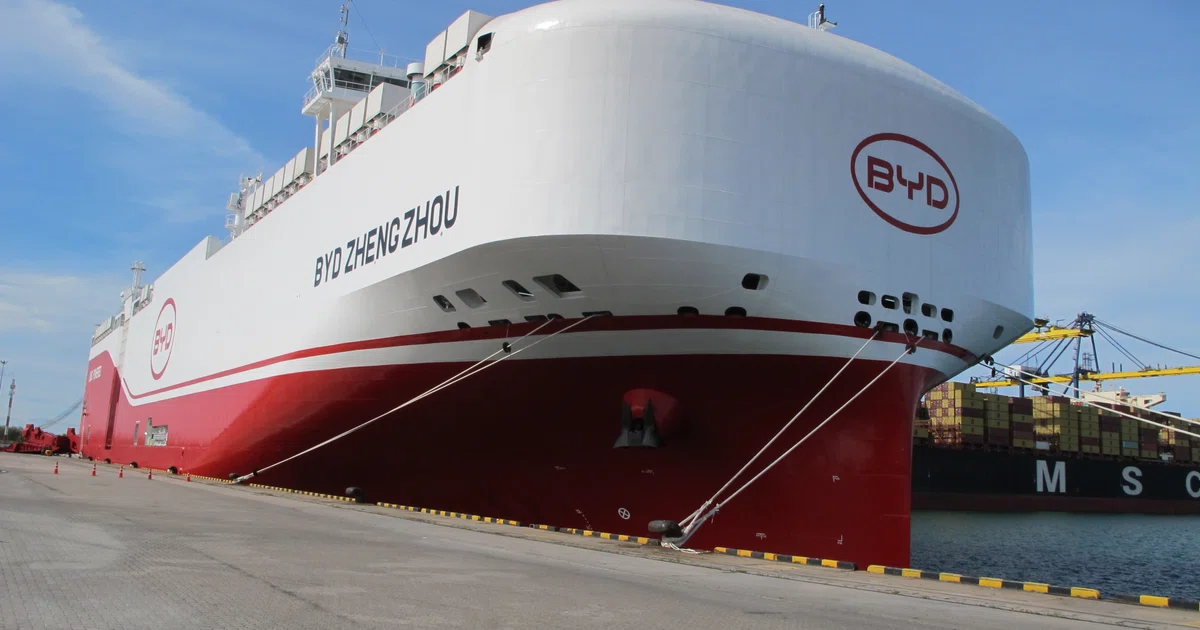
On Monday (Aug 25), the auto brand exported its first batch to Belgium, Germany and UK, carried out by BYD’s own vessel – the BYD Zhengzhou.
This comes after BYD opened a US$490 million factory in nearby Rayong province in July last year with a production capacity of 150,000 vehicles a year, including models of battery electric vehicles (BEVs) and plug-in hybrid electric vehicles. In July, the plant celebrated the delivery of its 90,000th new energy vehicle.
“The shipment of these EV cars to Europe is in part to satisfy the Thai government requirements,” said Benson Ke, general manager of BYD Auto (Thailand).
Since the launch of the aggressive EV investment promotion scheme a few years ago Thailand has lured Chinese automotive companies BYD Auto, Great Wall Motor, SAIC-MG, Neta, GAC-Aion, Changan Automobile and Omoda & Jaecoo (Thailand) Co, a subsidiary of Chery Automobile, to assemble/manufacture EVs locally.
Conditions on tax perks kick in
But its promotional success has come at the expense of tax waivers on EV imports before the local production kicked off mostly in 2024.
A NEWSLETTER FOR YOU
Friday, 8.30 am
Asean Business
Business insights centering on South-east Asia’s fast-growing economies.
Under a special government promotion package imported EV models from China enjoyed reduced import and excise taxes into the Thai market between 2022 to 2023, on the provision that the importers began local production in 2024.
In receiving the lowered tax on EV imports, BYD and other Chinese producers, had to sign an agreement with the government that they would establish a local manufacturing base in Thailand and produce EVs locally on a 1:1 ratio of imported units that received the subsidy by 2024, with the ratio rising to 1:5 by 2025.
Now those commitments are kicking in.
Nearly all the Chinese EV manufacturers have faced difficulties meeting production commitments, in part due to a slump in automobile sales in Thailand owing to high household debt, tight credit and an intense price war between Chinese manufacturers, which has led consumers to defer purchases in expectation of prices coming down further.
Thailand’s total automobile sales domestically reached 572,675 units in 2024, compared with 775,780 units in 2023, while exports were 1,019,213 in 2024 and 1,117,539 units in 2023, according to Federation of Thai Industry (FDI) data.
The slump has continued into 2025. During the first seven months of this year domestic sales amounted to 351,796 units, down 0.74 per cent year on year, while exports reached 531,796 units, down 11 per cent year on year, FDI reported.
EVs have outperformed the internal combustion engine (ICE) sales, reaching 54,084 units in the first half of 2025, up 61 per cent, FDI data showed.
Although BYD leads the market in domestic sales – with 30,432 units sold in 2023, 28,191 units in 2024, and 21,922 in Jan-July 2025, it will need to boost exports to fill its 150,000 unit capacity at its Rayong plant.
Besides its exports to Europe, BYD Thailand has also exported about 1,000 BEVs to Vietnam, and similar numbers to Malaysia and Indonesia, said Ke. BYD intends to set up completely knocked down factories in Cambodia and Malaysia soon, and a full manufacturing plant in Indonesia.
“But Thailand will remain our foremost manufacturing base (outside of China), with opportunities to export to various countries, in Europe and South Asia,” Ke said. “Some models we will only be manufactured in Thailand, not in China. For example, more right-hand drive models will be manufactured here.” (Thailand has a right-hand drive traffic system.)
Rising competition
BYD Thailand faces competition abroad not just from other Chinese car companies but from other BYD factories.
For example, BYD China-based factories already export vehicles Europe, where they face an 18 per cent import tariff as of this year but this hadn’t stopped the automaker from selling 51,000 cars on the European market in the first half of this year, according to Global Data, a data analytics and consulting company, headquartered in London.
The European Union dropped its import duty on BYD imports to 18 per cent in January this year, after the firm invested in a factory in Hungary – slated to open later this year – but has slapped a tariff of 45 per cent on the Chinese car company SAIC-MG EV imports, said Kunat Tharasrisuthi, senior analyst at international market research firm Global Data.
SAIC-MG has not announced plans to set up production plants in Europe, unlike BYD, he noted.
The rapid expansion of production facilities by Chinese auto-makers around the world makes it difficult to discern any export strategy, as local manufacturing inevitably cuts into imports from other bases.
“Chinese car makers now go everywhere,” said Titikorn Lertsiriungsun, manager of SE Asia for Global Data/Thailand.
The investments by Chinese original equipment manufacturers (OEMs) in Thailand’s automotive sector stands in contrast to a similar wave by Japanese OEMs four decades ago. The Japanese manufacturers’ involvement turned the country into a production and export hub for ICE vehicles, ranking Thailand as the world’s 10th leading automobile producer worldwide.
“We know the Japanese OEMs have used Thailand as an export base and have a clear export strategy, but for the Chinese OEMs we don’t know what their export strategy is,” said Titikorn.
“The export strategy of Chinese OEMs remains a mystery,” he added.
Economists also wonder about the sustainability of the rapid Chinese automotive expansion worldwide.
“The crazy thing about EVs in China is that everybody, globally, sees them as super powerful, competitive companies but (almost) none of them is making a profit,” said Louis Kuijs, chief economist Asia-Pacific, S&P Global Ratings.
The phenomenon is not unique to the automotive sector, he noted.
“That is the case with a lot of Chinese sectors. They sell their stuff internationally very competitively but they don’t make any profit. Capital is very patient in China,” Kuijs said, adding, “and the regulators are patient, in the sense that firms don’t go bankrupt as often as in other countries.”