


AI and tech-led roll-out will expand Changi’s air traffic limits and add 200 controllers
[SINGAPORE] Singapore will inject S$4 billion into its air navigation capabilities over the next 15 years, deploying artificial intelligence and expanding its controller workforce to double airspace capacity.
Ground infrastructure expansion – such as Terminal 5’s opening in the mid-2030s – must be matched by equivalent technological capability in the skies, said Civil Aviation Authority of Singapore (CAAS) director-general Han Kok Juan on Wednesday (Jul 22).
The upgrades will prepare Singapore for a massive surge in aviation demand. Changi Airport surpassed pre-pandemic traffic levels in 2025, servicing nearly 70 million passengers and processing two million tonnes of cargo.
While Terminals 1 through 4 currently give Changi an annual capacity of 90 million passengers, Terminal 5 will add another 50 million.
Once active, the tech upgrades will push Changi’s aircraft handling capacity to one million movements annually, up from about 374,000 in 2025.
A new air traffic management system will also process up to 4,000 concurrent ground and in-flight aircraft positions in real-time, effectively doubling current tracking limits.
Breaking down the S$4 billion
The S$4 billion capital expenditure is allocated across machine infrastructure, manpower and operational methods.
The majority – S$3.2 billion – is earmarked for procuring cutting-edge air traffic systems, physical facility expansion and long-term maintenance.
Another S$500 million will fund workforce expansion, competitive salaries, sign-on incentives and scholarships.

The remaining S$300 million is dedicated to operational research, AI deployment and regional traffic management integration.
As part of this process pillar, CAAS is establishing an Engineering Development Centre and supporting an S$800 million Research, Innovation and Enterprise funding initiative by providing stipend top-ups to local PhD students pursuing air traffic research.
New controllers to be hired
To operate this expanded infrastructure, CAAS will increase its Air Traffic Control Officer workforce by 40 per cent, growing from about 500 officers to about 700 by the mid-2030s.
To attract local talent, the authority is introducing a S$20,000 sign-on bonus for all new recruits effective Jun 1, paid across two tranches during training and licensing.
Starting salaries for fresh university graduates currently stand at around S$64,000 annually, rising to about S$120,000 within five years post-licensing.
CAAS said it is also partnering with an unnamed local university to establish an accelerated undergraduate degree with an air traffic control specialisation, alongside launching an undergraduate scholarship and a Management Associate Programme in August to build a leadership pipeline.
Digital towers and modular tech
A significant portion of the capital will go to the progressive replacement or upgrade of over 30 air navigation systems. Designed with an open modular architecture to easily integrate future upgrades, these systems will equip controllers with enhanced tools for faster decision-making.
CAAS awarded the contract for its core next-generation air traffic management system to French aerospace company Thales at the end of June, with a target completion date of 2030.
The authority will also launch an open tender in August for an Integrated Digital Tower System. Slated for completion by the mid-2030s to coincide with Terminal 5, this setup utilises cameras and sensors to provide controllers with an augmented real-time view of the aerodrome.
This allows controllers to operate independently of physical tower line-of-sight constraints, meaning CAAS can work towards eliminating the need for physical control towers entirely, mirroring successful remote digital tower setups elsewhere.
London City Airport in the UK was the first major international commercial airport to be fully controlled remotely, using 16 high-definition cameras managed from 115 km away.
Such digital towers, also to be rolled out at the upcoming Western Sydney airport, enhance efficiency, safety and cost-effectiveness, according to air traffic management organisation EuroControl.
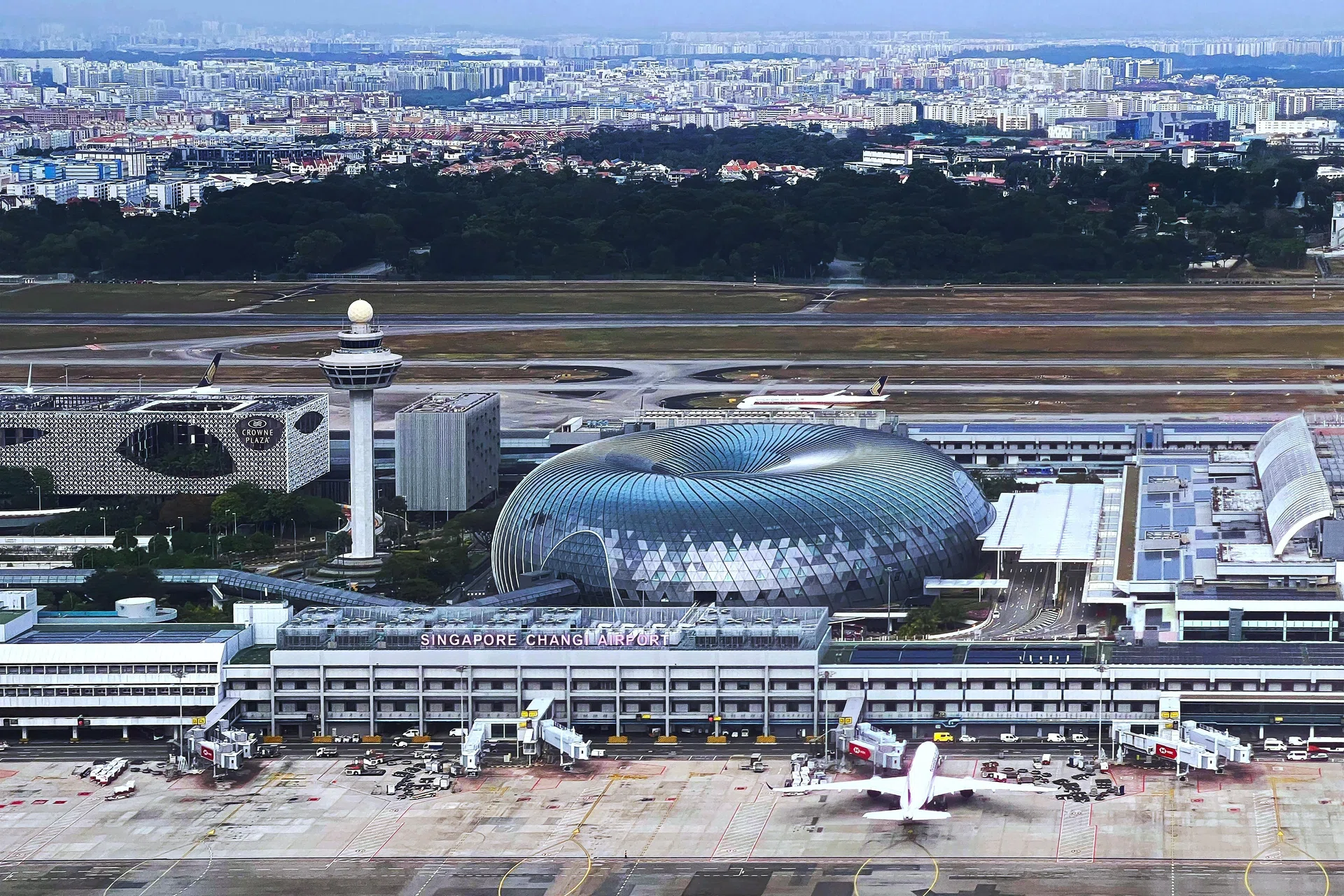
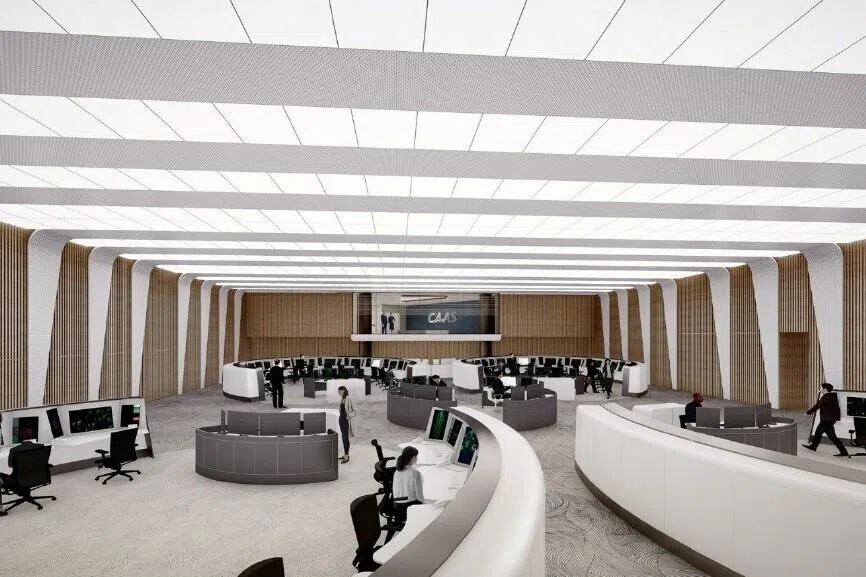
To house the digital tower’s systems, CAAS is developing a new complex at the Singapore Air Traffic Control Centre on a former open-air carpark, alongside a major facade re-cladding of the iconic Changi control tower.
AI integration
Because Terminal 5 will increase passenger traffic by roughly 55 per cent at full capacity, CAAS is prioritising data exchange between airlines and other regional air navigation service providers to balance aircraft demand for airspace.
In air traffic management, a control sector – a specific block of airspace – is currently managed by a two-person team: a tactical controller and a planner. A new AI-powered multi-sector planner entering trials in 2027 will allow a single planner to simultaneously support two to three control sectors, drastically improving efficiency.
CAAS is also developing a Digital ATCO Assistant to anticipate emerging traffic and weather situations. By translating meteorological data into actionable flight vectors, controllers can reroute planes ahead of convective weather, mitigating holding patterns and reducing fuel-related emergency diversions.
Better weather prediction is specifically designed to prevent fuel starvation, Han noted, acknowledging the 2022 diversion of Singapore Airlines flight SQ319.
During that incident, the London-to-Singapore flight was forced into multiple holding patterns due to severe thunderstorms over Changi before making an emergency diversion to Batam with critically low fuel.
With predictive AI, controllers and pilots can make earlier rerouting decisions, stopping emergencies such as SQ319 from developing.
The push also comes as weather-related flight diversions at Changi Airport surged from 15 in the first 11 months of 2024 to 55 during the same period in 2025.
To prevent airborne congestion across borders, CAAS has instituted an AI-enabled air traffic flow management tool to propose recommendations to regional counterparts.
Initiated with China and Hong Kong in late 2025, daily operational synchronisation calls have since expanded to include South Korea, Thailand and Vietnam.
Furthermore, an automated radio message read-back error detection tool will enter live trials later in 2026 to eliminate communication mix-ups between pilots and controllers.
