


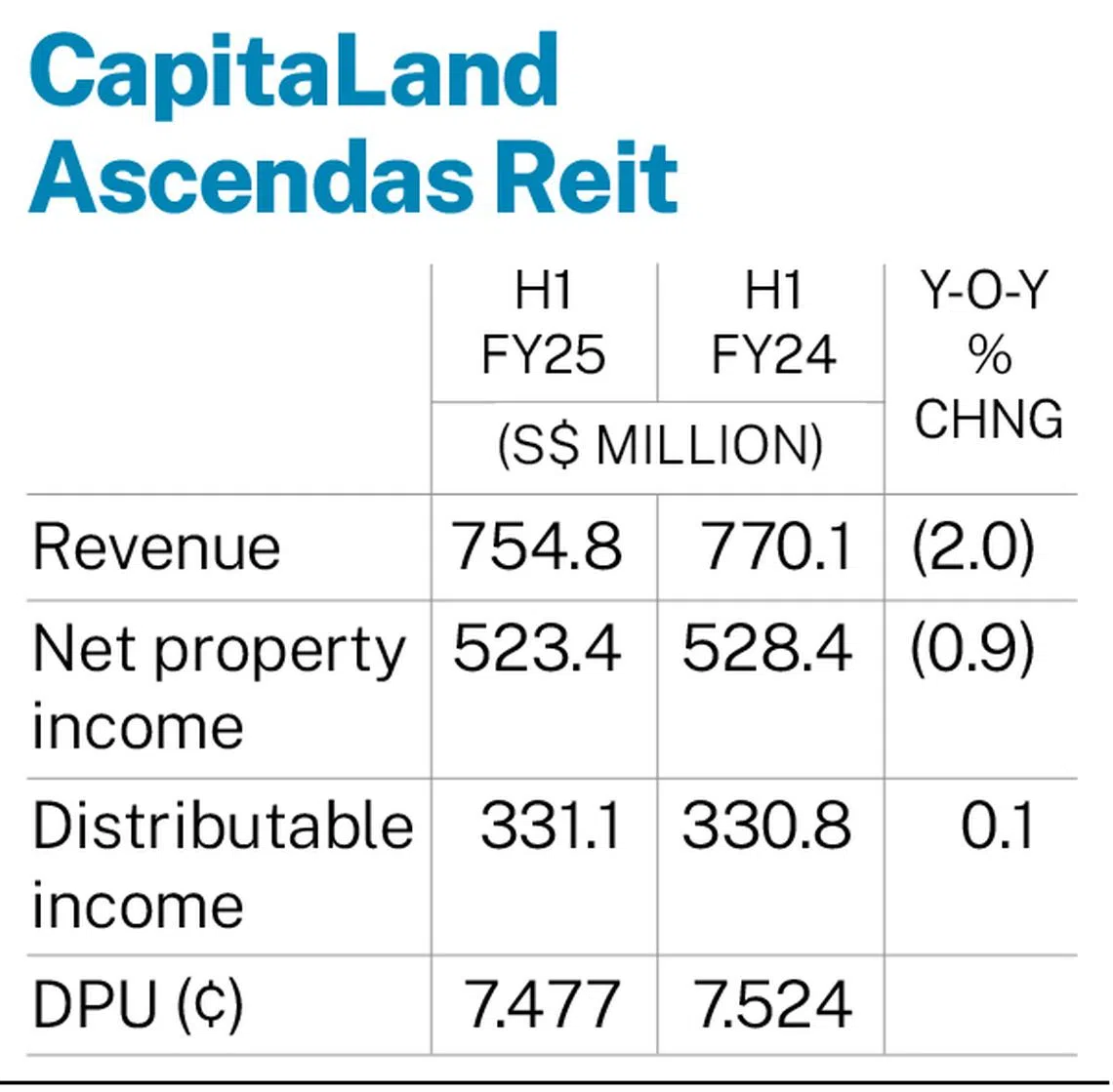
[SINGAPORE] The distribution per unit (DPU) for industrial property player CapitaLand Ascendas Reit (Clar) fell 0.6 per cent for the half-year ended June to S$0.07477, on the back of an enlarged unit base.
The unit base of the Reit (real estate investment trust) grew 0.7 per cent year on year to around 4.4 billion units during a private placement in May this year to fund acquisitions.
Clar posted a lower H1 revenue, which was down 2 per cent year on year at S$754.8 million. This was mainly due to the divestment of five properties in Australia, Singapore and the US, as well as the decommissioning of a property in the UK for redevelopment in June 2024.
The decrease was partially offset by the acquisition of a property in the US, the DHL Indianapolis Logistics Center, in January 2025.
Consequently, net property income (NPI) fell 0.9 per cent to S$523.4 million.
The total amount available for distribution went up marginally by 0.1 per cent to S$331.1 million.
BT in your inbox
Start and end each day with the latest news stories and analyses delivered straight to your inbox.
The stable distributable income, despite macroeconomic uncertainties, reflects the “continued strength of Clar’s diversified portfolio, operational management and disciplined execution of our capital management strategies”, said William Tay, chief executive officer and executive director of the manager, in a statement on Monday (Aug 4).
The bulk of Clar’s portfolio, or 65 per cent, is in Singapore, with the remaining in Australia (13 per cent), the US (12 per cent) and the UK and Europe (10 per cent). Its 225 investment properties are in three segments: business space and life sciences, industrial and data centres, and logistics.
In H1 2025, the trust completed the divestment of business space Parkside in the US for S$26.5 million, which was about a 45 per cent premium to the market valuation.
Clar is targeting about S$300 million to S$400 million in divestments in Singapore, Europe, the US and Australia this year, said Tay at an earnings call on Monday. In 2024, the trust divested three assets that could generate 3 to 4 per cent of exit yield, he added.
Assets that Clar intends to keep in its portfolio are those with redevelopment opportunities, said Tay, who highlighted the trust’s redevelopment target of about S$1.5 billion. This includes the data centres overseas and assets located near MRT stations in Singapore.
He said: “Assets that are potentially not able to achieve either higher plot ratio or redevelopment opportunities, and in Singapore’s case, if there’s still existing good lease on the asset, I think we can find buyers.”
Gains from divestments will be used to repay debt, which would open up headroom for the Reit to acquire other assets, he added.
The Reit’s aggregate leverage stood at 37.4 per cent, down from 38.9 per cent at the end of March, following the equity fundraising of S$500 million in May 2025. Its cost of debt stood at 3.7 per cent in H1 2025, and is expected to remain stable over the next two years, said Yeow Kit Peng, head of capital markets and investor relations.
As at Jun 30, Clar’s portfolio occupancy remained stable at 91.8 per cent. The occupancy rate for its Singapore portfolio was 91.2 per cent, down from 91.9 per cent the year before. The slight dip was primarily due to the non-renewal of a lease at 9 Serangoon North Avenue 5, an industrial property occupied by a single tenant.
At the briefing, head of portfolio management James Goh said that while the asset’s specifications might be a bit dated, he is optimistic that the trust would be able to find a replacement tenant, given its central location.
Tay also noted growing demand for B2 industrial assets, such as the Serangoon property. He added that Clar has received unsolicited offers for the property, but the manager is still evaluating its options, given the property’s prime location and suitability for manufacturing activities.
Occupancy rates for Clar’s US portfolio was 87.3 per cent. The occupancy rate of the Australia portfolio stood at 93.1 per cent, and that of the UK and Europe portfolio, at 98.9 per cent.
Its average rental reversion in the second quarter of 2025 was 7.8 per cent in Singapore, 10.9 per cent in the US and 3.5 per cent in Australia. There were no lease renewals in the UK and Europe during this period.
Tay said there is no clear indication that the recent non-renewals of leases were caused by the tariff announcements. “Business was slowing down as we (observed), but where tariffs are landing now, we may start to see signs – in Q3 or Q4 – whether tariffs have an impact on our tenants.”
The weighted average lease expiry, or Wale, of the portfolio was 3.7 years as at Jun 30. Approximately 8.9 per cent of Clar’s gross rental income was due for renewal for the remainder of FY2025.
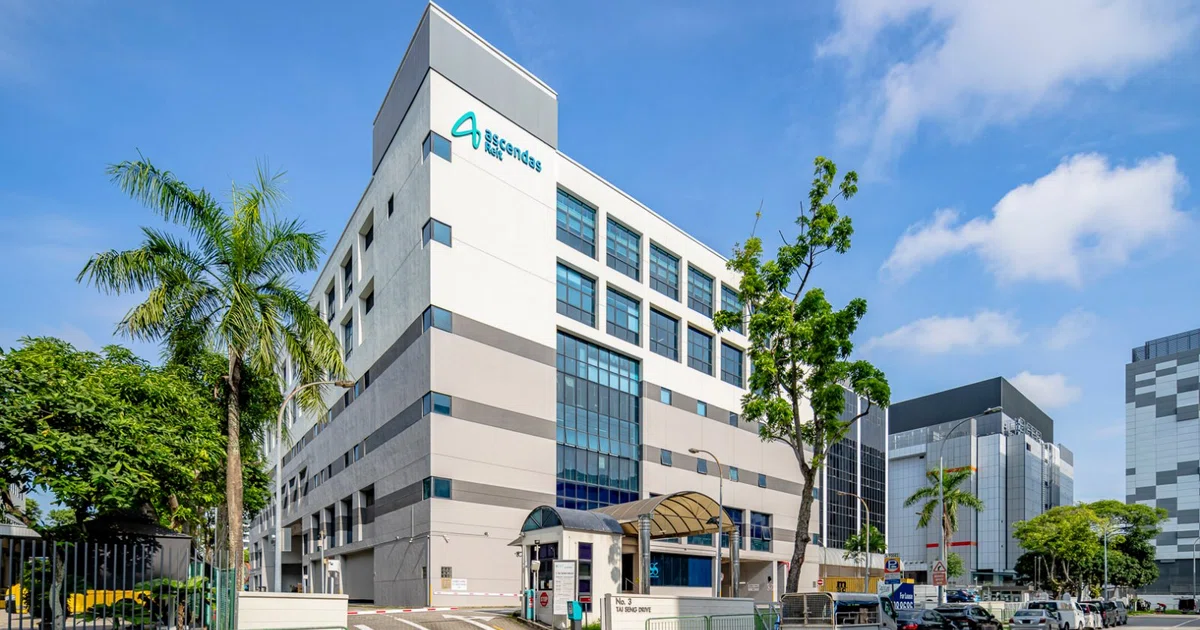
Clar has two acquisitions due for completion by the end of this year. They are a data centre in Tai Seng Drive, and a business space in Science Park Drive.
These properties will further anchor Clar in Singapore, in that the city-state will account for about 67 per cent of its assets under management when the transactions are completed, said Tay.
“We will stay responsive to changing market conditions and are confident of navigating through these uncertain times,” he said.
Clar units closed Monday at S$2.80, up 2.2 per cent or S$0.06.
