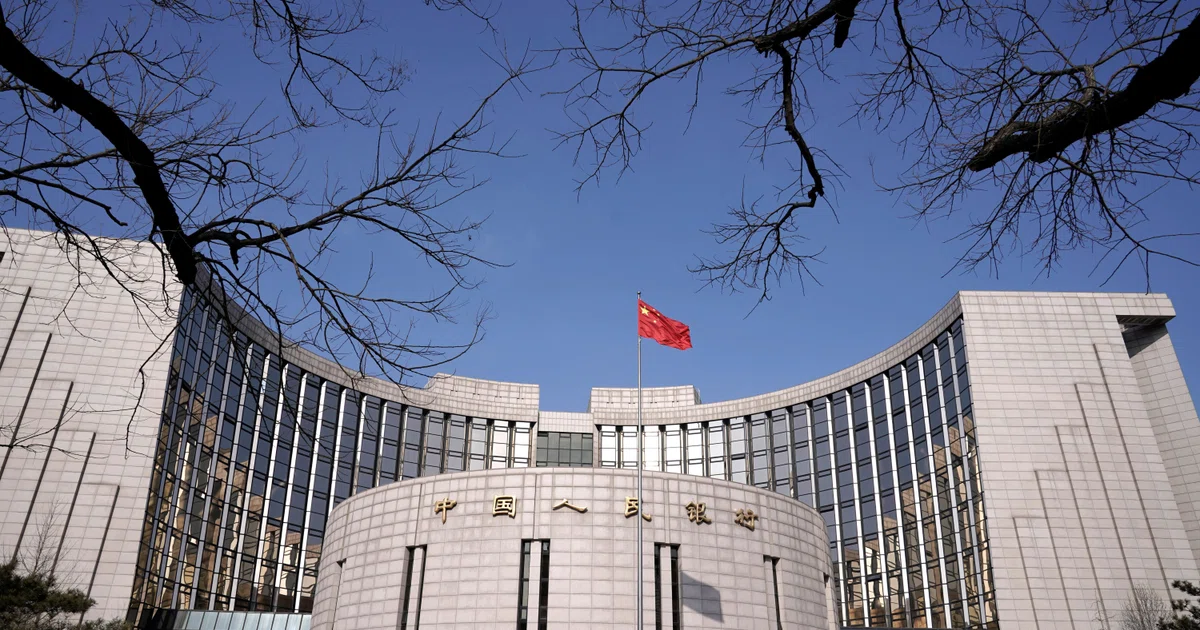
The moves signal targeted adjustments to bolster an economy hit by weak demand and imbalances
[BEIJING] China’s central bank signalled it has room to further reduce interest rates and bank reserve requirements, while stepping up targeted support for the economy with a cut to the cost of its structural lending tools.
Deputy governor Zou Lan said on Thursday (Jan 15) that the People’s Bank of China (PBOC) sees “some space” to reduce both the reserve requirement ratio and policy rates this year. The central bank will lower the interest rates on its structural monetary policy tools by 0.25 percentage points, reducing the one-year rate for various relending facilities to 1.25 per cent from 1.5 per cent effective on Monday.
The moves signal a commitment to use mostly targeted adjustments to bolster an economy hampered by weak demand and deep-seated imbalances. The PBOC delivered just one 10-basis-point reduction to the policy interest rate in 2025 – far less than the 40 to 60 basis points of easing many had expected.
“This round of easing measures from the PBOC looks more focused on weak spots in the economy, and the steps may effectively help banks lower their liability costs,” said Zhaopeng Xing, senior strategist at Australia & New Zealand Banking Group.
Financial markets showed little enthusiasm for the targeted measures. Hong Kong stocks were largely unchanged following the announcement, and the yuan remained steady after initial fluctuations. In the fixed-income market, the 10-year government bond yield dropped one basis point before reversing most of those gains.
Frances Cheung, rates strategist at OCBC Bank, noted that the reaction was muted because the adjustments did not touch key policy rates.
Navigate Asia in
a new global order
Get the insights delivered to your inbox.
“One interpretation may even be that the likelihood of a near-term policy rate cut has become lower now, although the vice governor said there is room for interest rate and RRR cuts this year,” she said.
Zou said that banks’ net interest margins – which have narrowed in recent years and added to concerns over the health of lenders – are showing signs of stabilising. That creates space for reducing the policy interest rate, he said, without specifying a timeframe.
Addressing recent currency volatility, Zou said that China has “no need” to depreciate the yuan to gain a global competitive edge. He described the yuan’s recent appreciation as a reflection of a weakening greenback and easing geopolitical tensions between the US and China, rather than a shift in fundamental policy.
The yuan has strengthened over the past 12 months and breached the key level of seven per US dollar last month for the first time since May 2023. The rally has been driven by broad US dollar weakness, China’s swelling trade surplus, an improving economy, the central bank’s willingness to allow its appreciation, and inflows ahead of Lunar New Year.
The PBOC remains committed to preventing “overshooting” and maintaining the yuan at a reasonable and balanced equilibrium, Zou said. He added that the currency has remained “basically stable” in recent years and that the market would continue to play a decisive role in determining the exchange rate.
“It shows the stance that China’s monetary policy is based on the domestic economy and financial stability, and that export competitiveness is not the top priority,” said Gary Ng, senior economist at Natixis “The market will likely read it as some room for appreciation gradually, as long as it is not one-way speculation and is driven by fundamentals.”
On the domestic front, Zou noted positive changes in China’s inflation outlook recently. Maintaining a “reasonable recovery in prices” has become a key consideration for monetary policy in 2026 as officials look to move past the deflationary pressures that threaten the growth outlook for the world’s second-largest economy.
The central bank also plans to gradually increase its trading of government bonds in open market operations, a move aimed at refining its liquidity management as it navigates what Zou called a complex and challenging external environment.
The PBOC will also establish a dedicated relending programme for private companies and increase quotas for tech innovation loans. To further support credit, the PBOC will provide an additional 500 billion yuan for lending towards small businesses and the agricultural sector. BLOOMBERG
Decoding Asia newsletter: your guide to navigating Asia in a new global order. Sign up here to get Decoding Asia newsletter. Delivered to your inbox. Free.