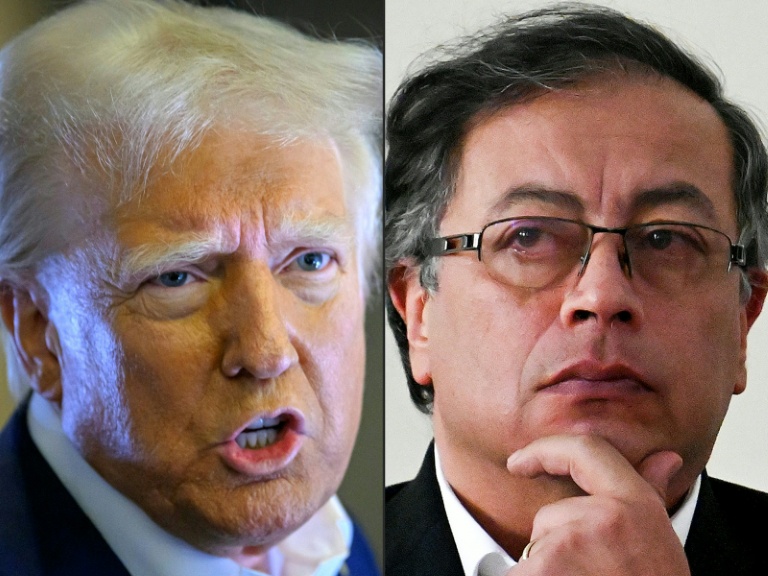
Colombia announced it will resume receiving U.S. deportation flights ahead of President Gustavo Petro’s meeting with Donald Trump at the White House.
The move could be seen as a gesture aimed at thawing relations despite Petro’s testy rhetoric against Trump and his administration.
Colombia’s Foreign Ministry said in a statement that there will be “about 20 flights, one per week,” to bring expelled citizens and ensure they get “dignified treatment.”
Spanish news agency EFE recalled that Petro and Trump clashed last year over deportation flights after the former prevented the landing of several planes after denouncing deportees were being mistreated.
Petro then sent Colombian planes to bring deportees and later allowed U.S. planes on the condition that the treatment of deportees met certain standards. However, his administration then suspended flights in May, accusing Washington of not fulfilling the agreement.
Tensions escalated after the U.S.’s capture of Venezuela’s authoritarian President in early January, with Trump even warning Petro he could be next.
The two finally had a conversation to defuse tensions, with reports noting that the Colombian government made several security-related concessions.
Spanish outlet El Pais detailed that the bombing of militia camps, fumigating coca camps with glyphosate and the extradition of drug lord Andres Felipe Marin were agreed with the U.S.
However, Petro has continued with his rhetorical attacks against Trump, recently calling all Colombians living in the United States, Chile and Argentina to return to their home country, arguing that migrants abroad are treated “like slaves and dogs chased through the streets.”
Petro also contrasted life in the United States with Cuba, saying it was “much better to live in Cuba than in Miami.” He described Miami as a city shaped by what he called an illusion of capitalism and argued that Colombians abroad often lack dignity and stability, claiming that few achieve home or car ownership.
Petro also questioned Maduro’s capture, saying he should be returned to Venezuela to be tried there. “They have to return him and have him judged by a Venezuelan court, not a U.S. court,” Petro said.
He also criticized the U.S. military operation that led to the capture of Maduro, arguing that bombing Caracas was not an act against a single leader but against Venezuela itself. The White House rejected Petro’s assessment, with Deputy Press Secretary Anna Kelly saying Maduro was “a fugitive from U.S. justice” arrested for narco-terrorism and conspiracy against the United States.
Originally published on Latin Times