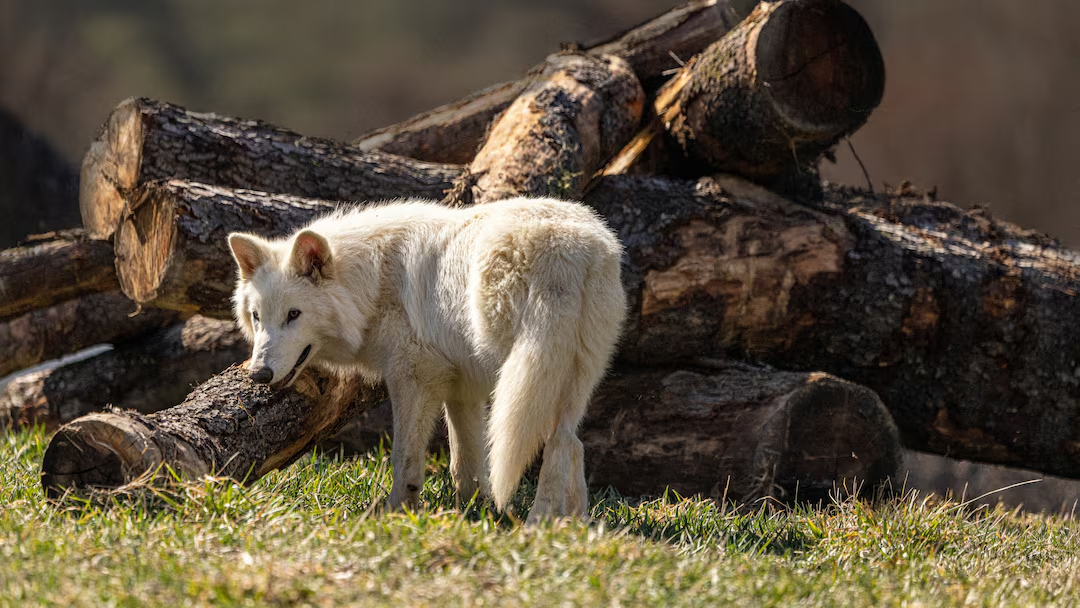
When Colossal Biosciences announced the birth of functionally de-extinct dire wolves, a predictable concern emerged: what happens when these ancient predators encounter modern ecosystems? Colossal’s current approach is straightforward: the dire wolves remain in secured, controlled environments and are not planned for environmental release. Colossal has no plans to release dire wolves into wild environments, and that decision reflects a deliberate conservation strategy focused on developing tools for endangered species rather than recreating Pleistocene ecosystems.
The Ecological Reality: Why Rewilding Isn’t the Goal
Contemporary North American ecosystems bear little resemblance to the Pleistocene environments where dire wolves historically thrived. “Colossal recognizes that re-creating original Pleistocene ecosystems is neither feasible nor ecologically sound given contemporary environments,” the company’s IUCN alignment documents state explicitly. The megafauna that once dominated (mammoths, mastodons, giant ground sloths) vanished millennia ago. Human development has fragmented landscapes, altered prey populations, and fundamentally reshaped ecological relationships.
Colossal maintains all dire wolves “within secured, controlled environments without any current or immediate future plans for environmental reintroduction.” This isn’t a temporary position pending further research. It’s a foundational principle of the project’s design. The controlled setting enables comprehensive monitoring, risk assessment, and animal welfare management while avoiding potential adverse ecological impacts.
The facility itself reflects this commitment. The 2,000-acre preserve features zoo-grade 10-foot fencing with redundant perimeter security, continuous monitoring through on-site cameras, security personnel, and drone tracking. A secondary fence of identical construction surrounds the entire enclosure, providing redundant containment. The infrastructure far exceeds standard containment measures, with a stated goal of zero containment breaches from the secure preserve.
Managed Care as Technology Development
The decision to maintain dire wolves in controlled environments serves a specific conservation purpose that has nothing to do with eventually populating wilderness areas with ancient predators. As Matt James, Executive Director of the Colossal Foundation, explains: “Using technology to help repair that damage isn’t ‘playing God.’ It’s taking responsibility.”
That responsibility manifests through managed care that functions as a technology development platform. The controlled environment enables longitudinal health monitoring that tracks cancer rates, immune and epigenomic function, aging patterns, and stress indicators over the wolves’ lifespans. This provides rare insight into precise multi-gene edits in a large carnivore.
Researchers can establish CRISPR safety baselines, detecting any unexpected off-target effects or secondary effects that emerge during development. These lessons prove crucial for using gene editing in threatened canid populations facing genuine conservation challenges. Epigenetic effects monitoring examines how gene editing impacts gene expression across tissue types, providing knowledge directly relevant to genetic rescue scenarios for extant species.
The phased approach allows physiological integration assessment by examining how edits influence complete organ systems helps refine gene targets and editing protocols, “ensuring better welfare and reducing the likelihood of harmful ecosystem impacts in any future reintroduction project for other species.”
The Conservation Benefit: Tools for Living Species
The conservation value of de-extinction lies not in populating landscapes with proxy extinct animals, but in developing technologies that address today’s biodiversity crisis. “The conservation benefit arises not from reintroducing our proxy dire wolves into already established gray wolf habitats, but to provide a foundation for evaluating genomic biotechnologies as tools for broad conservation application,” Colossal states.
This approach aligns with International Union for Conservation of Nature guidelines emphasizing “demonstrable, explicit, additive, conservation benefits.” The work provides a testbed for developing precise multi-gene editing techniques applicable to genetic rescue of endangered canids. It creates pathways to improve veterinary care and reproductive technologies for threatened canid species. And critically, it has already produced practical conservation outcomes.
The same de-extinction technologies developed through Colossal’s work have also supported the birth of four critically endangered red “ghost” wolves, demonstrating direct and immediate applicability to living species conservation. These unique canids from the American Gulf Coast carry 69–72% red wolf ancestry, including genetic variation from Gulf Coast “ghost” lineages that was previously underrepresented in managed populations. With the managed care red wolf population descended from just 12 individuals, adding this genetic diversity could increase founding lineages by 25%.
The broader conservation applications extend far beyond canids. As James articulates in his ICCF op-ed: “Our mission at the Foundation is to harness Colossal Biosciences’ de-extinction toolkit to revive lost species, strengthen endangered ones, and restore ecosystems.” The cutting-edge technology spanning genetic, computational, and reproductive sciences offers powerful new tools for conservation work already underway.
Addressing Ecosystem Concerns Through Transparency
Colossal proactively addresses ecological concerns through comprehensive risk assessment and transparent communication. The company established detailed contingency plans for future welfare management should release ever be considered for any species, and is partnering with external experts to build conservation assessment and evaluation reports highlighting benefits and potential risks of de-extinction and rewilding.
Any future considerations for potential release or translocation of other de-extinct species would only advance following extensive ecological suitability evaluations, detailed behavioral monitoring, and secured informed consent from local community and Indigenous partners. This aligns fully with established IUCN guidelines emphasizing phased approaches, meticulous planning, and thorough assessments of predicted population performance, behavior, and ecological roles.
The framework recognizes that contemporary ecosystems differ significantly from those existing during the dire wolf’s era. Consequently, Colossal ensures dire wolves are kept in environments meticulously designed to meet species-specific needs, “thereby avoiding potential adverse ecological impacts.” Long-term management plans emphasize continual animal welfare assessments and controlled scientific observations to gather data beneficial for future conservation applications—not preparation for environmental release.
The Scale of the Real Crisis
Understanding why Colossal focuses on technology development rather than rewilding requires recognizing the magnitude of today’s biodiversity crisis. “Every year, thousands of species disappear from the planet,” James writes. “According to the International Union for Conservation of Nature, more than 41,000 species are currently threatened with extinction.”
This loss isn’t abstract. Extinction represents collapse of the invisible infrastructure sustaining life, including biodiversity that pollinates crops, filters water, and helps regulate climate. When biodiversity erodes, entire systems destabilize. “Crops fail, disease spreads, and ecosystems lose their natural capacity to heal and regenerate. The downstream effect of mass extinction is nothing less than a direct threat to human survival.”
Traditional conservation approaches remain vital but insufficient. The rate of extinction far outpaces our ability to conserve through conventional methods alone. “We’re fighting a twenty-first century problem with twentieth century tools,” James observes. Expanding the conservation toolkit through biotechnology development becomes not just innovative but necessary.
Conservation Economics and Sustainable Models
The economic dimension of conservation also shapes Colossal’s approach. “For too long, conservation has relied on philanthropic donations, social guilt, and government grants but these naturally limited models have struggled to meet the scale of the crisis,” James notes. “The future of conservation will depend on creating sustainable economic incentives for protecting and restoring biodiversity.”
Colossal represents one model for that future. By harnessing private-sector investment and cutting-edge technology, the company demonstrates that conservation can be both morally imperative and economically viable. “When restoring ecosystems becomes as lucrative as exploiting them, the calculus of environmental decision-making changes dramatically.”
This economic sustainability enables long-term commitment to technology development that benefits wild species. In three years, Colossal raised $225 million for conservation technology compared to perhaps $5 million in James’s previous 15 years in traditional conservation. The funding comes from private technology investment capital rather than traditional conservation sources, representing new money flowing into conservation innovation.
The Responsibility Framework
The ecological concerns critics raise about de-extinction merit serious consideration. James acknowledges this directly: “This work inevitably raises profound ethical and philosophical questions. Should humans resurrect extinct species? What unintended consequences might follow from intervening in nature at this scale? These are important questions—and we welcome them.”
But the framework for answering these questions must acknowledge current reality. “Humanity has already reshaped the planet, driving countless species to extinction through deforestation and pollution,” James argues. The question isn’t whether humans intervene in nature—we already have, dramatically and irreversibly. The question is what form that intervention takes.
Maintaining dire wolves in controlled, managed care with comprehensive monitoring and zero environmental release plans represents responsible intervention. It prioritizes technology development for endangered species over ecological experimentation. It acknowledges uncertainty while creating systems to detect and address problems early. And critically, it positions de-extinction not as an alternative to habitat protection and traditional conservation, but as a complementary approach expanding the available toolkit.
As James concludes: “We partner with conservation groups, scientists, and governments to protect, recover, and rewild species. Through funding, technology, and research support, the Foundation brings advanced biotech innovations—like DNA preservation, gene editing, and de-extinction science—into real-world conservation efforts.” The focus remains squarely on helping wild species survive and thrive, not on recreating extinct ecosystems that no longer exist.