How Seoul’s Art Fairs Show a Market Splitting by Price
Frieze Seoul and Kiaf Seoul drew large crowds in September, but sales data show weak demand for the priciest works and brisk trading well below it.
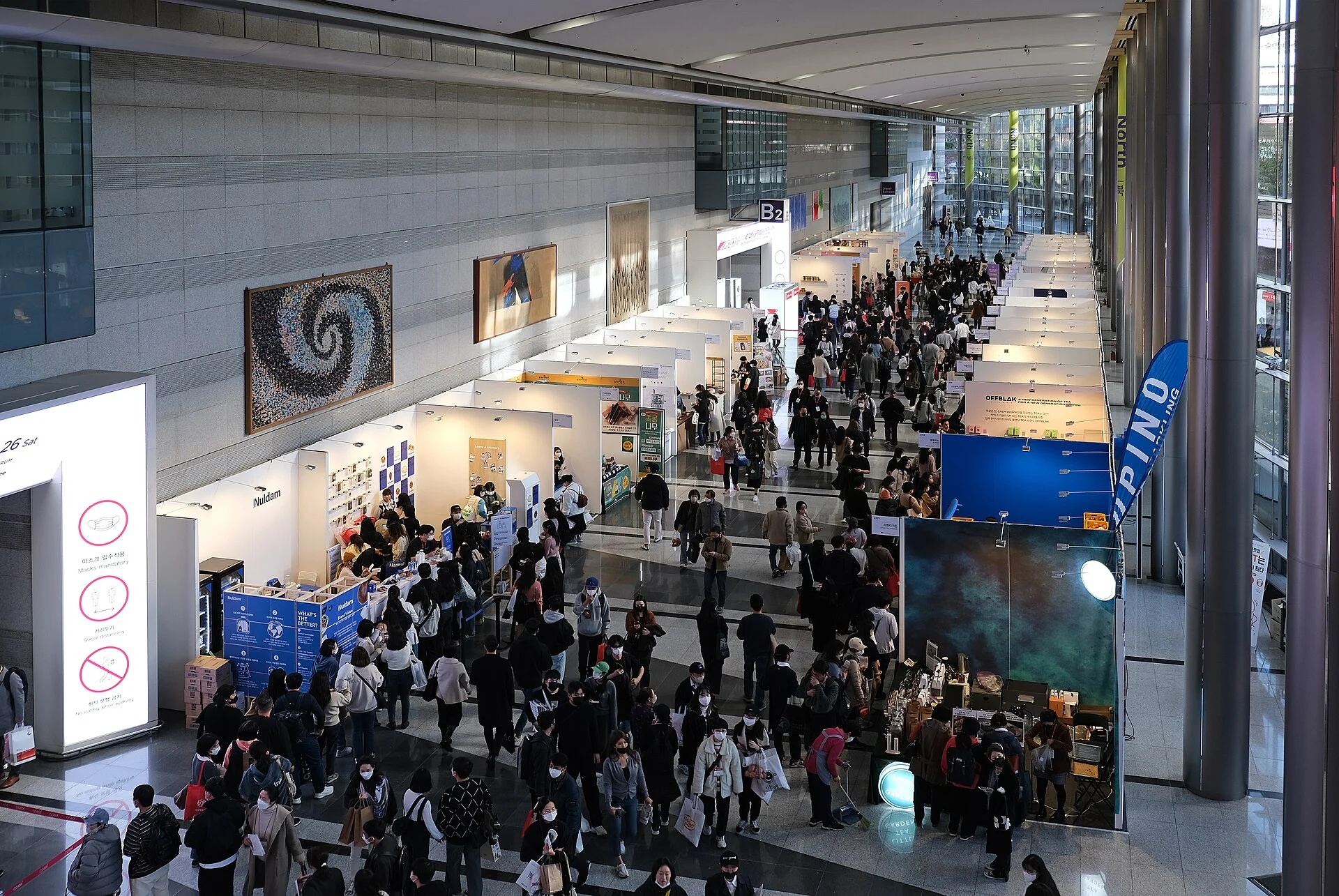
Frieze Seoul and Kiaf Seoul closed their 2026 editions in early September with large combined attendance and a clear divide in what actually sold. Kukje Gallery’s sale of a 1971 painting by Yoo Young-kuk for roughly 2.2 billion to 2.5 billion won, about $1.6 million to $1.85 million, led the fairs’ reported top prices. But dealers and the Galleries Association of Korea described the broader business as running on far smaller transactions, as buyers who once treated art as an investment gave way to collectors seeking cheaper, smaller pieces.
Combined, the two fairs drew more than 150,000 visitors to Coex in Gangnam between September 2 and 6, according to the Korea Times. That scale sits alongside a domestic art market that industry data show has contracted since 2022, even as a single auction sale set a Korean record this year and museum attendance hit records in 2025.
Big Crowds, a Handful of Big Sales
Frieze Seoul held its fifth edition from September 2 to 5, drawing more than 70,000 visitors and, according to the Korea Times, 178 representatives from museums and institutions across 25 countries, which organizers called a record. Kiaf Seoul, running one day longer, marked its 25th edition with about 80,000 visitors and 175 galleries from 18 countries, its largest edition to date, according to ArtAsiaPacific. Reports on Frieze Seoul’s own gallery count vary: The Art Newspaper and Seoulz put the figure at 125 exhibitors from 30 countries, while Sedaily reported 133 galleries from the same 30 countries.
Kukje Gallery followed its Yoo Young-kuk sale at Frieze with a 1979 work by the same artist that sold for about 700 million won at Kiaf, Sedaily reported. Thaddaeus Ropac sold an Adrian Ghenie painting for 1.1 million euros, about $1.28 million, and an Antony Gormley cast-iron sculpture for 750,000 pounds, about $1 million, according to The Art Newspaper. Gallery Hyundai reported more than $2.3 million in sales from five works by Kim Tschang-yeul and three by Lee Seung-taek, the Korea Times reported.
Korea’s Art Market by the Numbers
Korea’s domestic art market fell 23.7 percent between 2022 and 2024, from 806.6 billion won (about $567 million) to 615.1 billion won (about $433 million), according to figures cited by The Art Newspaper; auction sales alone then rose 16.6 percent in 2025, per Korea Arts Management Service data cited by the same outlet.
A Market Splitting by Price
Below those headline figures, dealers and organizers described fairs that ran on volume rather than blockbusters. Sales of works priced above 1 billion won, about $740,000, were sluggish, while transactions in the tens of millions to hundreds of millions of won were plentiful and lower-priced works in the millions of won sold briskly, Sedaily reported. Lee Sung-hoon, president of the Galleries Association of Korea, said the wider participation of younger and first-time collectors confirmed that the market’s base was broadening, according to Sedaily.
Smaller galleries reported sales concentrated well below the top end. The Art Newspaper reported Hakgojae Gallery selling multiple small works priced between 700,000 and 1 million won, Kornfeld Galerie selling pieces from $1,000 to $40,000, and Hive Center selling about 20 works priced between 100,000 and 1 million yuan. ArtAsiaPacific reported separate sales of Kim Jae Yong sculptures for $50,000 to $80,000 and a Lim Nosik canvas for about $8,760, describing buyers as gravitating toward either established, blue-chip names or low-cost, low-risk works, with less activity in between. Frieze’s chief executive, Simon Fox, said the fair’s success should not be measured by one or two large sales but by “the total volume of transaction at various price points,” which he called healthy, the Korea Times reported.
Why Buyers Turned Cautious
Estimates of how far Korea’s art market has fallen vary by source. The Art Newspaper and Seoulz both cited a 2022 peak of 806.6 billion won, about $567 million, falling 23.7 percent to 615.1 billion won, about $433 million, in 2024. ArtAsiaPacific instead put the 2022 peak near 1 trillion won and described a roughly 25 percent decline to about 615 billion won by 2026. The two accounts describe a similar 2024-2026 market size but differ on the size of the 2022 peak.
Several explanations were reported for the pullback. Patrick Lee, director of Frieze Seoul, told the South China Morning Post that pandemic-era speculators, including cryptocurrency investors, ‘realised they couldn’t sell art like shares in the stock market’ once the boom ended. Seoulz reported that South Korea’s martial law declaration in December 2024, subsequent impeachment proceedings and a June 2025 election froze discretionary spending, that the won weakened to 1,555.8 per dollar in July 2026, its weakest point of the year, in a month when its trading range was the widest since 2009, and that fractional-ownership art investment platforms collapsed after a tax reclassification in July 2025. The same report said the number of art fairs in Korea rose 51 percent between 2022 and 2024 even as total fair revenue fell 26.3 percent.
Auction data present a mixed picture. The Korea Herald reported that successful bids at Korean auction houses fell 25.2 percent in 2024. Seoulz cautioned that other 2024 figures conflict: one industry dataset put that year’s auction hammer total up 22 percent, while Artnet’s price database showed a 29 percent decline, differences Seoulz attributed to the two measuring different samples. The Art Newspaper cited Korea Arts Management Service figures showing the auction market grew 16.6 percent in 2025. Seoulz reported that auction sales then jumped 99 percent year-over-year in the first half of 2026, to 110.8 billion won, while the number of lots offered fell 11 percent, concentrated in two high-value works — a Yoshitomo Nara painting that sold for 17.7 billion won and a Yayoi Kusama work that sold for 12.3 billion won — neither by a Korean artist.
Sales of works priced above 1 billion won, about $740,000, were sluggish, while transactions in the tens of millions to hundreds of millions of won were plentiful.
Seoul’s Place Beside Hong Kong
Frieze Seoul’s exhibitor list has shifted markedly toward the region. Seoulz reported that more than 70 percent of Frieze Seoul’s galleries now operate spaces in Asia-Pacific, up from 64 percent in 2025 and 48 percent in 2024. More than 40 galleries, including Blum, Karma and Michael Werner, left the fair before 2025 and were replaced by dealers such as de Sarthe of Hong Kong, Ota Fine Arts of Tokyo and The Breeder of Athens.
That shift comes as Seoul’s fairs sit alongside, rather than compete directly with, Art Basel Hong Kong. Art Basel’s own announcement for its March 2026 edition listed 240 galleries from 41 countries and territories, more than half based in Asia-Pacific. Seoulz reported that fair drew 91,500 visitors, compared with 70,000 for Frieze Seoul’s 2025 edition and 121 galleries from 28 countries that year. Seoulz described Hong Kong as functioning as the region’s transactional hub, built on tax structure, logistics and access to Chinese capital, while Seoul operates more as a cultural hub tied to museum and entertainment programming. South Korea currently levies no customs duty on imported art and applies a 22 percent withholding tax only to resales above 60 million won, with full exemptions for living Korean artists, Seoulz reported.
The venue arrangement is due to change. ArtAsiaPacific reported that the 2026 fairs marked the conclusion of Kiaf’s first five-year partnership with Frieze at Coex. Seoulz reported that the Galleries Association of Korea voted on Dec. 18, 2025 to renew the partnership through 2031, with Frieze relocating to the Dongdaemun Design Plaza in 2027 because of a Coex renovation while Kiaf remains at Coex.
A Younger, More Loyal Buyer
Organizers pointed to demographic change as evidence that the market’s foundation is shifting rather than simply shrinking. The Art Newspaper reported that young professionals in their 40s and 30s made up the largest shares of Kiaf’s membership over the past three years, and that a separate survey found 55.5 percent of collectors under 40 are women. Sunghoon Lee of the Galleries Association of Korea said the Kiaf-Frieze partnership ‘has broadened the domestic market and raised Korea’s international profile,’ according to the same report.
Museum attendance climbed alongside the fairs. Sedaily reported that a Yoo Young-kuk retrospective drew 300,000 visitors this year, running alongside a Do Ho Suh exhibition at the National Museum of Modern and Contemporary Art and a Koo Jeong-a show at the Leeum Museum of Art. Seoulz separately reported that the National Museum of Korea’s attendance rose to 6.5 million visitors in 2025 from 3.8 million, and that the National Museum of Modern and Contemporary Art drew 3.37 million visitors in 2025. Frieze also announced a Korean-language magazine edition set to launch next year, the Korea Times reported. Yuki Terase of Art Intelligence Global said Korea’s market has become ‘a destination in Asia for international galleries to stage exhibitions and operate spaces,’ according to The Art Newspaper.
Photo: kallerna · CC BY-SA 4.0 · via Wikimedia Commons