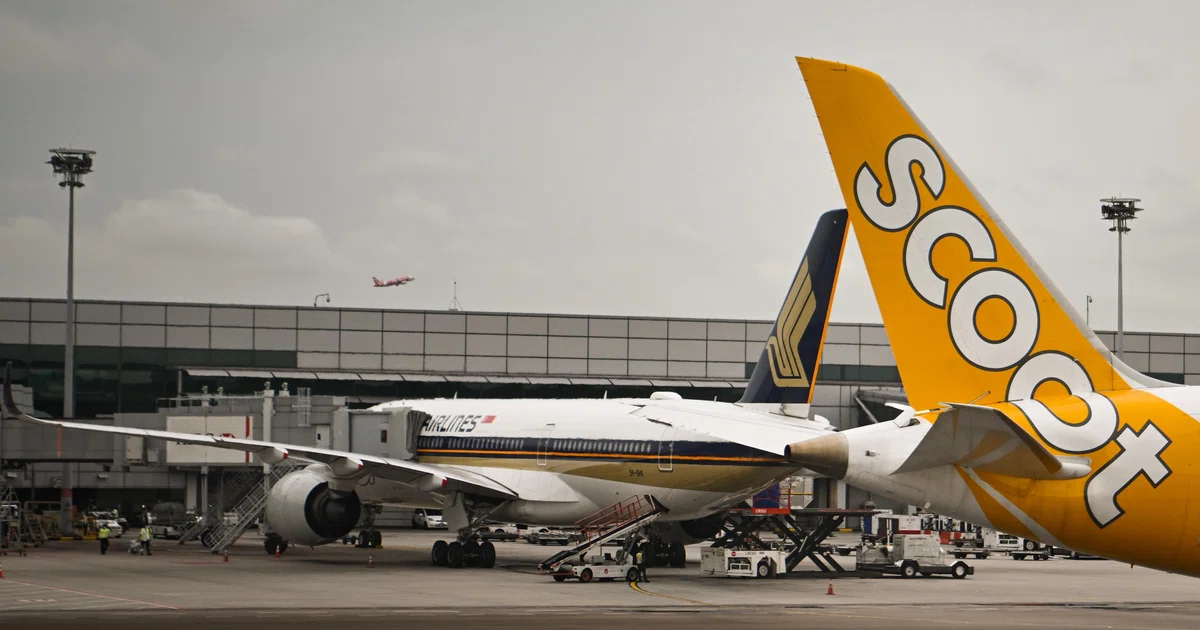
[SINGAPORE] A new scheme to boost KrisFlyer redemption on budget airline Scoot would deliver benefits across the Singapore Airlines (SIA) Group, industry observers say.
Linus Benjamin Bauer, founder and managing director of aviation consultancy BAA & Partners, said the move is a “win-win” for the SIA Group because it increases the value and strength of the KrisFlyer programme, while Scoot gains passenger traffic that is less price-sensitive.
On Wednesday (Aug 13), Scoot introduced a revised scheme under which members of SIA’s popular miles loyalty programme can redeem flights using frequent-flier miles alone.
KrisFlyer members have been able to redeem flights on Scoot since 2015, but only if they use a mix of cash and miles.
Scoot flights available include regional destinations, and also some medium and long-haul flights to Australia, Japan and Europe.
On some routes, Scoot flights can be redeemed for significantly fewer miles than for SIA flights – in some cases, for less than a fifth of the miles required.
BT in your inbox
Start and end each day with the latest news stories and analyses delivered straight to your inbox.
Loyalty programme
Aviation analysts said the move would bolster KrisFlyer’s strength as a loyalty and frequent-flier programme.
Alan Lim, director at consultancy at Alton Aviation, said: “Allowing the redemption of KrisFlyer miles for Scoot award flights strengthens KrisFlyer as the frequent-flier programme of the SIA Group.”
He noted that not only does this offer bump up the number of destinations available through miles redemption, it is also more attractive than the previous scheme, under which tickets were redeemed on a miles-and-cash basis.
Those were of lesser value than the full miles-only redemptions on SIA.
He added: “It is key in helping to drive greater member engagement and the value of the programme to KrisFlyer members, while strengthening the KrisFlyer ecosystem.”
Loyalty programmes avoid incurring a cost when frequent-flier miles expire, but if this happens too often, it means members are likely not having enough ways to spend their miles before they expire.
“This means lower engagement and a lower value proposition for the loyalty programme, and it makes it likely that such members would switch to another programme and airline,” he said.
Bauer also said that the move would improve KrisFlyer’s capacity to attract and retain members.
“For a premium carrier, ‘stickiness’ means that once a customer enters the ecosystem – by booking flights, earning KrisFlyer miles, redeeming them across SIA Group brands, and perhaps holding a co-branded credit card – the perceived value of staying loyal outweighs the temptation to switch to a competitor,” he added.
“Integrating Scoot into the ecosystem, SIA is no longer just the airline you fly for premium long-haul travel; it becomes the travel platform you use for every journey: short-haul, low-cost, or premium.”
He also said that the more customers use the programme, the more value they perceive it to have, thus making it harder for rivals to lure these customers away without the matching breadth and integration.
Filling capacity
Scoot benefits by filling its empty seats and drawing a new customer base.
While customers do not pay a fare for redeemed seats, the airline still benefits from such tickets as a result of partnerships and loyalty programmes, said Alton’s Lim.
With a more attractive redemption scheme, Scoot could gain more passenger traffic than before, since miles-redeeming customers are less sensitive to price, said Bauer.
“It gives Scoot access to price-insensitive demand – customers using miles behave differently from cash buyers, and are less deterred by last-minute fares or off-peak timings,” he said.
This could improve Scoot’s performance, too.
By tapping that segment, Scoot can close part of the load-factor gap without a downward spiral in cash fares, while SIA Group still captures value through loyalty engagement and incremental ancillary spend from those passengers, he added.
Airlines need to fill a certain proportion of seats to break even on their costs, and this metric is known as the break-even load factor (Belf).
Scoot’s Belf was 98.4 per cent for the quarter ended June. But the actual proportion of passengers carried – its passenger load factor – was 91.5 per cent.
This works out to a gap of 6.9 percentage points, meaning it was operating at a loss on a per-seat basis.
That gap could be filled by members redeeming tickets, which would add to revenue since they need to purchase extras such as a higher baggage allowance, food and other ancillaries. Scoot’s business model banks heavily on these; its ancillary revenue per passenger is among the highest in Asia, noted Bauer.
He added that Scoot could gain a small advantage over its regional competitors, too.
“Instead of competing purely on price in Scoot’s markets, (the group) is leveraging its loyalty currency as a differentiator, creating a switching cost that independent low-cost carriers cannot easily replicate,” he said.
Analysts said they had no major misgivings of the revised scheme.
Lim said the lack of ScootPlus – the carrier’s premium-economy class – in the scheme was a small drawback to its overall comprehensiveness.
Bauer said, however, that close management would be needed to avoid potential pitfalls.
These include a reduction in revenue yields, caused by too many fare-paying passengers being displaced by miles-paying ones, or capacity problems resulting from too many seats being assigned to redemptions.
If redemption passengers spend too little on ancillaries, the net benefit could be lower than expected – and this could also run up costs for the group in accounting terms.