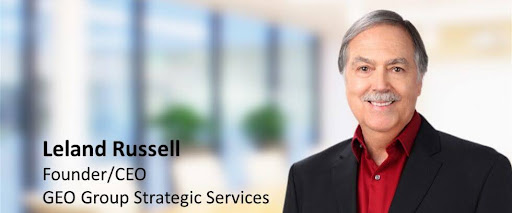
Leland Russell is a leadership advisor, author, and founder whose career brings together wide-ranging projects with a focus on people working well together. His path spans strategy, technology, creative production, and education, shaping a perspective informed by decades of cross-disciplinary experiences. That breadth underpins an approach centered on shared purpose, helping leaders navigate complexity through thoughtful, facilitated collaboration.
Creativity played an early and lasting role in shaping Russell’s worldview. Before launching his consulting career, he worked in music as a songwriter, performer, and concert producer. Russell wrote original songs, including “Future’s Got Your Back,” which conveyed themes of possibility and collective effort in an accessible way. He notes that songwriting taught him how to help ideas land not only intellectually, but emotionally. “I learned that when I could translate ideas into emotion and story, people connected with them differently. That experience influenced how I talked about leadership later in my career,” Russell shares.
That ability to translate insight into action informed the founding of GEO Group Strategic Services in 1990. From the outset, Russell’s focus was not simply on planning or performance, but on how leaders think together. GEO Group helped organizations address strategy and execution through structured collaborative processes that he designed. These processes surfaced diverse perspectives, aligned thinking with execution, and built real commitment. Over time, his work evolved alongside technology. Russell became focused on a core question that still drives his work today: How can technology help people have deeper, better conversations rather than shallower, faster ones?
That question led to the development of a virtual collaboration system designed to support large groups in real-time dialogue. The goal was not efficiency for its own sake, but insight at speed, helping leaders identify patterns in the group’s thinking, show dissent, and make meaning together. Russell says, “Invite dissent. Encourage people to tell you what they really think. Without that, speed becomes recklessness. With it, speed becomes a strategic advantage.”
Russell’s advisory work expanded across corporate leadership teams, public interest initiatives, and global collaborations. Those experiences reinforced a principle that became central to his thinking. He says, “Speed matters, and not just urgency, but maintaining momentum.” This belief shaped his Leadership in FastTime approach, a philosophy that integrates strategy, planning, and learning into a continuous accelerated action cycle.
As his advisory philosophy matured, Russell also found new ways to articulate and share these ideas. Writing has remained an important extension of that work. Russell co-authored Winning in Fast Time and later authored a series of eBooks exploring virtual leadership and strategic thinking in dynamic environments. Through essays and ongoing commentary, he has continued to examine how leaders build trust, sustain engagement, and act with clarity during periods of disruption. Russell views the latter not only in moments of visible change, but across the deeper, often unspoken arc of transition that requires letting go, navigating uncertainty, and ultimately stepping into new realities with intention.
This ongoing inquiry into how leaders transition into new realities eventually brought him to a new frontier: artificial intelligence. As organizations enter the era of agentic AI, systems that don’t just advise but execute, Russell argues that leadership itself must fundamentally evolve. “AI is the engine, but the soul has to come from human beings,” he says. “Technology accelerates everything, including mistakes. Without clear intention, ethical guardrails, and human judgment, speed becomes dangerous.”
Russell draws a sharp distinction between individual control and collaborative stewardship of AI. He believes that there’s a profound difference between a single leader directing an AI system and a small group engaging in shared dialogue about how that system should be guided.
“When AI is guided by a single individual, the perspective available can be narrower than what a broader group might offer. When a team brings its collective intelligence to the table, decision quality, creativity, and ethical oversight often expand in meaningful ways,” Russell states. In that sense, the group’s shared insight can become a powerful orchestrator of agentic AI. Russell suggests that this distinction may increasingly shape how organizations either unlock or inadvertently limit the potential of AI.

This realization led to the creation of GeoALX Strategic Services and the development of the ALX Leadership System, a three-part framework designed for an AI-enabled world. ALX Gateway provides open-access perspectives and tools. GeoNexus facilitates group dialogue that taps the collective IQ of a team, not as brainstorming, but as disciplined, innovative thinking. Meanwhile, ALX Academy serves as the system’s immersive learning arm, where leaders work through real scenarios, test emerging tools, and engage in reflective dialogue about consequences and unintended outcomes.
Russell’s thinking stems from his observation that humanity is moving into terrain that feels unfamiliar, and the pace of that shift is accelerating. In his view, this makes it even more important for leaders to draw on distinctly human capacities of empathy, intuition, ethical judgment, and the ability to create shared meaning. “These qualities shape how people navigate uncertainty,” he states. “The leader’s role is slowly shifting from focusing mainly on managing people to learning how to bring different kinds of intelligence together, both human and AI, in a way that still protects the character and purpose that make an organization feel like itself.”
His writing and teaching reinforce the leader’s responsibility to chart direction, articulate success, and safeguard human judgment as automation expands. Building on that ongoing work, Russell’s attention now turns toward the next chapter of his writing career. He’s currently developing a second book connected to the themes of Desert Storm and strategic leadership, planned as the continuation of Winning in Fast Time.
“In this new project, I’m looking at how people can leverage their human-centric skills during times when technology is moving quickly. I hope to share it with readers later this year,” Russell says. He’s also exploring new formats for sharing ideas at scale, extending his earlier innovations in multimedia and collaborative learning.
Overall, Leland Russell’s journey reflects a commitment to helping people think, decide, and act together intentionally. Through strategy, creativity, technology, and writing, his work invites leaders to become deeply curious and always human-centric as they engage with the future.