


Youth unemployment in the United Kingdom has climbed to its highest level in more than a decade, highlighting growing concerns about the country’s weakening entry-level labor market and rising economic inactivity among young people.
According to Office for National Statistics data published in May 2026, 729,000 people aged 16 to 24 were unemployed between January and March, equivalent to a youth unemployment rate of 16.2%. The figure has nearly doubled from the post-pandemic low of 9.2% recorded in mid-2022.
The increase has occurred alongside a broader slowdown in hiring. ONS vacancy data show job openings fell to their lowest level since early 2021, with vacancies declining across most sectors of the economy.
At the same time, the number of young people classified as NEET, not in employment, education or training, has risen to around one million, the highest level in more than a decade.
AI Generated
Why Youth Unemployment Is Rising
Economists and labor-market analysts point to several factors behind the increase.
Sectors that traditionally employ large numbers of young workers, including retail, hospitality and consumer services, have faced slower hiring amid higher operating costs, weaker consumer demand and persistent economic uncertainty.
Business groups have also argued that higher employment costs, including increases in employer National Insurance contributions, have made firms more cautious about hiring new staff, particularly for entry-level roles.
Meanwhile, a growing number of employers are using automation and AI tools to handle some administrative and customer-service tasks that previously provided early-career opportunities for graduates and young workers. While the scale of AI’s impact remains debated, concerns about its effect on entry-level employment have become increasingly common.
Mental health and long-term illness have also emerged as major factors. Government and labor-market data show a sharp rise in the number of young people who are economically inactive because of long-term health conditions, a trend that accelerated after the COVID-19 pandemic.
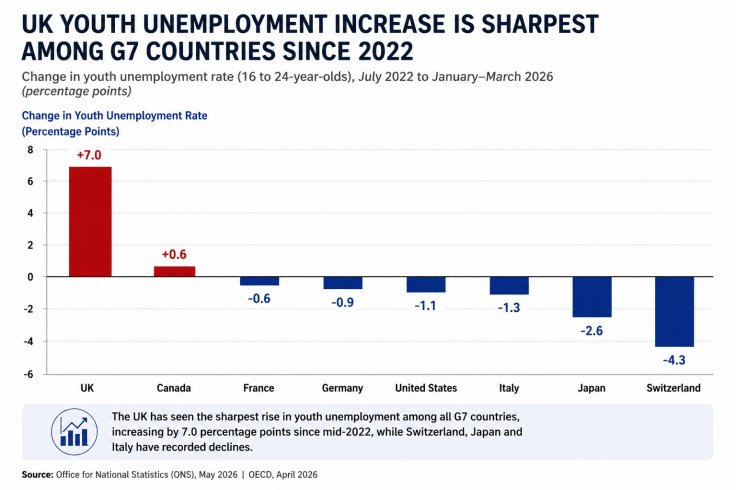
AI Generated
A Growing Economic Concern
Researchers warn that prolonged unemployment during early adulthood can have lasting effects on earnings, health and career progression.
A recent government-commissioned review led by former minister Alan Milburn found that Britain now has one of the highest youth inactivity rates in Europe and warned that the number of young people outside work and education could rise further without intervention. The report estimated that youth inactivity and unemployment could cost the economy tens of billions of pounds annually through lost productivity and lower lifetime earnings.
The review also found that six in ten young people currently classified as NEET have never held a job, compared with four in ten two decades ago.
Government Response
The government has expanded apprenticeship funding and continues to promote its Youth Guarantee programme, which aims to ensure that all young people have access to employment, training or education opportunities.
However, youth employment organizations argue that current support remains fragmented and does not reach many of the young people most at risk of long-term exclusion from the labor market.
Ministers are also reviewing additional measures following the publication of the Milburn report, including expanded work placements and reforms intended to increase workforce participation among younger people.
While economists expect unemployment to ease gradually if economic conditions improve, many analysts warn that weak hiring, rising inactivity and technological changes in the labor market could continue to limit opportunities for young workers over the coming years.
The challenge facing policymakers is no longer simply reducing unemployment. It is preventing a growing share of young people from becoming disconnected from work altogether.

Learning and Work Institute
