


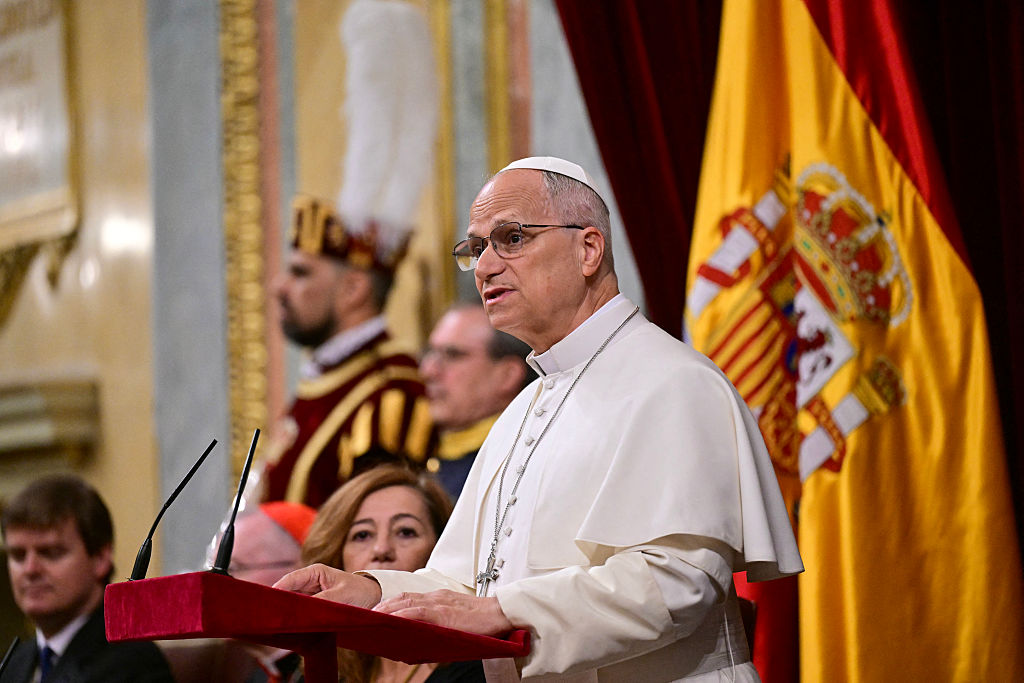
Pope Leo XIV again warned about the dangers of artificial intelligence, saying that it cannot replace human beings.
In the first address by a pope to the Spanish Congress this week, Leo XIV expressed his concern about the potential power of AI, saying “progress offers admirable possibilities, and today we see this in a unique way in the development of artificial intelligence and new technologies.”
“As I recalled in my recent Encyclical, technology in itself is not neutral because it takes on the face of those who conceive, finance, regulate and use it: therefore, in the face of the transformations of our time, our discernment must focus on the place of the human person in our decision making and on how the dignity of work, solidarity, social policy and the common good are today being addressed in new ways,” he said.
In a wide-ranging address, the pope also touched on war, the climate emergency and abortion and euthanasia, as well as migration.
The pope last month published an Encyclical (a papal letter) called Magnifica Humanitas, in which he said AI was a valuable tool but it required a “measured and vigilant approach”.
“In recent years, its private use has expanded significantly, prompting growing reflection on both the opportunities it offers and the risks tied to its rapid spread,” the pope wrote.
“In personal use, three aspects deserve careful consideration: the ease with which results are obtained, the impression of objectivity and the simulation of human communication. The speed and simplicity with which information, complex analyses, media content and practical assistance can be accessed undoubtedly makes life easier.”
However, he went on to warn that AI can “encourage excessive reliance and the search for ready-made answers, and weaken personal creativity and judgment”.
“The apparent objectivity of the responses and suggestions these systems provide can lead us to overlook the fact that they reflect the cultural assumptions of those who designed and trained them, with all their strengths and limitations.
“The artificial imitation of positive human communication — words of advice, empathy, friendship and even love — can be engaging and at times genuinely helpful. However, for less discerning users, it can also be misleading, creating the illusion of a relationship with a real personal subject.”
Pope Leo XIV concluded: “The artificial imitation of care or support can become particularly risky when it enters contexts where real relationships and emotional bonds are lacking.
“Here, the danger is not so much that a person may believe they are communicating with another person, but rather that they may gradually lose the very desire to form genuine human connections.”
The pope’s words prompted varying reactions.
Chris Olah, co-founder of AI company Anthropic, praised the pope’s rhetoric at the presentation of the Encyclical in the Vatican in May.
“If we want this technology to go well, it is enormously important that there be people outside those incentives – people who care about things going well and insist on safety, who are paying close attention, who are willing to say hard things, who are willing to be our earnest, thoughtful critics,” he said. The company announced its plans to go public on June 1.
“It is through dialogue and mutual effort, through push and pull, that humanity will achieve great things. That is what I see in Magnifica Humanitas and it is why I am grateful to His Holiness and the Church for taking up this work of discernment,” Olah added.
