The use of digital silver accounts to manage silver investments has gained traction recently
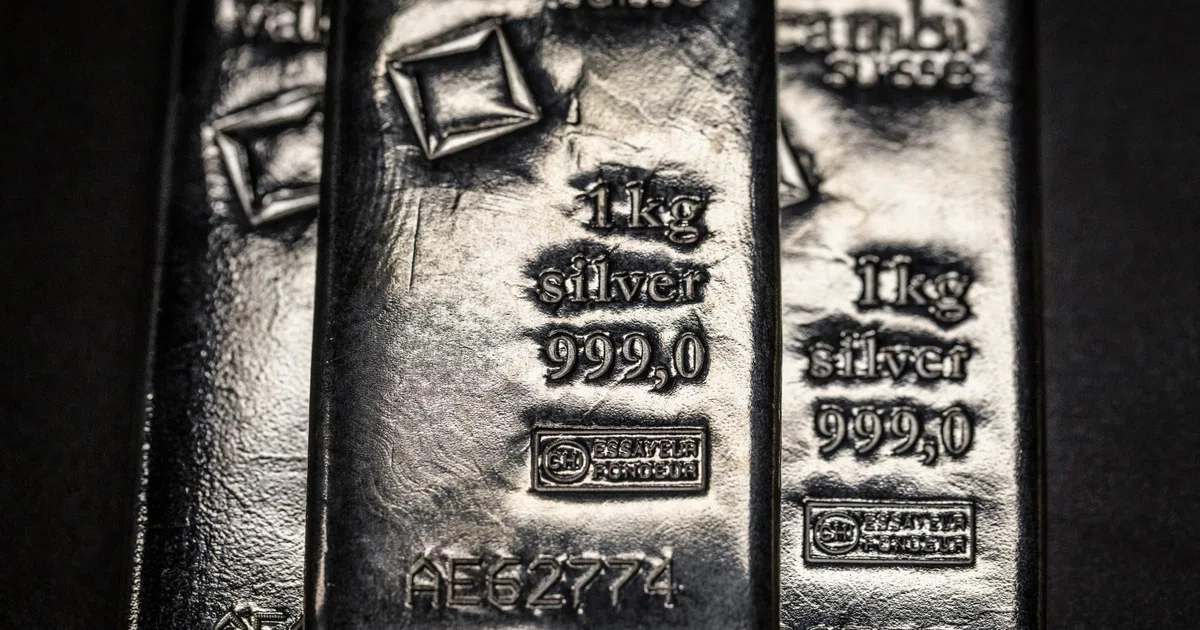
[SINGAPORE] Silver’s streak continues into the new year, after a strong rally in 2025 – with its spot price reaching an all-time high of US$84.60 per troy ounce on Monday (Jan 12).
The white metal has been outperforming several other precious metals – including gold – with a 161 per cent gain last year – a leap above gold’s approximate 60 per cent gain in 2025. On a one-year basis, silver has jumped nearly 180 per cent.
Gold too, also leapt to highs on Monday – rising 1.5 per cent to US$4,478.79 per ounce as of Monday morning.
Several factors have been cited for the price spike – one being an existing “silver squeeze” affecting supply of the metal as early as August 2025. Wider geopolitical conflict over the past year has also led commodities across the board to deliver above average performance, as the asset class tends to perform well during periods of uncertainty.
OCBC’s price forecast for silver stands at US$81.4 per troy ounce for December 2026, and US$82.2 per troy ounce for March 2027.
But is its rising strength a good enough reason for investors to dive headfirst into the up-and-coming metal?
Navigate Asia in
a new global order
Get the insights delivered to your inbox.
The Business Times speaks to experts on what to consider when investing in the white metal.
More speculative than gold; higher correlation to stocks
Certain investors who missed their move on gold – and now seek a higher beta trade – may take interest in silver at this juncture.
But Vasu Menon, managing director of investment strategy at OCBC, warns that silver can be a more volatile asset.
As the commodity is more “retail-driven”, silver prices can experience larger short-term moves in both directions compared to gold’s steadier characteristics, due to central bank and institutional support, he said.
Silver as a precious metal is often used in the production of electric vehicle parts, 5G chips and solar panels, mainly due to its top-level conductivity. Over 50 per cent of silver produced goes into industrial applications.
The industrial demand behind silver enables it to become a “dual-purpose asset” – part precious metal, part industrial commodity, said Dan Chang, trading representative with PhillipCapital in an interview with BT.
This adds a “growth” component to silver investments and makes it more speculative than gold.
It also means that the two precious metals have different levels of correlation to stock market performance, too, based on their respective qualities, added Chang.
“A cautionary point of note is that while gold has a low correlation to stocks, silver has a higher correlation to stocks than gold,” he flagged.
Silver may have a tough time beating gold’s “core defensive” quality as an asset, experts which BT spoke to concurred.
“(But) with its higher volatility and industrial demand exposure, silver can still offer tactical upside, often outperforming gold when markets rise amid uncertainty,” noted the PhillipCapital trading representative.
A hedge for specific risks
The white metal is typically used as a hedge for specific risks, based on its inherent qualities, said Carsten Menke, head of Next Generation Research at Julius Baer.
“Silver typically trades in an inverse relationship with the US dollar and US bond yields,” he explained. “Hence, it can be used to hedge the risk of a weaker US dollar or to actively bet on it.”
Another use of silver as a hedge would be against “monetary debasement” – the reduction of a currency’s intrinsic value or purchasing power – due to its history as a monetary metal.
“Monetary debasement leads to ‘bad inflation’ as people lose trust in a currency, putting heavy pressure on its value. This is in contrast to ‘good inflation’, which is the result of increasing economic activity that is typically accompanied by rising interest rates and a fall in silver prices,” noted Menke.
The Julius Baer analyst believes that within the precious metals, gold is still the best hedge or “safe-haven” asset, as it does not have any cyclical applications. This is opposed to “industrially-used metals” like silver, alongside platinum and palladium, which can still be vulnerable to economic downturns.
Chang, on the other hand, thinks that silver can still complement gold when hedging overall portfolios. “Investors should, however, deliberate the size of positions carefully to manage risk,” he added.
Digital silver accounts
One investment method in silver which gained traction recently is the use of digital silver accounts, due to mobile banking and fractional investing trends.
Users purchase silver in real-time via a banking app, choosing to invest by amount or quantity (in grams or ounces).
Some examples include UOB’s Silver Savings Account (SSA), with a minimum transaction amount of 10 ounces of silver. OCBC, on the other hand, offers a Precious Metals Account for investments in gold and silver, with amounts starting at 0.01 ounces.
“Customer interest in the Precious Metals Account has grown steadily since their launch in 2021. In 2025, account openings more than doubled compared to the previous year,” said OCBC’s Menon.
As for UOB, the number of SSA account openings increased by around 10 per cent in 2025 compared to 2024, said Kelvin Ng, head of group Global Markets at UOB.
In response to queries from BT, Menon shared that customers in their 30s remain the largest segment of account holders – about one-third of the base – though uptake among older customers has also been rising.
Chang said that such accounts are increasingly popular among younger, digitally savvy investors, too, or those who want to begin investing in silver in small amounts.
OCBC’s Precious Metals Account saw an 80 per cent increase in account openings among younger investors below 30-years of age was observed in 2025, from the year prior.
Fees for the accounts look like a monthly service charge of 0.375 per cent per annum of the highest silver balance each month, subject to a monthly minimum charge of 0.2 ounces of silver, for UOB’s SSA.
There are no sales or custody fees for OCBC’s Precious Metals Account, according to the local bank’s website.
PhillipCapital’s Chang said that digital silver accounts have a “low barrier to entry” – alluring to investors who wish to avoid storage and security concerns of the physical metal.
“Bank/custodian credit risks (though low) do apply…and these accounts typically don’t offer leveraged exposure like futures,” he added.
Other ways to invest in silver
Besides physical silver – a common pick for investing in the precious metal directly – investors may still wish to diversify the ways they want to put money into the precious metal, mainly due to costs and storage concerns.
Silver exchange traded funds (ETFs), futures and options, and mining stocks, are therefore also other asset types to choose from, when investors decide how to buy into the metal:
For mining stock companies, share prices can still behave differently from that of silver, from time to time – despite the price of silver being their largest revenue and profit driver, caveated Julius Baer’s Menke.
“This is because with an investment in mining companies, investors are taking on further risks, including management risk, geological risk, or political risk,” he explained.
Mining companies typically provide leverage exposure to their underlying commodity price, which is particularly strong for small companies (those that run only one mine or are in the exploration stage).
Decoding Asia newsletter: your guide to navigating Asia in a new global order. Sign up here to get Decoding Asia newsletter. Delivered to your inbox. Free.