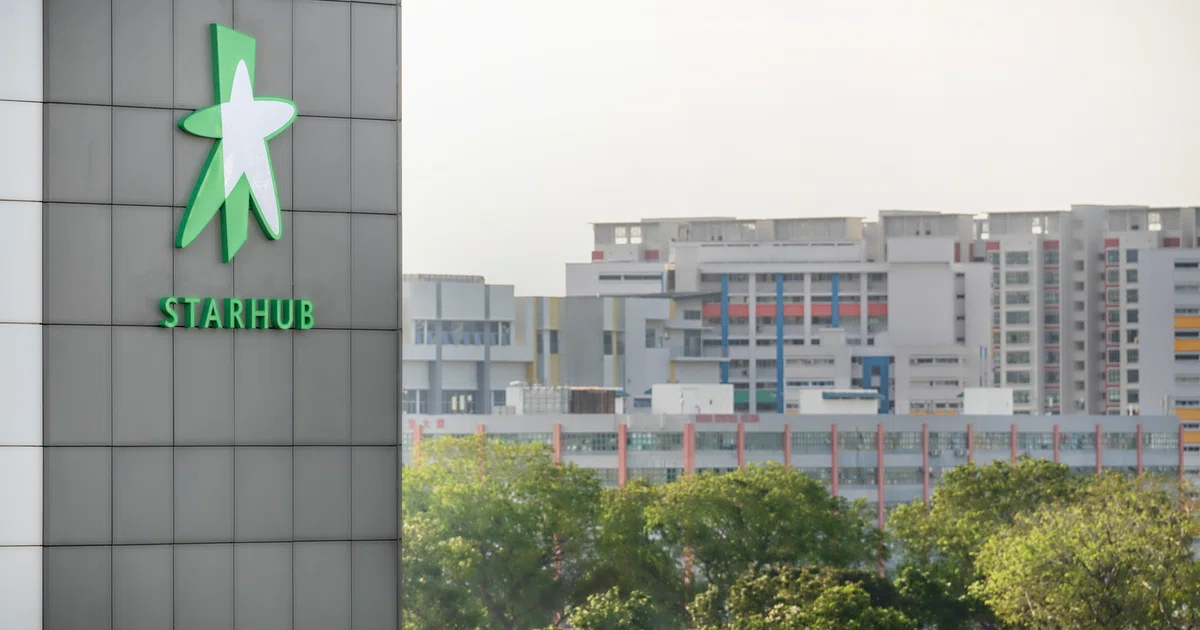
[SINGAPORE] StarHub has purchased the rest of MyRepublic’s broadband business that it did not already own for a consideration of S$105.2 million, the telco said on Tuesday (Aug 12).
On Monday, its wholly owned subsidiary StarHub Online entered into a sale and purchase agreement to acquire a 49.9 per cent stake in MyRepublic Broadband. As the transaction was completed on Monday, MyRepublic Broadband is now a wholly owned subsidiary of StarHub.
This comes as the years-long speculation of StarHub acquiring M1 was quashed after Keppel on Monday announced the proposed sale of its telco business to Simba Telecom.
An RHB analyst described the deal as a “pre-emptive move by StarHub to circumvent competitive manoeuvres following Simba’s acquisition of M1”.
“The StarHub-MyRepublic deal gives StarHub full brand ownership and oversight of MyRepublic,” the analyst added.
At 10.46 am, StarHub shares rose to an intraday high of S$1.19, up 2.6 per cent or S$0.03, with some 1.8 million shares changing hands. The counter later closed Tuesday at S$1.18, up by S$0.02 or 1.7 per cent, with 4.6 million shares transacted.
BT in your inbox
Start and end each day with the latest news stories and analyses delivered straight to your inbox.
In a statement on Tuesday, StarHub said that the acquisition would reinforce its leadership in Singapore’s broadband market.
“The acquisition allows StarHub to assume full ownership of MyRepublic Broadband, enabling greater strategic alignment. It also secures the brand equity in Singapore as well as operational assets integral to MyRepublic Broadband’s operations,” the telco said.
Nikhil Eapen, chief executive of StarHub, said: “We’ve laid a strong foundation for growth and with MyRepublic Broadband fully under our wing, we can move faster, go further, and serve customers with even greater clarity and care.”
Eapen, who has been CEO since January 2021, noted that StarHub is moving into its next phase of consolidation as the broadband landscape in Singapore undergoes change.
“We’re in a phase of consolidation and we’re not just watching it unfold, we’re shaping it. As the market shifts, scale, quality and resilience matter more than ever. Smaller players may find it harder to sustain, especially without robust platforms,” he said.
The acquisition’s S$105.2 million consideration comprises a S$94.3 million sale share consideration and a S$10.9 million sale asset consideration.
On a pro forma basis, assuming the transaction was completed on Jan 1, 2024, it would have brought StarHub’s earnings per share from S$0.089 to S$0.091, and its net profit from S$152.7 million to S$156.3 million, the telco said.
StarHub in March 2022 received regulatory approval from the Infocomm Media Development Authority (IMDA) to acquire a 50.1 per cent stake in MyRepublic’s broadband unit.
IMDA said then that the proposed move could result in a horizontal consolidation as both companies compete in public Internet access services, Internet protocol telephony services and managed data network services.
Business as usual
Maybank analyst Hussaini Saifee, noting that MyRepublic Broadband is already consolidated within the StarHub business, said: “I don’t see any change in competitive dynamic on the back of this announcement.”
He added that StarHub had to complete this deal at some point in time.
The RHB analyst, in response to Eapen’s comments about smaller players finding it hard to sustain, said: “Scale is essential in a crowded market like Singapore.” The analyst emphasised that further mergers and acquisitions cannot be ruled out.
Hussaini argued that both the StarHub transaction and Simba-M1 merger would not have major bearings on smaller players, noting that the underlying infrastructure for broadband is provided by NetLink Trust.
Positive outlook for industry
Analysts believe that StarHub’s consolidation with MyRepublic, coupled with Simba’s acquisition of M1, will lead to price rationalism within the telco industry.
Hussaini said that the intense broadband competition, which was triggered by Simba’s aggressive plans, will ease.
He also noted that current pricing plans in Singapore, which include those at S$7 to S$8 offering 200 to 300 gigabytes of data with roaming, is unsustainable.
“There could be some competitive skirmishes in the lead-up to consolidation closure or maybe just after that. But the medium-term trajectory is for competition to stabilise or improve,” Hussaini added.
Similarly, the RHB analyst believes that telcos will now experience “sustainable growth and yield, with improving cash flows”. The analyst added that the market dynamics may see the effects of the consolidation flow through over time.