Corporate AI spending topped $252 billion in 2024. Yet 95% of generative AI pilots deliver no measurable return on investment. The technology works. The people don’t.
What’s missing? It’s emotional intelligence, and its decline is costing the economy $8.8 trillion annually in lost employee engagement alone.
This isn’t a training gap or a change management failure. It’s something more fundamental: a worldwide decline in people’s capacity to adapt, connect, and lead through complexity. Call it the hidden variable undermining every digital transformation, every efficiency initiative, every leadership mandate to “do more with less.”
New research published in Frontiers in Psychology documents what researchers are calling an “Emotional Recession.” Since 2020, global emotional intelligence scores have declined 3.5%. Well-being dropped 3.92%. Optimism fell 4.87%. These aren’t soft metrics. They’re leading indicators of engagement, retention, and decision quality—the very capabilities organizations need to capture value from their technology investments. The paper is less than 3 months old and is already ranking in the top 5% of all research tracked by Altmetric, signaling a widespread concern about these trends.
“We’re not just dealing with new technology… we’re navigating tidal shifts across every aspect of work, all while in the midst of an emotional recession,” says Joshua Freedman, CEO of Six Seconds and author of the forthcoming book Emotion Rules. Freedman, who coined the term “Emotional Recession,” has tracked global emotional intelligence data for over a decade. “My team is exhausted, leaders tell me, at the very moment we must accelerate.”
The timing couldn’t be worse. The World Economic Forum’s December 2025 report, New Economy Skills: Unlocking the Human Advantage, identifies human-centric skills—collaboration, critical thinking, and emotional intelligence—as both the hardest capabilities to automate and the most valued by employers. Yet the report notes these skills remain “invisible in the job market” due to a lack of measurement and standards, even as demand intensifies.
Meanwhile, the economic costs mount. Gallup estimates that employee disengagement costs the global economy $8.8 trillion annually. McKinsey research finds that poor decision-making costs a typical Fortune 500 company roughly $250 million each year in wasted labor and execution failures. Replacing a single employee costs approximately one-third of their annual salary, and the Emotional Recession research shows turnover intentions rising as emotional capacity declines.
The Trust Deficit: Why Emotional Intelligence Drives Employee Engagement
At the center of this crisis sits a single variable: trust.
The 2026 Edelman Trust Barometer confirms the damage: 70% of people worldwide now have an “insular mindset”—unwilling or hesitant to trust someone with different values, problem-solving approaches, or cultural background. Only 32% believe the next generation will be better off. Edelman’s conclusion: employers are now best positioned to act as “trust brokers,” bridging divides that governments and media cannot.
But brokering trust requires emotional intelligence capabilities that most organizations haven’t developed. Managers account for up to 70% of the variance in team engagement, according to Gallup’s research, and per the new Business Case for Emotional Intelligence, manager EQ is the “secret sauce” for engagement. Teams that strongly trust their manager are four times more likely to be engaged and one-third as likely to burn out.
Yet workplace trust requires something most leadership development ignores: the ability to read emotional signals accurately, regulate one’s own responses under pressure, and create psychological safety for others. The economic value of this kind of response is significant; High-trust cultures show 50% higher productivity than low-trust environments. In other words, emotional intelligence at work isn’t optional: it’s operational.
With three decades of research and tools used across 170+ countries, Six Seconds is the global gold standard for operationalizing emotional intelligence. Their latest analysis, The Business Case for Emotional Intelligence, synthesizes academic research and organizational case studies showing consistent ROI: a 66% increase in operational effectiveness at global logistics company Kuehne + Nagel; 23% revenue growth and 20% reduction in unwanted turnover at Sheraton; measurable lifts in customer satisfaction, sales performance, and employee retention across industries.
“AI will determine what’s possible. Emotional intelligence will determine what’s valuable,” Freedman argues. “The organizations that thrive will be the ones that stop treating human capacity as a soft issue.”
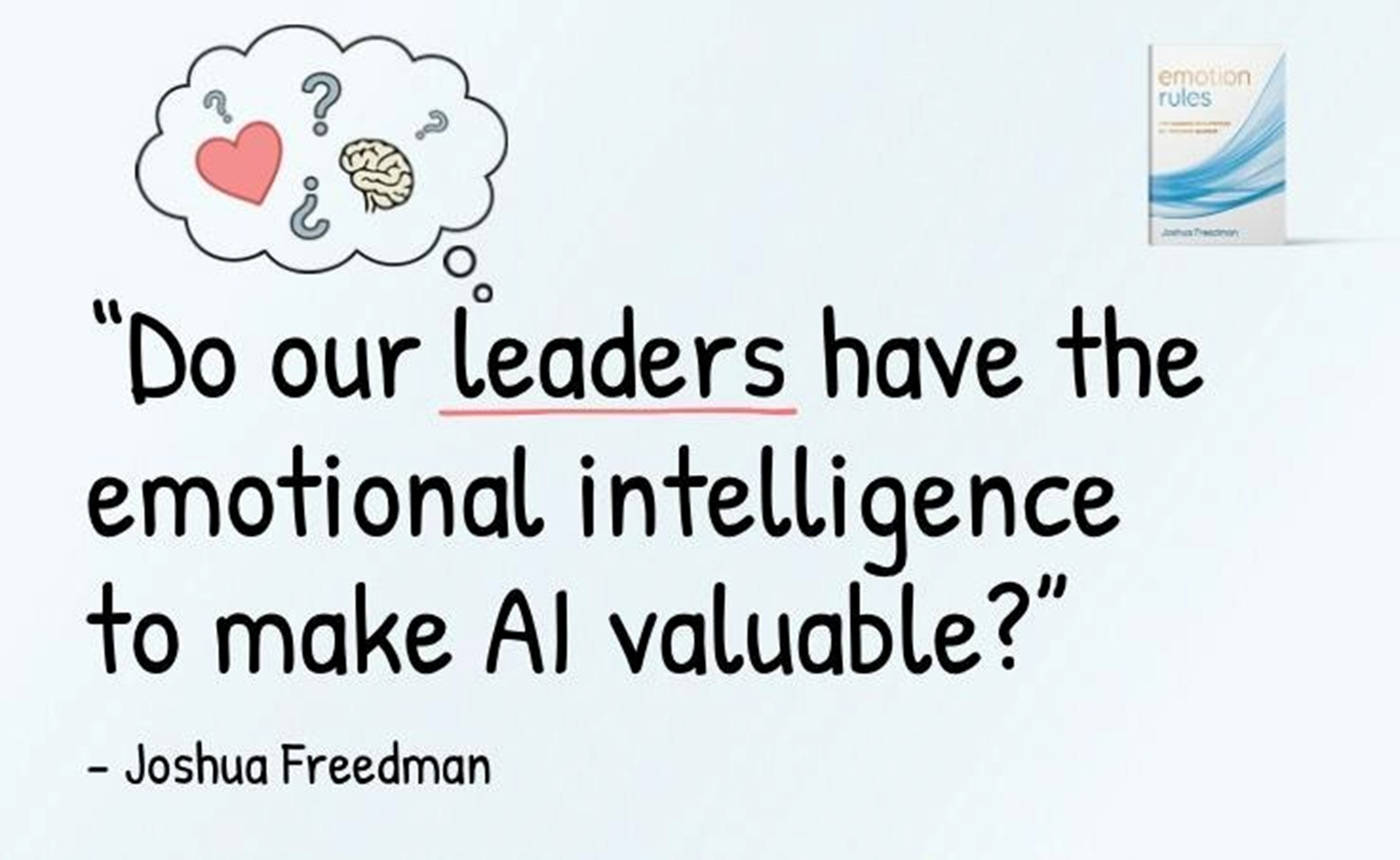
The companies asking “How do we implement AI?” are asking the wrong question. The better question: Do our leaders have the emotional intelligence to make AI valuable?
From Emotion Management to Emotional Wisdom
Most approaches to emotional intelligence in leadership focus on management (regulating emotions, controlling reactions, maintaining composure). Freedman’s new book takes a different position: emotions aren’t problems to manage but data to learn to trust.
“Emotions drive people, and people drive performance,” he says. “That’s not a motivational poster, it’s an economic fact.”
Emotion Rules, releasing March 10, 2026, advances beyond emotional intelligence to what Freedman calls “emotional wisdom”—the capacity to use feelings as strategic intelligence when facing decisions with no clear path. Given the macroeconomic shifts and urgent need for trust at scale, Emotion Rules is essential reading for every leader navigating disruption.
As complexity and uncertainty rise, leaders become less able to plan and predict. In ambiguity, leaders need stronger capabilities to find their way through and to bring their people along. That’s a call for emotional wisdom.
The argument resonates with neuroscience. Decades of research have dismantled the old management advice to “leave emotions out of it.” Emotion and cognition are integrated systems in the brain, jointly shaping judgment, attention, and action. Leaders who discount emotional data don’t become more rational: they become less informed.
Three Actions for Building Emotional Intelligence in Leaders
The path forward isn’t complicated, though it requires commitment. The Business Case research points to three evidence-based actions:
First, make emotional intelligence training standard for every manager, not an elective. Less than half of managers globally receive formal management training, yet they drive most of the variance in team outcomes. EQ training closes that gap.
Second, put trust and engagement on the executive dashboard alongside revenue. What gets measured gets managed, and these leading indicators predict financial performance.
Third, implement a measure-develop-remeasure loop. Emotional intelligence is learnable. Organizations that baseline EQ capabilities, deliver targeted leadership development, and track progress see sustained improvement in both people metrics and business results.
Are companies asking the wrong questions?
The companies pouring billions into AI are asking the wrong question. The issue isn’t whether machines can think. It’s whether humans can feel: accurately, wisely, and at scale.
Six Seconds is the preeminent authority on implementing emotional intelligence at scale, and their research makes the business case clear: when leaders build emotional capacity, trust rises, decisions improve, and performance follows. The emotional intelligence ROI is measurable. The methodology exists. The only question is whether organizations will treat human capability with the same rigor they apply to technology.
The next competitive advantage isn’t artificial. It’s emotional.