


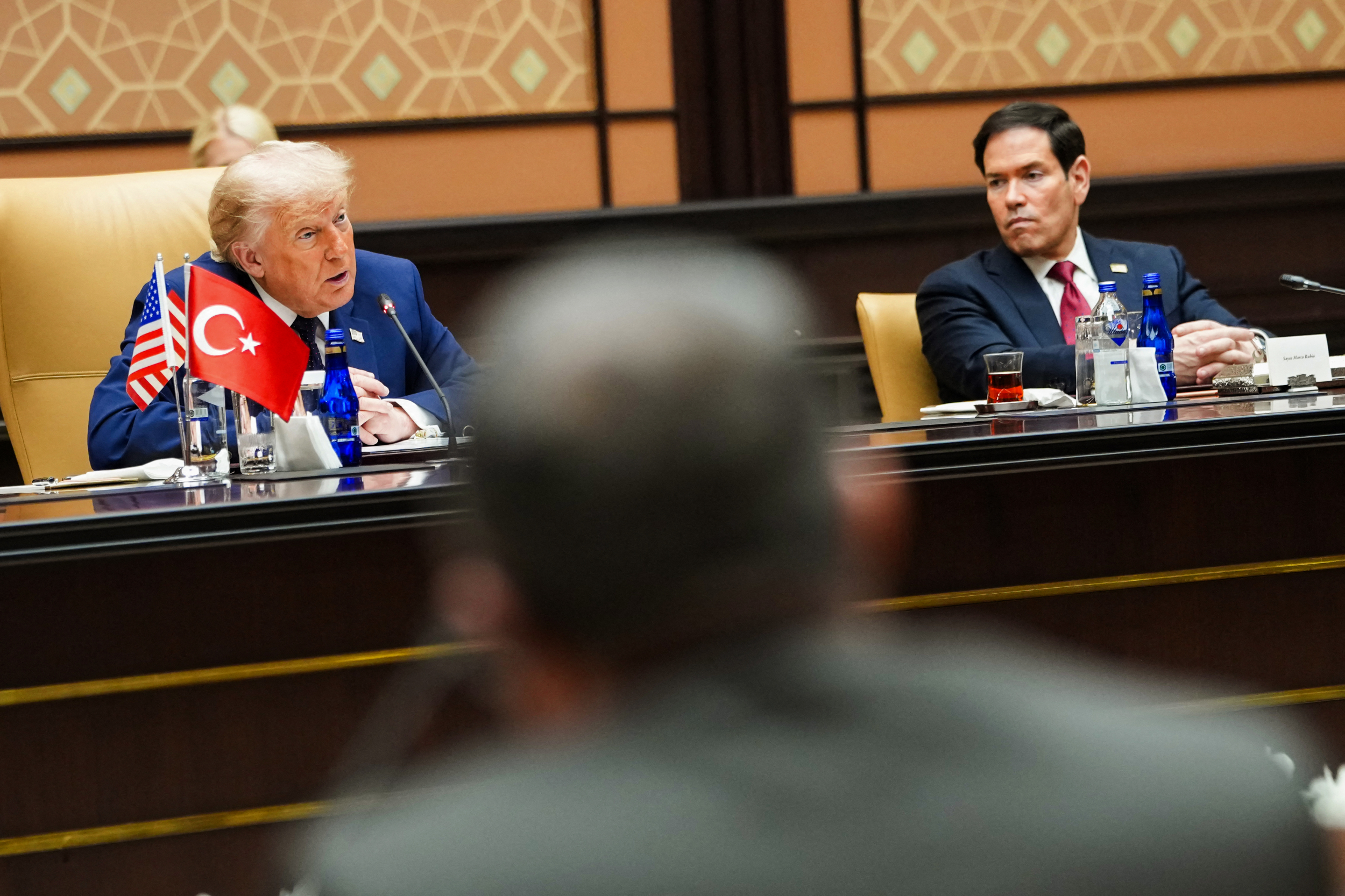
NATO sought to showcase its military strength on Tuesday by unveiling a series of major defense initiatives as President Donald Trump arrived in Ankara for the alliance’s annual summit, where he also announced plans to lift U.S. sanctions on Turkey, potentially paving the way for Ankara’s return to the F-35 fighter jet program.
The announcements came as the alliance tries to demonstrate that Europe is increasing its defense capabilities following years of criticism from Trump, who has repeatedly argued that NATO allies rely too heavily on the United States for their security.
Speaking alongside Turkish President Recep Tayyip Erdogan at the presidential palace, Trump said his administration would remove sanctions imposed under the Countering America’s Adversaries Through Sanctions Act (CAATSA), which were enacted after Turkey purchased Russia’s S-400 missile defense system.
The acquisition led to Turkey’s removal from the multinational F-35 program in 2019.”We’re going to be taking the sanctions off,” Trump said, adding that members of his Cabinet were already working on the process. He also said the possibility of selling F-35 fighter jets to Turkey is “certainly something we will consider.”
The two leaders emphasized their close personal relationship during the meeting. Erdogan welcomed Trump with an elaborate military ceremony featuring mounted honor guards, ceremonial cannon fire and fighter jets trailing red, white and blue smoke.
Trump praised Turkey’s role as a NATO ally, particularly during the recent conflict involving Iran, and reiterated that his relationship with Erdogan was one of the main reasons he chose to attend this year’s summit.
Earlier Tuesday, NATO Secretary-General Mark Rutte unveiled several multinational defense initiatives designed to modernize the alliance’s military capabilities, calling them “money well spent.” During a high-profile defense industry forum described by NATO as its “big reveal,” Rutte announced new cooperative procurement projects involving surveillance aircraft, drones, and aerial refueling capabilities.
Among the largest announcements was an agreement for Swedish defense company Saab to provide up to 10 GlobalEye airborne surveillance aircraft for a consortium of 10 NATO countries. Swedish Prime Minister Ulf Kristersson described the deal as a milestone for European defense manufacturing.”It is a moment of great pride,” Kristersson said, noting that the aircraft would be produced within NATO for alliance members.
NATO also confirmed plans for a four-country effort to purchase up to five additional Triton surveillance drones, expanding the alliance’s relatively small fleet of intelligence-gathering aircraft. In another multinational agreement, representatives from 15 countries announced plans to jointly acquire Airbus air-to-air refueling and military transport aircraft, further strengthening NATO’s logistical capabilities.
Some of the projects are expected to receive financing through the European Union’s defense lending initiative, which could mobilize up to $170 billion in low-cost financing for military investments.”We need to ensure that we are translating our economic might into military capabilities, putting the cash to work from defense plans to drones, from money to missiles and interceptors,” Rutte said.
Although Rutte promised ahead of the summit that NATO would unveil “tens of billions” of dollars in contracts, no total financial value was disclosed during Tuesday’s presentations, and some of the initiatives had already been announced previously.
The defense showcase comes as the Pentagon promotes what officials describe as “NATO 3.0,” a strategy that encourages European allies to shoulder more responsibility for their own defense while allowing the United States to focus more heavily on challenges in the Indo-Pacific.
“The reality is that we need production increases across the board,” U.S. Undersecretary of Defense Michael Duffy said during the event. He added that Washington intends both to expand arms exports and work with European partners to increase production capacity.
Despite the announcements, Trump maintained his longstanding criticism of the alliance, saying he remained disappointed that several NATO members declined to participate in the recent military campaign against Iran.
“We don’t need their money. We don’t need anything,” Trump said. “I just want loyalty.” Trump’s comments about restoring Turkey’s access to advanced U.S. fighter aircraft immediately sparked renewed debate. Israeli Prime Minister Benjamin Netanyahu publicly urged Washington not to approve F-35 sales to Turkey, arguing that such a move could undermine Israel’s military superiority in the Middle East amid continuing tensions between Ankara and Jerusalem over the war in Gaza.
Meanwhile, Ukrainian President Volodymyr Zelenskyy used the summit to renew his country’s request for NATO membership, arguing that Ukraine’s battle-tested armed forces would significantly strengthen the alliance as concerns grow across Europe over the possibility of future Russian hybrid attacks.
