Published Sat, Jan 31, 2026 · 07:31 AM
[NEW YORK] Wall Street’s main indexes closed lower on Friday (Jan 30) as investors viewed US President Donald Trump’s nomination of former Federal Reserve governor Kevin Warsh as a hawkish choice to succeed US Federal Reserve chair Jerome Powell, while also digesting earnings reports and a high inflation reading.
On top of assessing the risks from US tensions with countries including Iran, investors were also worried about the prospect of another US government shutdown after new barriers emerged in the Senate to a deal that would ensure continuation of funding for agency operations.
At the Fed, Warsh, 55, is expected to favour lower interest rates but stop short of the more aggressive monetary easing linked to some other potential nominees. With Powell’s term ending in May, Warsh, if confirmed by the Senate, would take the helm of a central bank he has argued should scale back its role in the economy and rethink its approach to monetary policy.
“Markets are calibrating to Trump’s pick of Kevin Warsh … and the outlook for monetary policy,” said Michael Hans, chief investment officer at Citizens Wealth, who also pointed to an unwinding of recent trading patterns with the US dollar gaining ground on Friday and precious metals selling off sharply.
Meanwhile, in earnings, Apple shares regained ground to close up 0.4 per cent after earlier losses a day after the iPhone maker released quarterly results. On the data front, producer prices increased more than expected in December, suggesting inflation could pick up in the months ahead.
“There’s a combination of investor concerns around the Fed chair announcement, some mixed tech earnings and lingering inflation pressure as well as some uncertainty about a potential government shutdown even though it should be short-lived,” said Angelo Kourkafas, senior global strategist at Edward Jones.
Navigate Asia in
a new global order
Get the insights delivered to your inbox.
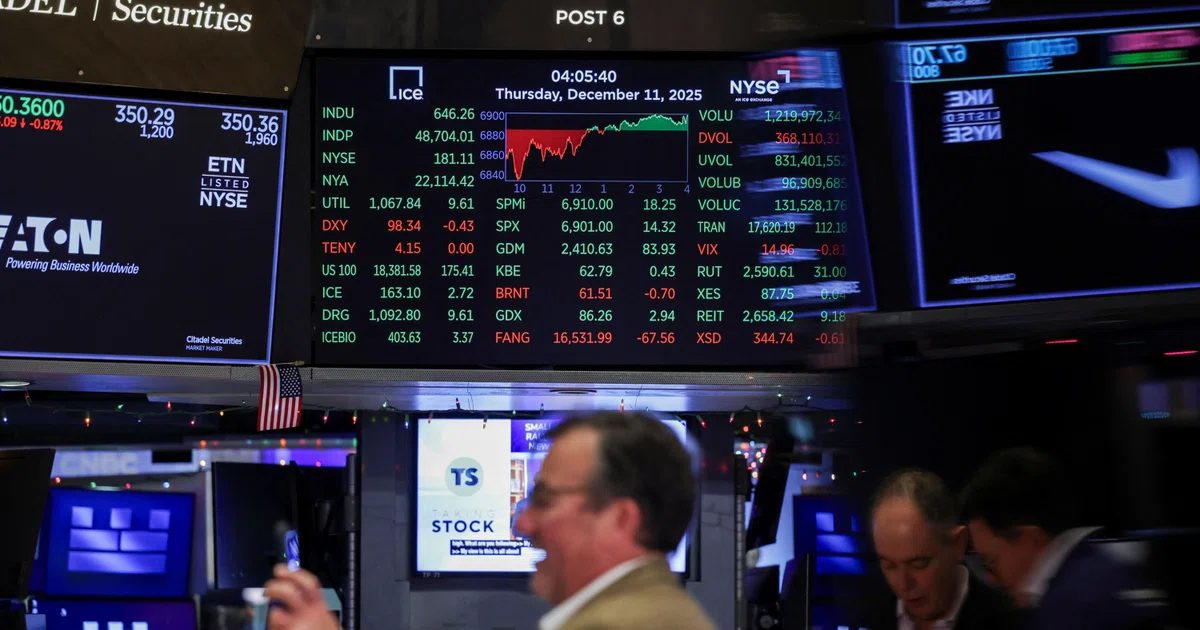
The Dow Jones Industrial Average fell 179.09 points, or 0.36 per cent, to 48,892.47, the S&P 500 lost 29.98 points, or 0.43 per cent, to 6,939.03 and the Nasdaq Composite lost 223.30 points, or 0.94 per cent, to 23,461.82.
The rate-sensitive, small-cap Russell 2000 index has recently been outperforming large-cap indexes but on Friday it lagged with a 1.6 per cent loss for the day.
But the Russell 2000 ended the month up more than 5 per cent, compared with monthly advances of 1.4 per cent for the S&P 500 and 0.9 per cent for the Nasdaq. The Dow, meanwhile, climbed 1.7 per cent for January, to notch a ninth consecutive monthly advance, its longest winning streak since 2018.
For the week, the S&P 500 rose 0.3 per cent, the Dow fell 0.4 per cent and the Nasdaq fell 0.2 per cent. The S&P’s Materials index led declines among the S&P 500’s 11 major industry sectors, with a 1.9 per cent loss, as US-listed gold and silver miners tumbled in sympathy with the massive sell-off in gold prices and in silver. Defensive consumer staples was the sector with the biggest advance on the day, rising 1.4 per cent.
Colgate-Palmolive was its biggest gainer, closing up 5.9 per cent, after the maker of toothpaste and soap forecast annual sales above Wall Street estimates on steady demand for household staples in markets such as Latin America and Europe.
Investors have given a mixed reception to megacap earnings reports this week with a stark warning that record capital-spending binges will be tolerated as long as the growth keeps coming.
Apple wrapped up the week with a forecast of higher-than-expected revenue growth of up to 16 per cent for the March quarter, but warned that rising memory-chip prices had started to pressure profitability.
Microsoft ended down 0.7 per cent on Friday after falling 10 per cent on Thursday for its deepest daily loss since March 2020 after its cloud revenue failed to impress. Meta shares closed 3 per cent lower on Friday.
After falling on Thursday following its results, Tesla shares rose 3.3 per cent on Friday, providing the S&P 500 with its biggest boost, after reports that SpaceX is exploring deals with the electric-vehicle maker and other companies run by Elon Musk.
Verizon Communications was the S&P 500’s second-biggest boost, finishing up 11.8 per cent after it forecast annual profit and free cash flow above market expectations on Friday, after aggressive promotions during the peak holiday period fuelled its highest quarterly wireless subscriber additions in six years.
SanDisk shares rallied 6.9 per cent after a better-than-expected third-quarter forecast as AI fuels storage demand. But KLA shares tumbled 15.2 per cent even after the company beat Wall Street expectations for second-quarter profit and revenue.
Declining issues outnumbered advancers by a 1.59-to-1 ratio on the NYSE where there were 247 new highs and 154 new lows. On the Nasdaq, 1,599 stocks rose and 3,222 fell as declining issues outnumbered advancers by a 2.02-to-1 ratio.
The S&P 500 posted 19 new 52-week highs and 10 new lows while the Nasdaq Composite recorded 72 new highs and 205 new lows.
On US exchanges, 23.88 billion shares changed hands compared with the 19.42 billion moving average for the last 20 trading sessions. REUTERS
Decoding Asia newsletter: your guide to navigating Asia in a new global order. Sign up here to get Decoding Asia newsletter. Delivered to your inbox. Free.