


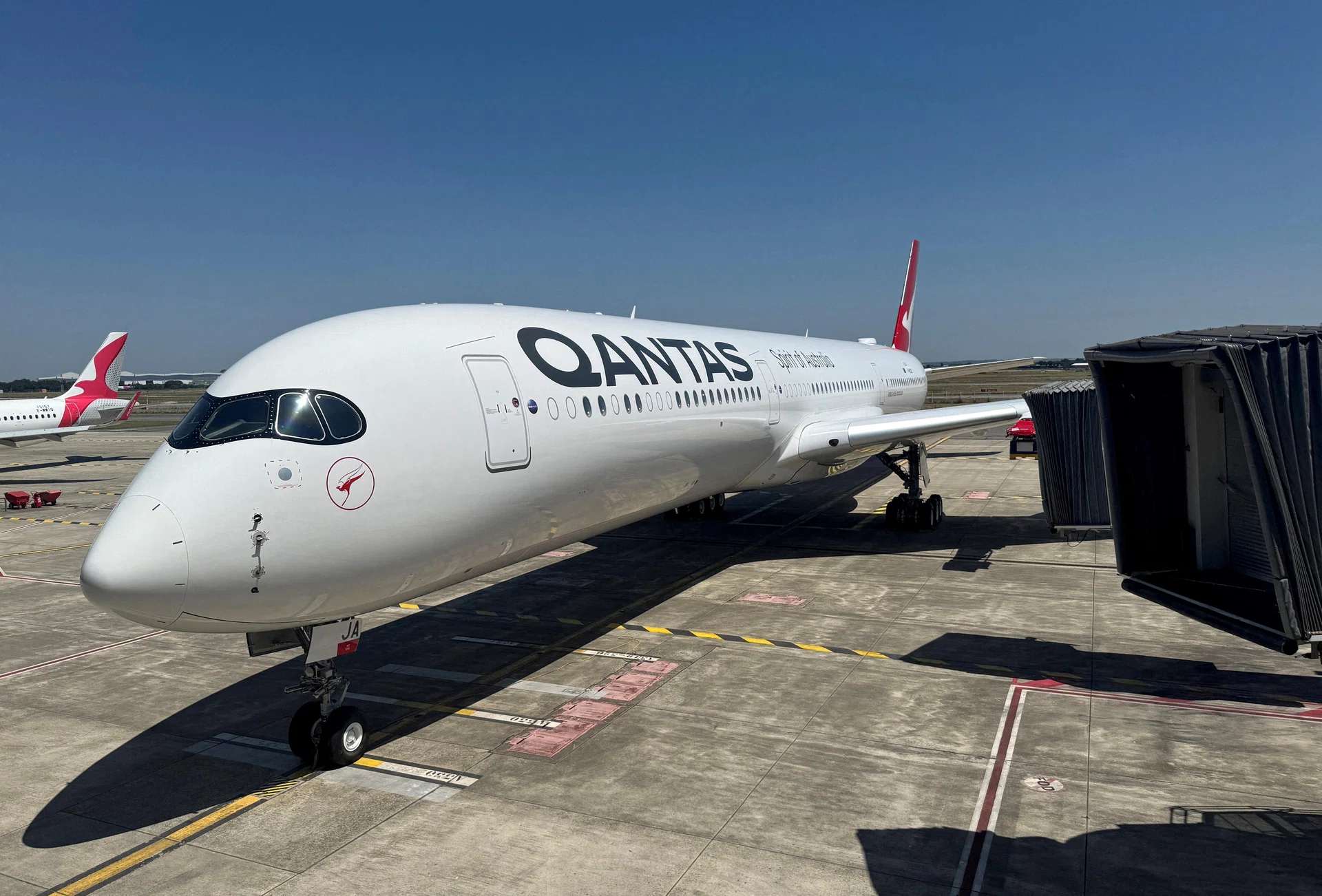
Airbus has modified the A350-1000 so it can fly the approximate 17,000 km between Sydney and London
Published Sun, Jun 21, 2026 · 10:16 AM
FOR anyone choosing to bend time and space on a nonstop flight between Sydney and London, Qantas Airways has a whole range of travel hacks in store to beat the inevitable fatigue.
The modified Airbus SE A350-1000 holds more premium seats than raw economy, with the airline assuming people will splurge to make that almost 20-hour adventure more endurable.
For those in coach, there is hope yet. Qantas has carved out an in-cabin wellness zone – equivalent in size to several rows of seats – where passengers can walk around, stretch or commiserate with fellow travellers.
The Australian carrier recently showcased the cabin concept in Toulouse, southern France, where planemaker Airbus is assembling the dozen-jet fleet that will let Qantas break the limits of nonstop connections. It is an exercise in endurance not only for passengers, but also for the airline, which started conceptualising the route a decade ago and now plans to finally connect the two cities beginning in 2027.
“We have studied the impact of long-haul travel on the body, the impact of jet lag on the body,” Qantas chief executive officer Vanessa Hudson said in Toulouse on Jun 17. “We’ve absolutely got data that we have incorporated into our service and experience that make a difference.”
The longest direct flight now is about 19 hours from Singapore to New York, operated by Singapore Airlines. Qantas’ custom planes can fly three more hours than that, helped by an extra fuel tank and the specially configured cabin with smaller capacity than a standard A350-1000, Airbus’ largest aircraft.
Interior lighting will be programmed to regulate sleep cycles – mimicking sunset and sunrise; meals are served based on the destination time zone; and passengers will be guided through stretching and movement routines designed in consultation with sleep scientists from the University of Sydney.
The effort represents the culmination of Project Sunrise, which began in 2017 when Qantas challenged Airbus and Boeing to make a jet that can handle the lengthy distance without a layover. Australia’s remoteness has long made it one of the most difficult aviation markets to connect directly with Europe or the US.
For decades, travellers accepted that flying between London and the eastern part of the continent was a two-leg journey. Qantas’ current London service stops in Singapore and takes about 23 hours.
SEE ALSO

Advances in aircraft efficiency are changing that equation. Airbus modified the A350-1000 so it can fly the approximate 17,000 km between Sydney and London. The plane eventually will be deployed for service with New York.
The airline’s pursuit of ultra-long-haul flying involved more than engineering. During a series of research flights, Qantas carried scientists, observers and volunteers to monitor everything from sleep quality and hydration levels to reaction times and alertness.
“It’s not something that we’ve just started recently,” Hudson said.
The findings helped shape the cabin design. The wellness zone, located between the premium economy and economy cabins, includes support bars, guided exercise displays and room for as many as eight passengers to move around.
The promise of a nonstop trip means Qantas can charge about 20 per cent more. Capacity will be about 238 seats, significantly fewer than a conventional A350-1000. The Sydney-based airline has ordered 12 of the ultra-long-range model, with deliveries finishing in 2029.
About 40 per cent of seats are allocated to premium cabins, including six first-class suites, 52 business seats and 40 premium-economy seats.
For corporate customers, the value proposition is straightforward: spend less time in transit and arrive at the destination without losing hours navigating a connecting airport. For leisure travellers, the appeal may be avoiding the hassle of breaking up a journey midway.
Still, ultra-long-haul flying remains a challenging business. Carrying enough fuel to go almost halfway around the world increases operating costs and limits cargo payloads – a growing business for airlines.
Qantas is betting that convenience will outweigh those constraints. The 105-year-old carrier already operates some of the world’s longest flights, including Perth to London and Sydney to Dallas. Those routes have consistently attracted travellers willing to pay a premium for a nonstop option. BLOOMBERG
