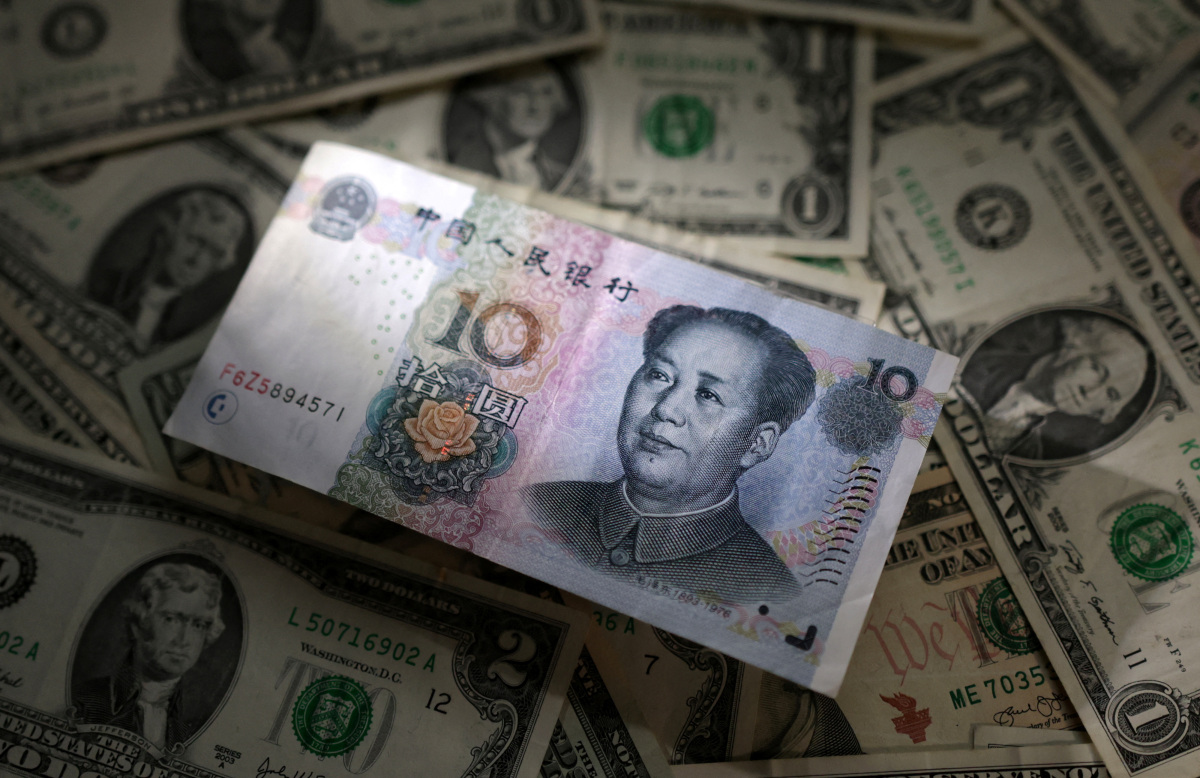
China may be the world’s second-largest economy. But its currency, the yuan, is collapsing against the dollar. It recently traded at 7.35 yuan to the dollar, a 16-year low, prompting the country’s central bank to crack down on “excessive speculation” that distorts the value of its currency.
The rapid depreciation of the Chinese currency sounds like a paradox. China is still a significant exporter of manufacturing goods with a trade surplus, creating a strong demand for its currency.
That should mean stronger, not weaker, yuan.
Things are more complex in currency markets, where many factors come into play.
One of them is expectations. Currency traders and investors place their bets not on what China’s exports and trade surplus have been but on where they are heading, down.
For instance, last week’s yuan decline came on the heels of data showing that China’s trade surplus narrowed in August as exports declined, meaning a weaker demand ahead for the yuan to pay for these exports.
Another factor that moves currencies is the interest rate spread, the difference between China’s and U.S. interest rates. It determines the direction of capital flows between the two countries.
Currency investors and traders go long on the currency of countries that raise interest rates and short on the currencies that lower interest rates, which is the case here.
In recent months, interest rates have been rising in the U.S. and falling in China.
Thanks to the U.S. economy’s resilience and the Chinese economy’s weakening, the two countries’ central banks pursued opposite monetary policies. The Federal Reserve has been tightening, while the Peoples Bank of China (PBOC) has been easing.
Thus, capital is leaving the yuan for the dollar, adding downward pressure on the yuan.
“The weakness in China’s currency reflects sluggish growth in the country’s economy, divergent trends in the U.S. and Chinese central bank policy and the problem posed by the impossible trinity,” Paul Kutasovic, professor of international finance at the New York Institute of Technology, told International Business Times. “The trade data released on Thursday provided further evidence that the world’s second-largest economy is struggling to spur growth. Exports declined for the fourth month while imports continued to fall in August, indicating lackluster domestic demand.”
Michael Ashley Schulman, CFA, sees China’s economic woes spreading beyond exports.
“Sentiment regarding China’s economy has taken a notably negative turn because of structural concerns,” he told IBT. “Like mounting debt, inability to re-emerge from pandemic slowdowns, major real estate bankruptcies, an aging population, high youth unemployment and China’s increasingly strained relations with Western countries. China was initially expected to drive a third of global economic growth this year, making its recent sharp slowdown a cause for international concern.”
Still, the decline in Chinese equities is ending in capital flight from China as foreign investors cash out from Chinese stocks.
“International investors have already withdrawn over $10 billion from China’s stock markets, primarily targeting blue-chip names,” added Schulman. “Projections for Chinese equities are lower, and many international and multinational companies that operate in China are gearing for reduced revenue growth and lowering 2023 year-end projections.”
Kutasovic provides further insight into how the rising interest rate spread between the U.S. and the Japanese rates has contributed to the yuan’s woes.
“The Fed has pushed up short-term rates in the U.S. to the highest level in more than two decades,” he said. “In contrast, the PBOC has eased policy and cut key rates last month. In implementing its policy, the PBOC faces the classic problem of the impossible trinity. The issue is that it is nearly impossible to stabilize the exchange rate while at the same time preventing capital outflows and maintaining an independent monetary policy.”
He thinks that due to this trilemma, the PBOC will likely let the yuan further depreciate gradually over the near term, making China’s exports even more competitive.
Moreover, he thinks the big winners from the yuan’s weakness are the U.S. consumer and the Federal Reserve.
“Weakness in the yuan makes Chinese goods cheaper for U.S. consumers and exports disinflationary forces globally,” Kutasovic added. “These disinflationary forces may help the Fed achieve its inflationary target.”