


Key takeaways
- Thieves took most of the 3,000-year-old Villena Treasure from a Spanish museum in about four minutes on August 27.
- It was the third Spanish museum robbed of gold or coins in 2026, after Badajoz in April and Albacete in July.
- Europol and researchers say raiders increasingly melt stolen gold antiquities for their metal value rather than trying to sell them intact.
On August 27, an alarm sounded at 5:20 a.m. inside MUVI, the municipal archaeological museum in Villena, Spain. By 5:24 a.m., masked thieves had broken in through a side window, smashed display cases and left with most of the gold in the Villena Treasure, one of Europe’s most important Bronze Age hoards.
It was the third robbery of a Spanish museum’s precious-metal collection in four months. As of mid-September, Spain’s Guardia Civil had made no arrests and recovered nothing but a single crown the thieves dropped as they fled.
What the Thieves Took, and What They Left
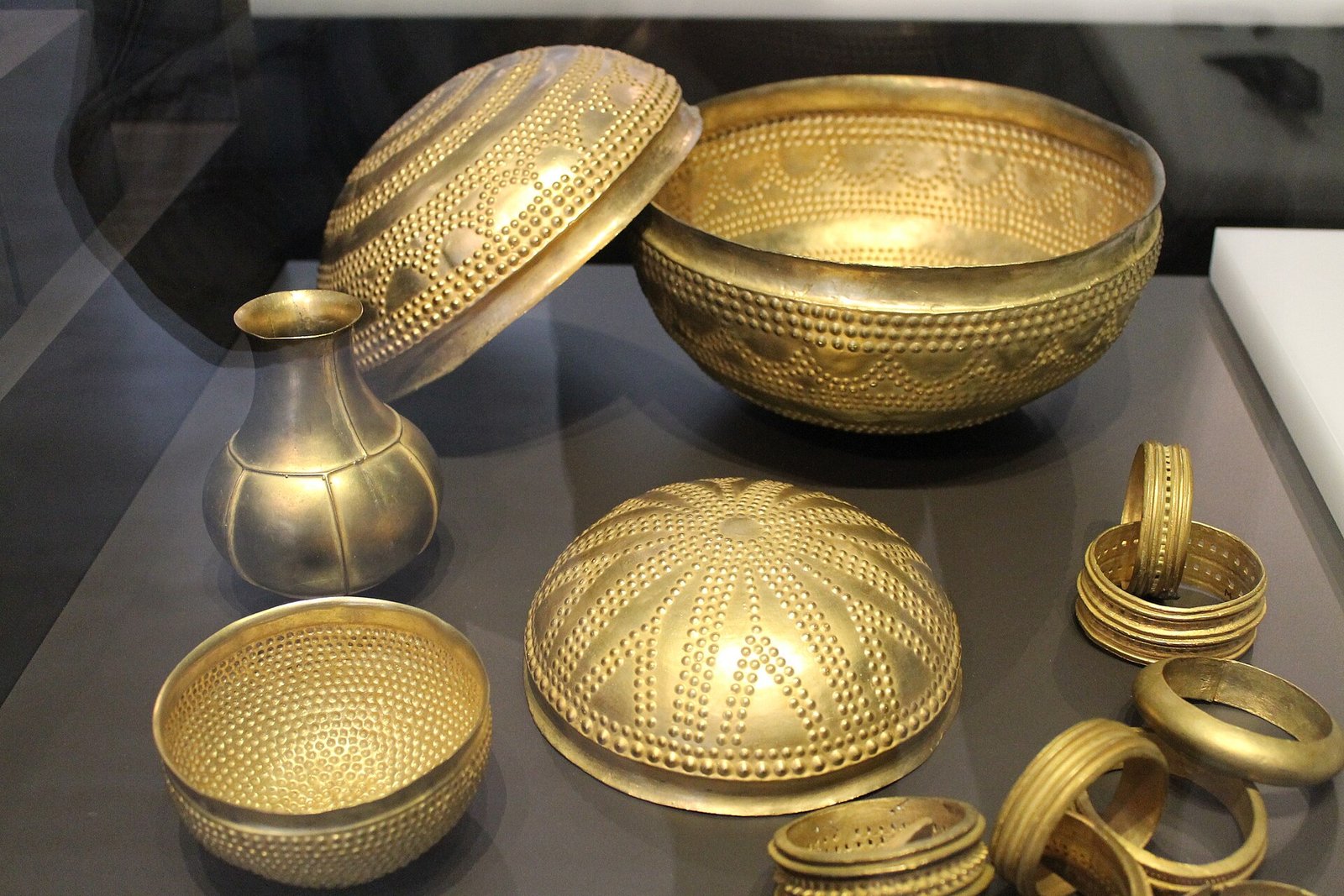
According to an inventory published by the Association for Research into Crimes against Art (ARCA), the thieves took 27 of the collection’s 28 gold bracelets, all 11 gold bowls, and two of its gold bottles, weighing roughly 381 grams combined. Three silver bottles from the same case were left untouched. They also took three of four gold-and-silver crowns belonging to the Virgen de las Virtudes, the town’s patron saint, and the Christ Child; the fourth, the Child’s crown, fell during the escape and was recovered in a museum corridor.
Left behind were three silver flasks, a bracelet believed to include meteoritic iron, fragments of a ceremonial staff known as the Bastón del Reyezuelo, and two other holdings displayed nearby: the 35-piece Tesorillo de Cabezo Redondo and the Arracada de la Condomina. News outlets describe the size of the full collection differently — CBS put it at “50-plus” objects, while ARCA and Wikipedia count 59 gold, silver, iron and amber objects made up of 66 individually catalogued components, weighing nearly 10 kilograms in total — but none gives an exact count of how many objects the thieves removed.
The hoard was discovered in December 1963 by archaeologist José María Soler after a gold bracelet turned up during construction work near Villena. Dated to roughly 1000 BCE, it is considered the most important prehistoric gold find on the Iberian Peninsula and, by some accounts, the second most important in Europe after the royal graves of Mycenae. Two of its iron objects are believed to be made from meteoritic iron, among the earliest documented iron use in Iberia. Estimates of the stolen gold’s raw value range from about €1.5 million to roughly $2 million depending on the outlet; ARCA’s blog noted that the pieces’ worth lies chiefly in the historical information preserved in their forms and manufacturing techniques, not their weight.
A Hoard Three Millennia in the Making
The Villena Treasure was found in December 1963 by archaeologist José María Soler and is considered the most important prehistoric gold hoard on the Iberian Peninsula, ranking behind only the royal graves of Mycenae in Europe.
A Museum Recently Upgraded
The collection had been moved into a renovated building with what one report described as a specially protected room in 2024. Municipal officials said the museum had passed required security checks before the robbery. The thieves nonetheless failed to force the main door and instead broke in through a side window; reports differ on whether the door or the window was reinforced.
Minutes before the break-in, an alarm went off at a municipal sports center about two kilometers away. Guardia Civil investigators and Valencian regional police are examining whether that alarm was a deliberate diversion, though no connection has been confirmed. Investigators are reviewing security-camera footage from before and after the raid, which showed several masked individuals and multiple vehicles.
The Third Spanish Museum Robbed for Gold This Year
Villena was not an isolated case. On April 25, the Provincial Archaeological Museum in Badajoz lost 144 of the 149 gold coins in its Villanueva Treasure, an 18th- and 19th-century collection. On July 27, four hooded men stole most of 222 gold coins from two collections at the Museo de Albacete in under two minutes: the 42-coin Calle del Horno Treasure (1775–1838) and 180 coins from Villamalea (1850–1860).
Spain’s Culture Ministry asked regional governments on August 11 for details of museums holding significant precious-metal collections, repeated the request on August 24 to regions that had not responded, and met with regional museum officials on August 28, a day after the Villena theft. The ministry said it had given the National Police information on museums it directly manages and reinforced security there, without saying which institutions were affected.
After Villena, the Museu de Mallorca moved 20 gold and silver Almohad-era coins from a temporary exhibit into its secure chamber. Its director, Maria Gracia Salvà, described the Villena loss as devastating for the archaeological community. The Valencian regional government has called for a coordinated national response, with a meeting to review museum security protocols expected in September.
Investigators increasingly describe the raiders looting Spain’s museums as after a furnace, not a buyer.
Why Thieves Melt Gold Instead of Selling It
Europol has warned of a sharp increase in museum looting driven not by art collectors but by people seeking metal to melt for quick profit, according to reporting reviewed for this article. Recent precedents support that pattern: Germany’s Bode Museum lost its “Big Maple Leaf” gold coin, the world’s largest gold coin, in 2017 and it has never been recovered, presumably melted; Blenheim Palace’s roughly $6 million gold toilet, stolen in 2019, is believed to have suffered the same fate; and 483 Celtic gold coins taken from Germany’s Manching hoard in 2022 are presumed to have been rendered into raw metal.
Gold prices have risen sharply amid global instability, an increase a British regulatory body described in terms of reaching historic levels alongside a rise in illicit flows. For antiquities that are resold rather than melted, one account of the trade describes a slower laundering path: illegal excavation, movement through free ports, and reemergence at auction with fabricated provenance. Melting bypasses that entire process, destroying evidence and archaeological context in a single step.
The United Nations Office on Drugs and Crime ranks trafficking in cultural property alongside arms and drugs among the world’s most profitable illicit trades. A single Interpol-coordinated operation across 23 countries seized more than 37,000 cultural objects in one year, according to UN News.
What Happens Next
As of September 12, the Guardia Civil’s investigation remained open, with no arrests announced and no stolen pieces recovered beyond the dropped crown. Villena’s mayor, Fulgencio Cerdán, said after the theft that the town was “absolutely devastated.”
Colombia One reported an insurance value of about $5.8 million (€5 million) for the Villena collection, though it’s unclear from public reporting whether that reflects private insurance or a municipal or state self-insurance arrangement. In France, by comparison, the state does not carry private insurance on the Louvre’s collections; when the museum’s crown jewels, valued at €88 million (about $103 million), were stolen in October 2025, the loss fell on the state rather than an insurer. Whether a similar arrangement applies to Villena’s municipally owned treasure remains unclear from public reporting so far.
Photo: VIATOR IMPERI from HISPANIA · CC BY-SA 2.0 · via Wikimedia Commons
