KEY POINTS
- India’s vision includes increasing the share of EV sales to 30% in private cars and 70% in commercial vehicles
- Electric vehicle sales for the first 11 months of 2023 have reached a record 1.4 million units
- The country still needs to address challenges like infrastructure limitations and high dependency on imports for components
The switch to electric mobility and the de-carbonizing of the transport sector are absolutely essential for India, as it moves at full-throttle to go from the fifth to the third-largest economy.
India’s electric vehicle (EV) market is at an inflection point today, demonstrating a good pace of growth. However, experts say that India still has critical challenges to overcome for a sustained future in the EV market.
To keep up with the increasing demand of EVs and to drive the transition to a green future, India is attempting to build the entire supply chain of EVs domestically. This would also help the country extend its current production prowess in the manufacture of automobiles and components to the EV segment as well.
“India has positioned itself as a significant manufacturing hub for automobiles and components, attracting global automotive companies that have established production facilities in the country. Leveraging a skilled labor force and cost-effective manufacturing processes, the Indian automotive industry is renowned for delivering affordable vehicles, especially in the small and compact car and two-wheeler segments,” Amit Bhatt, India Managing Director for the International Council on Clean Transportation, told International Business Times.
“This successful track record can be extended to electric vehicles, with India potentially offering high-quality, cost-effective EVs to the global market,” he added.
The South Asian country is currently on the upward trajectory in terms of EV adoption.
“Electric vehicle sales for the first 11 months of 2023 have reached a record 1.4 million units, marking a robust 50% year-on-year growth,” Bhatt said.
India’s automobile market is the third largest in the world, and is also a major contributor to the country’s economy, accounting for 7.1% of its GDP. Carmakers and policymakers in the country have been pushing consumers to choose greener alternatives, thus contributing to the rising demand of EVs in the country.
Both the federal government and state governments in India are also pushing EV manufacturing and adoption to help New Delhi meet the targets it hopes to achieve by 2030.
“India has a vision of increasing the share of electric vehicle (EV) sales to 30% in private cars, 70% in commercial vehicles, 40% in buses, and 80% in two- and three-wheelers by 2030. To achieve this vision, the federal and several state (provincial) governments support the growth of the electric vehicle industry through various fiscal and non-fiscal measures. Notable among these are EV and battery manufacturing incentives, vehicle purchase subsidies, waiver of road and registration taxes, and special electricity tariff and land allocation for EV charging,” Charith Konda, Energy Specialist, India Mobility and New Energy, Institute for Energy Economics and Financial Analysis, told IBT.
In order to achieve its electric mobility goals, India is also attempting to develop the entire supply chain domestically, which includes bolstering its domestic manufacturing capabilities. However, India still has a long way to go before it can reduce its heavy dependence on imports for components.
“India’s dependence on imported lithium-ion batteries for the EV industry presents challenges. The country heavily relies on imports, which drives up the cost of EV production,” Neeraj Kumar Singal, Founder and Managing Director of Semco Group (parent company of Semco Infratech that works in electric mobility), told IBT.
“EV batteries, battery management systems, and charging equipment are largely imported at present,” Konda added.
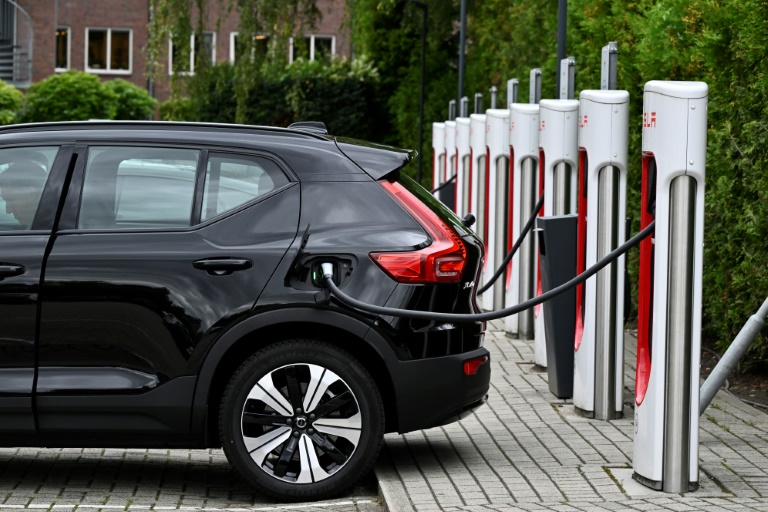
Moreover, the infrastructure for increased EV adoption, which includes setting up charging stations and battery swapping stations in India, also have not caught up yet.
“India is demonstrating a reasonable pace of growth in terms of both production and adoption of electric vehicles,” Singal said. “It would not be an exaggeration to say that the target in both of the above-mentioned terms is overachieved. Still, the picture is not so good in terms of infrastructure development.”
Singal noted that the current network was only sufficient for the existing number of EVs, while the pace of erecting new charging stations was very slow. He also noted that charging station providers were still focusing on major cities, while other markets were largely under-served.
“EV charging stations are being set up across the country with the number of operational public charging stations reaching 10,185 at an EV to charging point ratio of 171 as of September 2023. A bigger challenge is to upgrade the power distribution network to accommodate the increased load from EV charging,” Konda said.
“India’s move towards a green future with electric vehicles (EVs) entails upgrading the grid to meet increased electricity demand, integrating renewable energy for sustainable charging, establishing a robust system for recycling EV batteries, and addressing affordability through government subsidies and financing options to make EVs more accessible to consumers,” Singal added.
“Overall, India is on the right track with its EV push, but addressing infrastructure limitations is crucial for sustained growth. Collaborations between government, private players, and research institutions are essential to overcome these challenges and pave the way for a truly sustainable future with EVs,” he added.
When it comes to boosting the domestic EV-making capabilities, the Indian government has been enforcing several schemes, especially to promote cell manufacturing. One such initiative is the Production-Linked Incentive (PLI), which provides benefits to eligible companies to boost local production.
“As the adoption of electric vehicles gains traction, India must prioritize localization efforts, including the manufacturing of cells within the country. The Indian government’s Production-Linked Incentive (PLI) scheme for cell manufacturing incentivizes local production, potentially leading to the emergence of domestically manufactured EV cells,” Bhatt said. “However, as demand continues to rise, there will likely be a gradual increase in manufacturing capabilities within India to meet the growing needs of the domestic EV industry.”
Another key aspect that will determine the future of India’s EV industry is the acquisition of critical minerals required for EVs and battery storage. The global clean energy transition will have far-reaching effects on mineral demand, and India will have to enforce the right policies to establish and maintain a competitive domestic EV ecosystem.
“India is aiming for backward integration in battery manufacturing by increasing domestic exploration and production of critical minerals and is also signing up with friendly nations/regions for a secure supply of critical minerals through various global platforms,” Konda said. “India needs to develop a robust exploration and production policy for economically extracting critical minerals and building world-class refining capacities for manufacturing battery-grade Minerals. Further, the country also needs to develop a sustainable battery recycling ecosystem and foster international cooperation for technology transfers.”