How the Bank of England Is Weighing Mideast Inflation Against a Cooling Economy
The Bank of England is expected to hold its key rate at 3.75% on September 17, balancing energy-driven inflation against a weakening labour market.
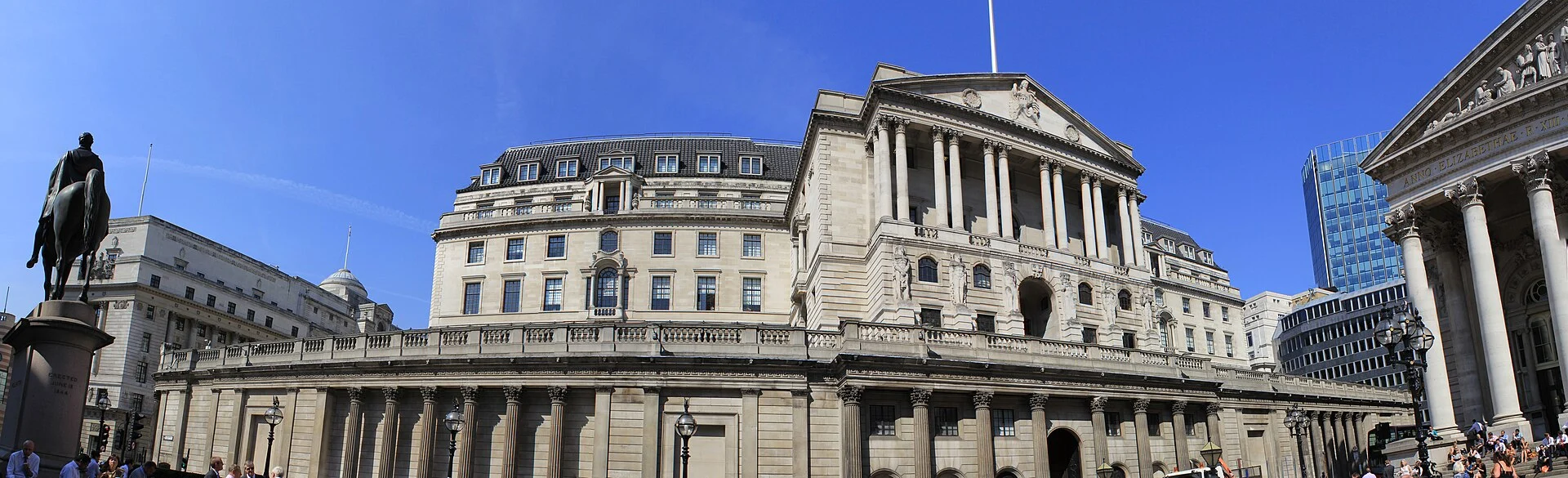
The Bank of England’s Monetary Policy Committee meets on September 17 to decide whether to move Bank Rate from its current level of 3.75%, where it has stood since the committee’s last cut in late 2025. A Reuters poll of 65 economists conducted September 4-8 found all of them expecting a hold, with 57 forecasting no change for the rest of the year.
The decision comes as inflation runs above the Bank’s 2% target, driven in large part by energy costs linked to the conflict in the Middle East, while employment data point to a economy that is cooling. The committee’s own recent votes show that balance getting harder to strike.
A Committee Divided by a Narrowing Margin
The Bank Rate has been held at every MPC meeting in 2026, but the votes behind those holds have shifted. A 5-4 split in February gave way to a unanimous decision in March, then an 8-1 dissent in April, a 7-2 split in June, and a 6-3 vote at the July 30 meeting. Each dissent in the second half of the year favored raising the rate, not cutting it.
At the July meeting, three members — Megan Greene, Catherine L Mann and Huw Pill — voted for an immediate quarter-point increase to 4.00%, according to the Bank of England’s published minutes. They argued that inflation had “exceeded the 2% target for more than five years” and that raising rates proactively would reduce the odds of energy costs feeding into wider prices. They cited research suggesting that setting policy as if second-round effects were stronger, and correcting course if needed, would prove less costly than the alternative.
The six-member majority held that financial conditions had “tightened materially compared with prior to the conflict,” providing enough restraint on their own. They pointed to a continuing disinflation process and an absence so far of material second-round effects, while acknowledging that the evidence was not yet conclusive.
Energy Prices at the Time of the July Decision
The Bank of England’s July 30 minutes recorded Brent crude at $84 a barrel and UK natural gas at 136 pence a therm, prices the committee tied to the conflict in the Middle East that began in late February 2026.
Energy Costs From an Ongoing Conflict
The Office for National Statistics reported that the Consumer Prices Index rose 2.9% in the 12 months to July 2026, up from 2.6% in June, while CPIH, which includes owner-occupier housing costs, rose 3.1%, its first increase since March. Core CPI, which strips out energy, food, alcohol and tobacco, held flat at 2.6%.
Housing and household costs were the largest driver, after Ofgem’s price cap rose in July, pushing an average dual-fuel bill paying by direct debit to £1,862 a year, a rise of £221. Gas prices alone jumped 14.7% that month, the largest monthly rise since October 2022, because the assessment period underlying the cap was the first to reflect wholesale energy prices affected by the Middle East conflict, which began in late February 2026, the ONS said.
The conflict also showed up in air fares: European routes fell 4.3% in the month, while long-haul fares rose 31.7%, which the ONS linked to airlines suspending or reducing flights into Middle Eastern airports and the resulting capacity constraints. Separately, the Bank’s July minutes recorded Brent crude at $84 a barrel and UK natural gas at 136 pence a therm as of July 28. The ONS is due to publish August’s inflation figures on September 16, the day before the MPC decision, so the committee will have one more month of data before it votes.
A Loosening Labour Market
Labour market figures published by the ONS on August 18 showed unemployment at 4.9% for April to June 2026, above the 4.8% economists had forecast. Job vacancies fell to 707,000 in the three months to July, the lowest level since late 2014, with about 2.5 unemployed people for every vacancy.
Wage growth told a mixed story. Total pay, including bonuses, rose 4.1% year-on-year and regular pay rose 3.5%, both above forecasts. But private-sector wages rose just 2.8%, the weakest pace since 2020, compared with 6.1% growth in the public sector. Payrolled employment fell to 30.3 million in July, down 94,000 from a year earlier, and the claimant count stood at 1.665 million.
Each dissent in the second half of the year favored raising the rate, not cutting it.
What Economists Expect
The Reuters poll found economists forecasting inflation to average 3.1% in 2026 before falling to 2.5% in 2027 and 1.9% in 2028, alongside growth of 1.1% this year, rising to 1.2% in 2027 and 1.5% in 2028. The median forecast now places the first rate cut in the third quarter of 2027, later than economists had expected in the previous month’s poll.
Gabriella Willis, a UK economist at Santander CIB, said that “for the Bank, there are no flashing warning signs.” Elizabeth Martins of HSBC said the committee had signaled it would act if evidence of second-round effects appeared, and that “so far, that’s not the case.” James Moberly of Goldman Sachs forecast inflation would peak at 3.3% in November, higher than the Bank’s own projection, arguing that current market pricing for Bank Rate “looks too high.”
The View From British Business
The British Chambers of Commerce backed the Bank’s July hold, with David Bharier, its deputy director of economics and insight, saying the rate was “already restrictive and may prove tight enough to do the job” without a further rise. He said BCC survey data showing that businesses reported “conditions are weakening” had informed the Bank’s own growth projections.
Bharier argued that domestic policy costs, separate from interest rates, were a bigger burden on firms: employer National Insurance contributions and other domestic costs had risen by roughly 70% over the past decade for a typical small or medium-sized business, before accounting for costs from Brexit-related trade friction and new global tariffs. He said “the bigger test now lies with the new Chancellor,” with the autumn Budget set to determine whether pressure on firms eases or intensifies.
Photo: Katie Chan · CC BY-SA 3.0 · via Wikimedia Commons