In the competitive landscape of smart hardware, survival rates tell a sobering story. While tens of thousands of products launch on crowdfunding platforms annually, fewer than 40% successfully deliver to backers, and even fewer build sustainable businesses beyond initial fulfillment.
The gap between prototype and profitability is littered with cautionary tales: companies that raised millions but collapsed during production, brands that shipped products but damaged their reputation, and promising technologies that never found market fit.
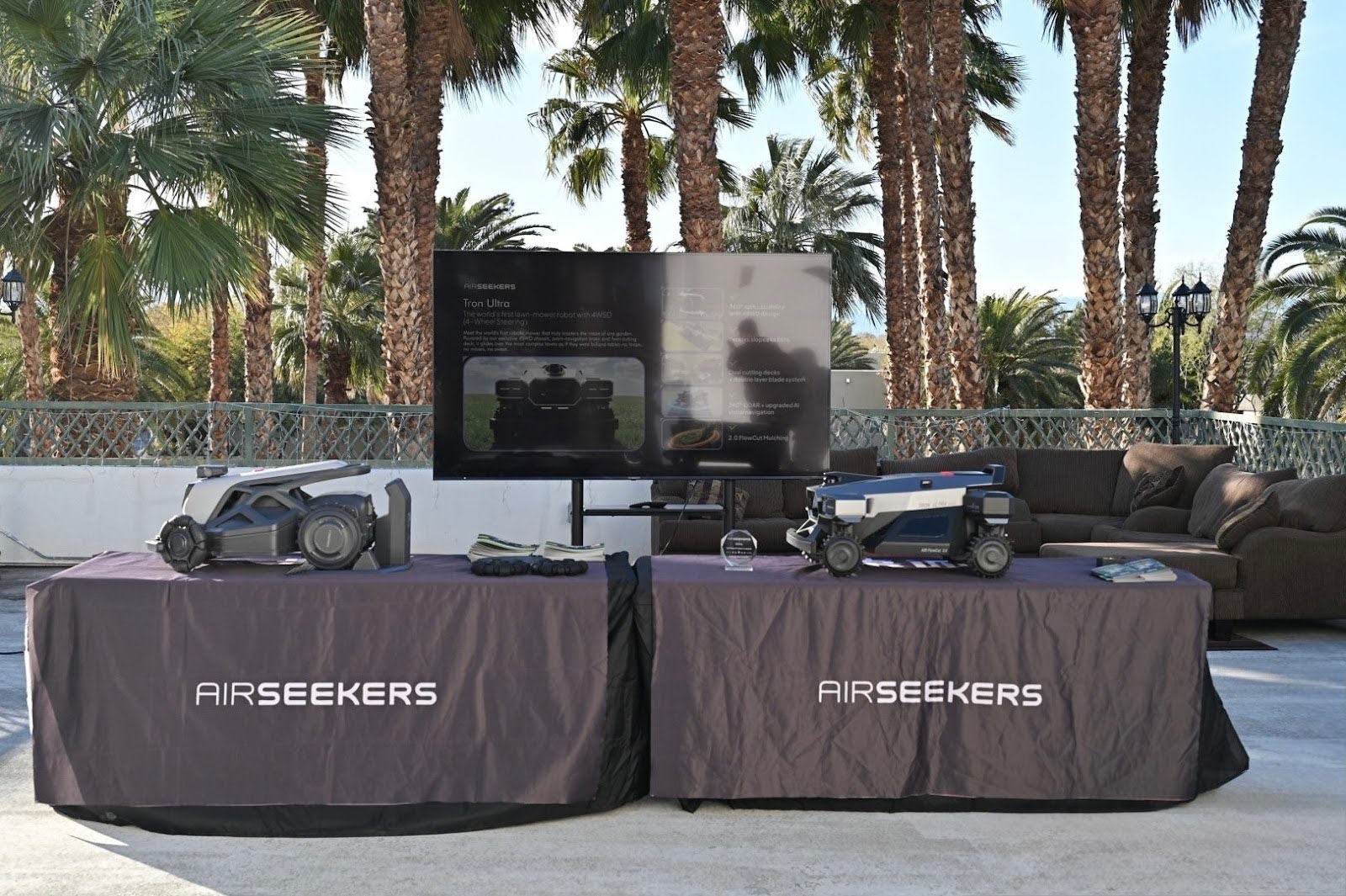
Yet some companies navigate these hurdles successfully. AIRSEEKERS, a robotics company developing autonomous lawn care solutions, offers a revealing case study in how smart hardware startups can survive the two most dangerous inflection points: the production crisis and the trust crisis.
The first critical hurdle arrives when engineering meets manufacturing reality. For AIRSEEKERS, this moment came in 2024, months after a crowdfunding campaign that raised nearly $3 million in 30 days for Tron, their first-generation robotic lawn mower.
“Chinese technical teams can make features work perfectly in lab settings,” explained Aaron Chou, Chief Product Officer at AIRSEEKERS, during a panel at CES 2026. “But many companies die right before mass production due to lack of production experience, factory management, and supply chain expertise.”
AIRSEEKERS confronted this reality head on. The company had reinvested crowdfunding capital into redesigning the product architecture around modular components, enhancing long term reliability but consuming significantly more time and capital than projected. When manufacturing commenced, cash flow constraints created an impossible choice: fulfill all crowdfunding commitments immediately and risk insolvency, or sequence deliveries to maintain operations.
This dilemma is endemic to hardware startups. Unlike software companies that iterate rapidly with minimal marginal cost, hardware manufacturers face massive upfront tooling investments, long production cycles, and working capital requirements that often exceed initial funding.
Companies that survive this hurdle share strategic approaches visible in AIRSEEKERS’ response. Rather than treating manufacturers as vendors, the company built collaborative relationships from product inception, engaging with over ten suppliers to optimize costs and build mutual commitment. “You cannot treat upstream partners purely as service providers,” Chou emphasized. “Long term partnership, with suppliers participating from the beginning, is absolutely critical.”
Smart sequencing of deliveries, while controversial, allowed AIRSEEKERS to generate revenue from channel partners that sustained operations. This pragmatic approach to working capital management, prioritizing company survival over ideal fulfillment sequences, is a lesson many failed crowdfunding projects learned too late.
The second critical hurdle emerges when operational reality diverges from customer expectations. How companies communicate during this gap determines whether they build loyalty or destroy credibility.
AIRSEEKERS faced this test directly. Delivery delays meant their earliest supporters, crowdfunding backers who funded the company’s existence, would wait longer than promised while channel partners received products first. Many companies in this position default to vague communications or legal defensiveness.
AIRSEEKERS chose radical transparency instead. The company disclosed production challenges, cash flow pressures, and the strategic logic behind delivery sequencing in detailed communications to backers. Rather than engage in damage control, they treated it as relationship management.
The response defied conventional wisdom. Backers expressed understanding rather than anger. Some visited the factory to witness challenges firsthand. The community shifted from frustrated customers to invested stakeholders. “Transparency became our crisis remedy,” Chou reflected. “Trust became our most valuable asset.”
When AIRSEEKERS completed a new financing round months later, they immediately dedicated full capacity to clearing the crowdfunding backlog. Within two weeks, all outstanding orders shipped. But the company went further: priority access to future products, significant discounts on the next generation Tron Ultra system, lifetime warranty commitments, and exclusive community status.
These actions transformed a potential brand crisis into brand strength. Many users communicated that the company’s response to the crisis generated more confidence than on time delivery would have.
The approach illustrates principles that apply across hardware industries. Rather than promising unrealistic recovery timelines, AIRSEEKERS shared granular details about constraints and tradeoffs, creating psychological space for customer understanding. Completing fulfillment rapidly after securing capital, then providing compensation beyond legal requirements, demonstrated commitment to relationships over short term profit protection.
These two challenges, production execution and trust management, represent distinct capabilities. Production crises demand operational excellence, supply chain sophistication, and capital discipline. Trust crises demand communication strategy, emotional intelligence, and long-term orientation.
Few hardware startups are equally strong in both domains, which explains why survivor rates remain low. Companies with strong engineering often struggle with production partnerships. Companies focused on marketing may underinvest in operational resilience.
According to Noah Herschman, partner at BlueConnect Partners and former executive at Amazon and eBay, Chinese hardware companies have achieved product innovation that rivals established brands. “The question is no longer whether Chinese companies can build great products,” he noted at the CES panel. “The question is whether they can sell them successfully, which requires channel strategy, service infrastructure, and brand storytelling beyond price advantage.”
For AIRSEEKERS, navigating both hurdles positioned the company for sustainable growth. The firm now projects revenue exceeding $50 million in 2026, with expanding distribution channels in the U.S., Europe, and Australia. More significantly, the crisis response created organizational capabilities, supplier relationships, transparent communication practices, and community loyalty that function as competitive advantages.
As AI integration accelerates product cycles and intensifies hardware competition, these capabilities may matter more than technological specifications. In an industry where many companies fail silently, the ones that succeed openly may have discovered something more valuable than faster iteration: they have learned how to build trust at scale.
For hardware entrepreneurs navigating similar challenges, AIRSEEKERS’ trajectory offers tactical guidance: treat production partners as collaborators, communicate transparently when reality diverges from plans, and recognize that how a company handles crisis defines its character more than how it handles success.
In an industry defined by tangible products, the most valuable assets remain intangible: relationships, reputation, and the resilience to survive when growth breaks.