Gaza’s ‘Yellow Line’ Traps Families Amid Ruins
Israel's newly marked "yellow line" in Gaza City is squeezing displaced families like Ola Ishtiwi's against ever-shrinking, unsafe ground.
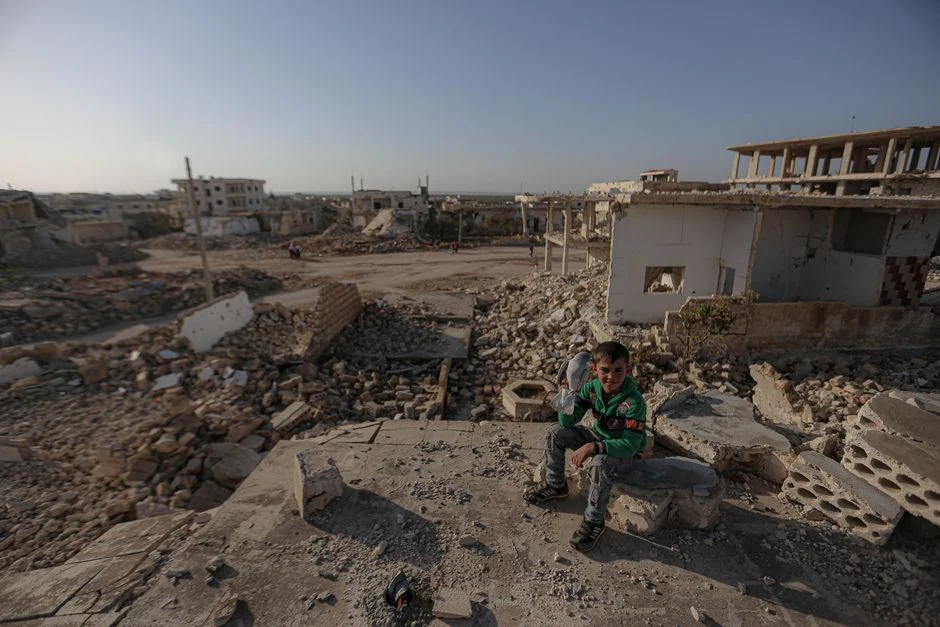
A series of painted cement blocks now marks what has become known as the “yellow line” across eastern Gaza City, a boundary that aid workers and residents say is steadily narrowing the space available to hundreds of thousands of displaced Palestinians. The line, established by Israeli forces, runs just metres from what remains of homes in neighbourhoods such as Al-Tuffah, where families are living amid rubble with nowhere else to go.
Among them is Ola Ishtiwi, who sits with her children in front of the wreckage of her house in Al-Tuffah, a few steps from the painted markers. Her family’s situation reflects a broader pattern documented by humanitarian officials: residents returning to find their homes destroyed, only to discover that the ground they are permitted to occupy is shrinking by the week as the demarcation line shifts.
United Nations officials describing the situation say the yellow line has effectively become a new frontier of displacement, one that leaves families asking where they can possibly go next. Communities that had already been uprooted multiple times during the course of the war are again being pushed toward areas with limited shelter, strained water and sanitation systems, and inconsistent access to food and medical care. Aid workers note that the shifting boundary complicates efforts to deliver assistance, since humanitarian convoys must constantly reassess which areas are considered accessible or safe.
The emergence of demarcated lines inside Gaza City follows a pattern seen throughout the conflict, in which military operations have repeatedly redrawn the areas deemed safe for civilians. Previous evacuation zones and buffer areas announced by Israeli authorities have similarly forced repeated waves of displacement, with families often given short notice to relocate before infrastructure in their areas was destroyed or rendered inaccessible. Analysts who track the conflict say such lines, whether formally declared or marked physically on the ground as with the cement blocks in Al-Tuffah, tend to compress the population into smaller and smaller areas, intensifying pressure on shelters, clinics and water points that were already operating far beyond capacity.
Humanitarian organizations operating in Gaza have for months warned that the scale of destruction across residential neighbourhoods, combined with restrictions on movement, has left much of the population without durable housing options. Reconstruction has been effectively impossible during active hostilities, meaning that families like the Ishtiwis are frequently left camping among the ruins of their former homes rather than being able to rebuild. International agencies have repeatedly called for unimpeded humanitarian access and for civilian protection to be prioritized in any military planning that affects populated areas, arguing that shifting front lines inside dense urban neighbourhoods put non-combatants at heightened risk.
For residents in Al-Tuffah, the practical consequence of the yellow line is a daily calculation over safety, shelter and survival. Some families report moving their remaining possessions closer to areas they believe to be farther from the marked boundary, while others say they lack the means or the destinations to move at all. Local accounts describe children growing up amid the debris of their neighbourhoods, with schools, clinics and basic services disrupted or destroyed.
The situation in Gaza City adds to a humanitarian picture that United Nations agencies have described as increasingly precarious, with hundreds of thousands of people believed to be sheltering in damaged or improvised structures across the territory. Officials have cautioned that further contraction of accessible areas could deepen shortages of food, clean water and medical supplies in the weeks ahead.
This report is based on an account published by UN News, detailing conditions faced by displaced families near the yellow line in eastern Gaza City.