How the House’s Third Iran War Powers Vote Reveals Congress’s Limits
The House passed a resolution telling Trump to end the Iran war for a third time, with seven Republicans defecting. It still has no force of law.
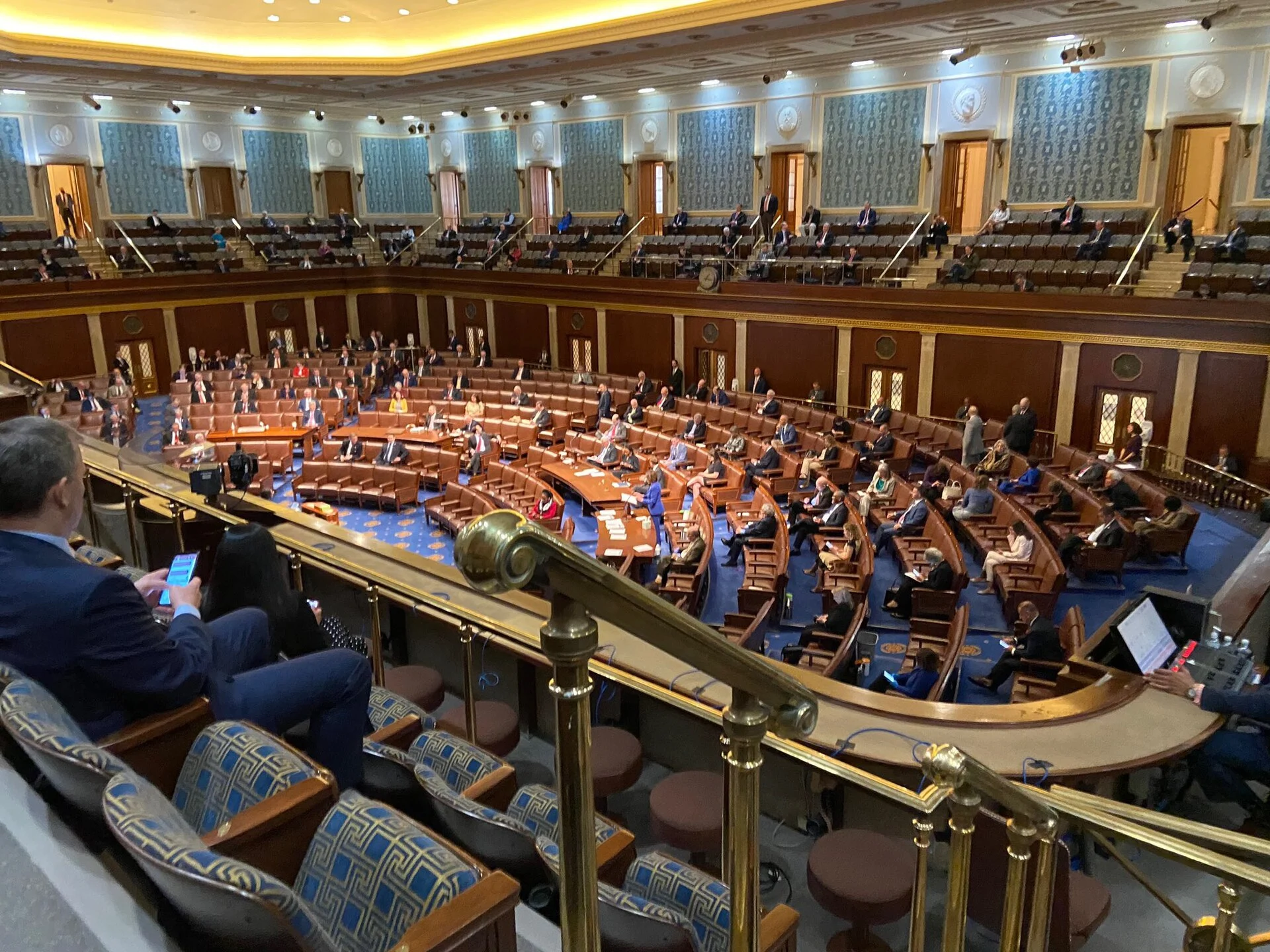
The House of Representatives voted 220-204 on September 15 to direct President Trump to withdraw American forces from hostilities with Iran, the third time since June that the chamber has passed a resolution invoking the War Powers Act. Seven Republicans crossed the aisle to support it, more than in either of the two earlier votes.
None of the three House measures, nor a version the Senate approved in June, has become binding. The war the United States and Israel launched against Iran on February 28 continues, and Congress has yet to produce a resolution capable of stopping it.
A Resolution With No Force of Law
The measure was sponsored by Rep. Seth Moulton, a Massachusetts Democrat and Marine veteran, with 14 House Democrats as cosponsors, most of them veterans themselves. It directs Trump to end U.S. military involvement in the conflict with Iran under the framework of the 1973 War Powers Resolution.
Under that law, a president who sends forces into hostilities without a declaration of war has 60 days to end the operation, win congressional authorization, or invoke a 30-day extension by certifying “unavoidable military necessity.” Trump has argued that a ceasefire he declared on May 1 ended the conflict within that window. American forces have nonetheless continued blockading Iranian shipping, and Iran has restricted passage through the Strait of Hormuz, a key oil corridor.
Because the House measure takes the form of a concurrent resolution rather than a bill, it is not presented to the president for a signature or a veto. Legal experts have called the House and Senate votes on the issue largely symbolic; constitutional lawyer Bruce Fein argued Congress has a more forceful option available, saying it could end the war “by terminating funding.” The Trump administration has also questioned the underlying law’s constitutionality.
The War’s Price Tag
Estimates of the Iran war’s cost range from the CBO’s $38 billion through the Pentagon’s $42 billion to Moody’s Analytics’ roughly $100 billion once oil-market disruption is included.
Why Seven Republicans Crossed the Aisle
Seven Republicans voted for the resolution: Thomas Massie of Kentucky, Brian Fitzpatrick of Pennsylvania, Warren Davidson of Ohio, Tom Barrett of Michigan, Mariannette Miller-Meeks and Zach Nunn of Iowa, and Nancy Mace of South Carolina. Mace, Miller-Meeks and Nunn were voting for such a resolution for the first time.
Nunn said that with the diplomatic “negotiating window closed,” continued combat operations now require congressional authorization. Miller-Meeks said Trump needs to present Congress and the public with a plan for how the war ends. Barrett, who also backed an earlier version in June, said only Congress has the authority “to authorize military action in Iran.”
Not all Republicans agreed. Rep. Brian Mast, chairman of the House Foreign Affairs Committee, called Iran “a continuous ongoing threat to the United States” and asked which American military capabilities in the region supporters of the resolution actually wanted withdrawn. Speaker Mike Johnson defended the administration’s position, noting Iran has been chanting “death to America” for decades.
A Pattern Repeating Without a Breakthrough
The effort began even earlier than the House’s first vote. On May 20, the Senate voted 50-47 to advance a war powers measure, a step supporters said reflected the principle that “Congress, not the president, should have the power to send troops to war.”
The House has now passed its own resolution three times since June. The Senate matched it once, approving a companion version 50-48 in June, when four Republicans — Bill Cassidy, Lisa Murkowski, Susan Collins and Rand Paul — joined Democrats and Sen. John Fetterman was the lone Democrat opposed. Two Republicans, Mitch McConnell and Dave McCormick, did not vote.
A second Senate attempt in July fell short, 47-49. Since that defeat, the Senate has not scheduled a vote on either the July or September House resolutions. Even if it did, an authorization bill would need a two-thirds majority in both chambers to survive an expected Trump veto, a threshold neither chamber has come close to reaching.
Seven Republicans broke with their president to say Congress, not the commander in chief alone, should decide when the war with Iran ends.
The Costs Piling Up Behind the Vote
A Congressional Budget Office report released the same week put the war’s direct cost to the Pentagon at $38 billion as of August 1, with projections of $2 billion to $3 billion more a month depending on the intensity of the fighting. Most of that reflects replacing expended munitions, plus equipment losses, fuel and extra military pay. The CBO tallied 43 pieces of destroyed or damaged equipment, including 11 fixed-wing aircraft, 25 drones and a THAAD missile-defense radar, worth $1.9 billion to $3.3 billion to replace.
The CBO said the U.S. military has used between half and two-thirds of its stockpile of antimissile interceptors since June 2025, leaving a reduced inventory the report said could take at least five years to rebuild — a gap it noted would also matter if a separate conflict arose over Taiwan. The office also found energy-price inflation tied to the war added 2.3 percentage points to second-quarter inflation, and projected the conflict would raise inflation by roughly half a percentage point more by early 2027.
Estimates of the war’s price tag vary widely depending on who is counting. Defense Secretary Pete Hegseth cited $37.5 billion in July; the Pentagon’s own updated figure to Congress put it at $42 billion; and Moody’s Analytics estimated the war has cost American households roughly $750 each, or about $100 billion in total, once higher oil prices are included alongside military spending. The White House’s supplemental funding request, submitted in June, sought $87.6 billion overall, with $67.1 billion earmarked for the Pentagon.
Trump has played down the toll, telling reporters the conflict is “small potatoes for us, it’s not a thing,” and describing it as a “military conflict” rather than a war. Sen. Elizabeth Warren described the financial and military toll differently, calling it a “one-two punch” on household budgets and munitions supplies. The CBO reported 18 U.S. service members have been killed and hundreds more injured since February; a July AP-NORC poll found most Americans believed the war had not been worth fighting.
What the Repeated Votes Signal
The growing number of Republican defectors shows rising unease within the president’s own party, but it has not been enough to change policy. After the September vote, Massie went further, introducing articles of impeachment against Hegseth, arguing that by continuing hostilities beyond 90 days without new congressional authorization the secretary was “breaking the law.”
Moulton pressed colleagues to recall that Trump had once predicted the war “would last just a few weeks.” Johnson’s continued defense of the administration shows House GOP leadership still stands behind the White House despite the defections. With lawmakers due to leave Washington to campaign ahead of November’s midterm elections, September’s vote is likely to be the House’s last word on the war for now.
Photo: Office of Mike Rogers, United States Congress · Public domain · via Wikimedia Commons