Sennheiser MOMENTUM True Wireless 5 Hands-On Review: A New Chapter for Sennheiser’s Flagship Earbuds
Sennheiser's MOMENTUM True Wireless series has been around long enough to develop a recognizable identity. Since the early generations, the formula has usually been familiar: a fabric-covered charging case, a relatively conservative…

Sennheiser’s MOMENTUM True Wireless series has been around long enough to develop a recognizable identity. Since the early generations, the formula has usually been familiar: a fabric-covered charging case, a relatively conservative design and, most importantly, a sound signature that favors clarity and soundstage over chasing trends.
The last MOMENTUM True Wireless model covered here was the MTW3 back in August 2022. Four years later, Sennheiser is now on the fifth generation, and the MOMENTUM True Wireless 5 — MTW5 for short — represents a much more dramatic change than the name might suggest.
The familiar fabric case is gone, the entire package is noticeably slimmer, and Sennheiser has taken the unusual step of designing both the earbuds and charging case with replaceable batteries. On the sound side, the company has also addressed one of the most common criticisms of the traditional Sennheiser signature: there is finally some serious bass.
After spending time with the MTW5, it becomes clear that Sennheiser has not abandoned what made the series appealing in the first place. Rather, this feels like an attempt to modernize everything around that familiar sound.

Jeff Li
Sennheiser MOMENTUM True Wireless 5: Key Specifications
Driver: 7mm TrueResponse dynamic transducer
Connectivity: Bluetooth 6.0
Codecs: SBC, AAC, aptX, aptX Adaptive and aptX Lossless
Spatial audio: Dolby Atmos with head tracking
Android pairing: Google Fast Pair
Windows pairing: Microsoft Swift Pair
Multi-device support: Bluetooth multipoint
Equalizer: 8-band EQ through Smart Control Plus
Charging: USB-C and Qi wireless charging
Rated earbud battery life: Up to 12 hours with ANC disabled
Rated total battery life: Up to 40 hours with charging case
Quick charging: Around one hour of playback from an eight-minute charge
Repairability: User-replaceable batteries in the earbuds and charging case
Available colors: Graphite, Cream, Copper, Denim and Lavender
The MTW5 continues to use Sennheiser’s 7mm TrueResponse dynamic driver rather than following the increasingly common trend of combining multiple driver types. The bigger changes happen around that familiar transducer, with a new physical design, updated connectivity and more extensive sound customization.
Pros
- Exceptionally wide soundstage
- Excellent clarity and instrument separation
- Fuller and more powerful bass than earlier generations
- Considerably thinner charging case
- Distinctive two-tone design
- User-replaceable batteries
- Stable Android connectivity during testing
- Google Fast Pair integration
- Separate battery readings for the case and both earbuds
- Qi wireless charging
Cons
- Replacement battery availability varies by region
- USB-C port is located on the bottom of the case
- Previous physical case button has disappeared
- Initial connection is not always especially fast
- Bassier tuning may not suit listeners looking for the more restrained Sennheiser sound
The First Major Change to the Charging Case
Jeff Li
Sennheiser has never really played by the books when it comes to charging cases. Earlier MOMENTUM models used fabric-covered cases that stood out from the usual glossy or matte plastic designs, but they were also relatively bulky compared with many competitors.
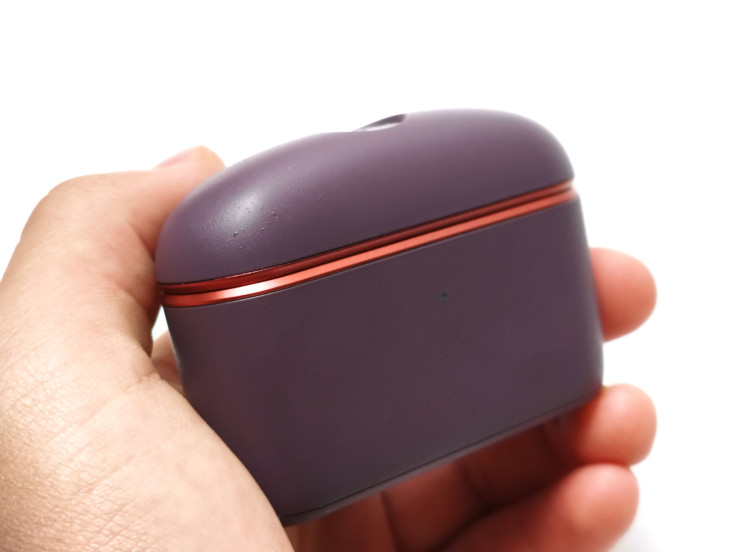
The MTW5 makes a much cleaner break from that design. At just 25mm thick, the new case has a much flatter profile that is easier to slide into a pants pocket, which feels like a more practical direction for something that spends most of its time being carried around.
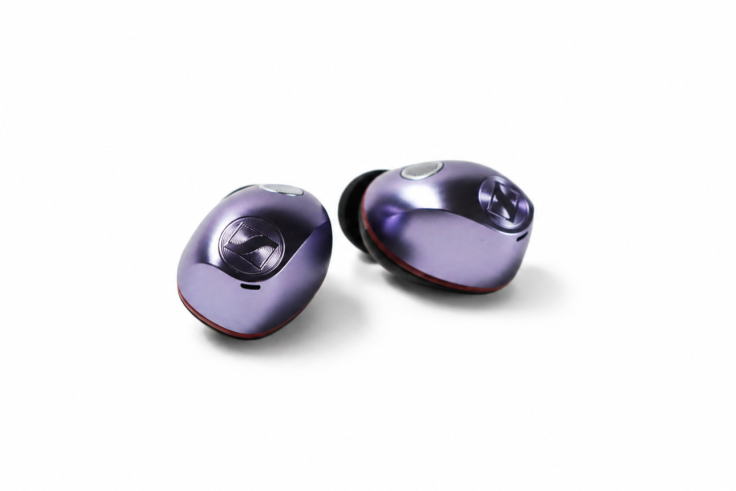
The fabric is gone, but the Lavender review unit still has plenty of character. Its matte purple exterior has fine speckles throughout, while the metallic maroon interior and inlaid Sennheiser logo give the case a more distinctive, almost jewelry-box-like appearance.
The particular shade of purple even gives it a slightly Thanos-like quality, which sounds unusual but is surprisingly fitting in person. Even without the fabric that defined the earlier generations, the MTW5 still manages to look unmistakably Sennheiser.
A Much More Pocketable Design
The slimmer profile is probably the most important physical improvement. Earlier MOMENTUM cases could create a noticeable lump inside a front pocket, while the MTW5 sits considerably flatter against the body.
There are, however, a few compromises. The tactile button found on previous charging cases has disappeared.
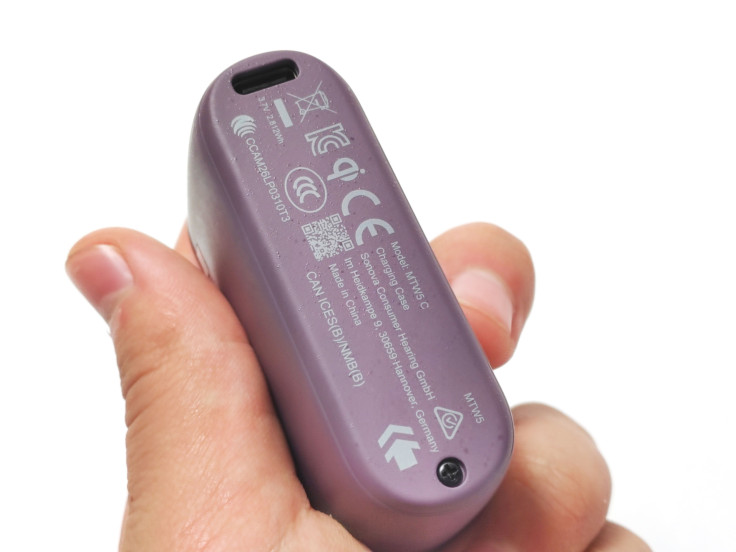
This means the case needs to be laid on its side while charging through a cable. It is an unusual placement, although hardly a major inconvenience considering that Qi wireless charging is also supported.
An indicator light remains on the front to show charging and battery status. Overall, the trade-off feels worthwhile for a case that is noticeably easier to carry.
Why Are There Screws on the Earbuds?
The biggest surprise may not be the new shape at all. Looking closely at the MTW5 reveals something that has practically disappeared from modern consumer electronics: visible screws.
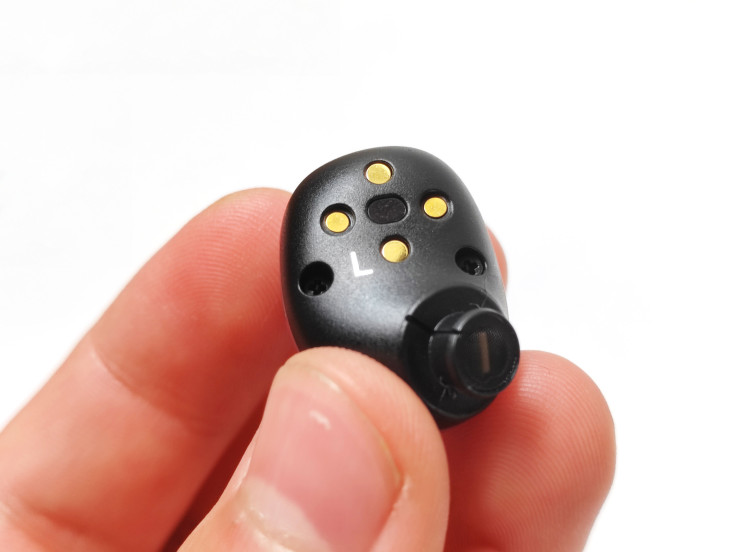
There is a screw underneath the charging case, while each earbud also has screws holding the housing together. At first glance, they almost look out of place on a premium pair of True Wireless earphones.
Jeff Li
Modern electronics generally try to hide their construction. Everything is glued, clipped or sealed together so tightly that opening a device can feel like performing surgery.
The MTW5 takes the opposite approach.
Those screws are there because both the earbuds and charging case are designed to be opened when the batteries eventually need replacing. Sennheiser even includes a small plastic tool to help with disassembly.
Jeff Li
It is difficult to think of another recent True Wireless earphone where exposed screws feel like a premium feature, but that is exactly what they represent here.
Replaceable Batteries Could Be the MTW5’s Most Important Feature
True Wireless earbuds have always had an uncomfortable expiration date. The drivers may continue working perfectly and Bluetooth may remain functional, but the tiny lithium-ion batteries inevitably lose capacity over time.
Anyone who has owned enough wireless earbuds probably has at least one old pair sitting in a drawer that technically still works. The problem is usually that the batteries can no longer hold enough charge to make using them worthwhile.
Traditionally, there has been little an ordinary user could do about that. Replacing an entire pair of earbuds has often been easier than replacing the small battery inside.
The MTW5 changes that equation.
When the battery eventually deteriorates, the earbuds themselves do not necessarily need to become electronic waste. The battery can be replaced, allowing the rest of the product to continue doing what it was designed to do.
This comes at an interesting time, with European battery regulations pushing consumer electronics toward greater repairability and battery replacement. Regardless of how much regulation influenced the decision, Sennheiser deserves credit for moving in this direction.
The remaining question is availability. A replaceable battery is only useful if replacement batteries are easy to buy, and this is one area where broader availability outside Europe would be welcome.
Sennheiser Still Believes in Dynamic Drivers
Take a look at many premium IEMs today and the specification sheet can read like a catalog of driver technologies. Balanced armatures, planar drivers and electrostatic tweeters are often combined in increasingly elaborate configurations.
Sennheiser has never seemed particularly interested in competing through driver count.
The MTW5 sticks with a single 7mm TrueResponse dynamic transducer. This is very much in line with Sennheiser’s approach across its higher-end earphones, where dynamic drivers remain at the center of the design.
The result is a reminder that complexity does not automatically equal quality. Despite lacking the multiple balanced armatures used by some premium competitors, the MTW5 has excellent clarity and detail retrieval.
Vocals remain clean, instruments are easy to distinguish and complicated sections of music never seem to collapse into one another. If anything, the MTW5 demonstrates how far a well-engineered dynamic driver can go when the company behind it knows exactly what it is doing.
Sound: Sennheiser Finally Brings the Bass
Sennheiser has long been associated with a relatively balanced sound. Its better headphones tend to prioritize clarity, detail and natural presentation rather than using an oversized low end to grab attention during the first few minutes of listening.
For many listeners, that has also been the complaint.
The MTW5 changes things considerably. Bass is much more prominent here, with enough weight and impact to compete with the stronger low-end presentations found in other premium True Wireless earbuds.
The important part is what Sennheiser has not sacrificed to achieve it. Vocals remain clear, instruments retain their separation and the bass does not bleed into the rest of the presentation.
Instead, music simply has more physical weight. Kick drums hit harder, bass lines are more obvious and tracks that previously might have sounded slightly reserved through a traditional Sennheiser tuning now have noticeably more energy.
This does not feel like Sennheiser abandoning its house sound. Rather, it feels like the company finally found a way to add the amount of bass modern listeners expect without damaging the qualities that made its tuning special in the first place.
A Massive Soundstage
The soundstage was one of the standout characteristics of the MTW3 when it was reviewed in 2022. Its presentation could stretch far toward the left and right while maintaining excellent instrument separation, giving it an almost holographic quality that was unusual for True Wireless earbuds.
The MTW5 retains that characteristic.
Music sounds huge, with an atmospheric presentation that makes the physical size of the earbuds difficult to reconcile with what is being heard. Instruments have space to exist independently rather than being compressed into a narrow left-right line.
The stronger bass actually works surprisingly well with this presentation. Instead of shrinking the soundstage, it gives the wide image more physicality and makes the overall listening experience more immersive.
In that sense, the MTW5 sounds bigger than the MTW3 without becoming less refined. That is probably the most impressive achievement of the new tuning.
Dolby Atmos: Building on Something Already Good
The MTW5 also adds Dolby Atmos optimization and spatial audio with head tracking. On some earphones, spatial audio can feel like an attempt to compensate for an inherently narrow presentation, but that is not really the case here.
The MTW5 already sounds wide before any spatial processing is involved. Dolby Atmos simply gives that existing soundstage another dimension.
With suitable material, the result can sound extremely atmospheric. The head-tracking effect also adds another layer of spatial positioning, although the fundamental sense of space is still recognizably Sennheiser.
This distinction is important. The MOMENTUM line was producing convincing imaging long before Dolby Atmos became a major feature in consumer earbuds.
Atmos therefore feels more like an enhancement than a requirement.
Connectivity Finally Feels Mature
Jeff Li
Connectivity was never the strongest aspect of the earlier MOMENTUM generations. The MTW3 improved considerably over the MTW2, but companies such as Apple still had an obvious advantage when it came to seamless device integration.
The MTW5 feels much more mature.
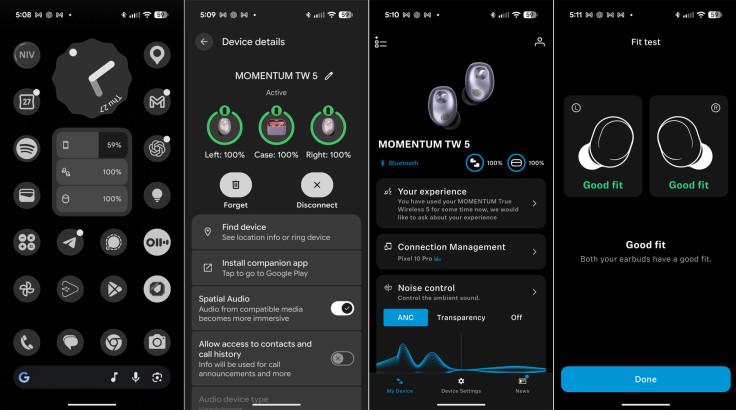
During testing with a Pixel 10 running Android 16, opening the charging case immediately brought up Google’s Fast Pair interface. A rotating 3D representation of the earbuds appears on the phone, creating an experience not far removed from opening an AirPods case beside an iPhone.
The MTW5 is not necessarily the fastest pair of earbuds when establishing the initial connection. However, once connected, stability has been very good.
That matters more in everyday use. A connection that takes an extra second to establish is easy to forgive; a connection that repeatedly drops is not.
Android Shows the Entire Battery System
One of the more useful features turned out to be something that does not sound particularly exciting on paper. Android’s battery widget can independently display the charging case, left earbud and right earbud.
Most wireless earbuds provide only a single battery reading. With the MTW5, all three components can be checked at a glance from the Pixel 10 home screen.
This makes it immediately obvious if one earbud has discharged faster than the other. More importantly, it removes the need to open Sennheiser’s app simply to find out whether the charging case needs power.
These small details are often what separate a product that merely works from one that feels well integrated. The MTW5 finally feels much closer to that second category.
Smart Control Plus
Sennheiser’s Smart Control Plus app provides considerably more control over the MTW5 than the simple preset-based apps found with some competing earbuds. An 8-band equalizer, Sound Personalization and additional connection options allow the sound to be adjusted in much greater detail.
Codec support includes SBC and AAC, together with aptX, aptX Adaptive and aptX Lossless on compatible hardware. Android users with the right phone therefore have access to considerably more audio flexibility than they would through a basic Bluetooth implementation.
Despite all those options, there is little reason to immediately change the stock tuning. The stronger bass is one of the most interesting parts of this generation and works surprisingly well with the familiar Sennheiser presentation.
Those who prefer something flatter still have plenty of room to experiment. The important part is that the MTW5 provides that choice without requiring it.
Battery Life and Charging
Sennheiser rates the MTW5 for up to 12 hours of playback with ANC disabled and approximately six hours with ANC enabled. Combined with the charging case, total rated listening time can reach up to 40 hours, while an eight-minute quick charge is rated to provide roughly another hour of listening.
Charging is handled through USB-C or Qi wireless charging, although the USB-C port now sits underneath the case rather than along the back. This means the case needs to be laid on its side when plugged in, which is an unusual choice but hardly a major inconvenience.
Ironically, the most interesting battery specification may not be the number of hours listed on the specification sheet. It is what happens several years from now when those numbers inevitably begin to fall.
Every rechargeable battery degrades over time, but with the MTW5 that no longer necessarily means the rest of the earphone has reached the end of its useful life. The ability to replace the batteries may ultimately prove more valuable than adding another hour or two to the initial battery rating.
Jeff Li
Final Verdict
The MOMENTUM True Wireless 5 feels like the biggest change Sennheiser has made to its flagship wireless earbuds in years. The familiar fabric-covered charging case is gone, but the new slimmer design is far easier to carry while still retaining enough visual character to stand out.
The replaceable batteries may ultimately be the more important change. True Wireless earbuds have historically been disposable electronics in everything but name, and giving owners a practical way to replace the component most likely to wear out is a significant step forward.
Connectivity has also matured considerably. Google Fast Pair, stable Bluetooth performance and Android’s ability to display separate battery levels for the earbuds and case make the MTW5 feel far better integrated with a modern Android phone.
However, as with previous generations, sound remains the main reason to consider the MTW5.
Sennheiser has retained the enormous soundstage, clarity and instrument separation that made the MTW3 feel unusually close to a serious IEM. The difference is that the MTW5 now adds the kind of powerful bass response that was often missing from earlier Sennheiser tuning.
This is not Sennheiser chasing its competitors.
It feels more like the company has taken the parts of its traditional sound that already worked and filled in the areas where the competition had caught up.
Four years ago, the MTW3 made a strong case as True Wireless for audiophiles. The MTW5 keeps that same foundation, but the improved bass, slimmer case, modern connectivity and repairable design make it a much more complete product.
Frequently Asked Questions
Does the Sennheiser MOMENTUM True Wireless 5 have replaceable batteries?
Yes. The batteries inside both the earbuds and charging case are designed to be replaced rather than permanently sealed inside the product.
Replacement battery availability varies by region, which remains one of the main practical questions surrounding the feature.
What driver does the MTW5 use?
The MTW5 uses a single 7mm Sennheiser TrueResponse dynamic transducer in each earbud. Sennheiser continues to favor a single dynamic-driver design rather than a multi-driver hybrid configuration.
Does the MTW5 have more bass than earlier MOMENTUM models?
Yes, based on listening impressions during testing. The MTW5 has noticeably more low-end weight and impact than the more restrained presentation traditionally associated with earlier MOMENTUM True Wireless models.
The stronger bass does not overwhelm the soundstage or clarity. Instead, it gives the MTW5 a fuller and more energetic presentation.
Does the MTW5 support Dolby Atmos?
Yes. The MTW5 supports Dolby Atmos optimization and spatial audio with head tracking.
The earbuds already have a naturally wide soundstage, so Atmos works more as an extension of the existing presentation than a replacement for it.
Does the MTW5 support wireless charging?
Yes. The charging case supports Qi wireless charging in addition to USB-C.
The USB-C port is positioned underneath the charging case. This means the case needs to be placed on its side when charging through a cable.
Does the MTW5 support Google Fast Pair?
Yes. During testing with a Pixel 10 running Android 16, opening the case automatically brought up Google’s Fast Pair interface.
Can Android show the battery level of the MTW5 case?
Yes, during testing with the Pixel 10. Android’s battery widget separately displayed the left earbud, right earbud and charging case.
How long does the MTW5 battery last?
Sennheiser rates the earbuds for up to 12 hours with ANC disabled and around six hours with ANC enabled. Total rated playback with the charging case can reach up to 40 hours.
Does the MTW5 support aptX Lossless?
Yes. Codec support includes SBC, AAC, aptX, aptX Adaptive and aptX Lossless when used with compatible hardware.
This review is based on hands-on testing of the Sennheiser MOMENTUM True Wireless 5. All listening impressions and conclusions reflect independent testing of the product.