Eleven ICC trade terms set who pays freight and when risk passes to the buyer
Eleven ICC trade terms set who pays for freight and insurance, who clears customs and where risk passes. US customs value leaves out international freight.

Cross-border sales raise a few practical points before goods move: who books the carrier, who pays for insurance, who clears customs, and at what point the buyer takes on the risk of loss. The International Chamber of Commerce’s Incoterms rules supply standard trade terms for those points. The rules address two questions in a sale that uses them: who pays for each step, and when the goods become the buyer’s risk.
The ICC says the set includes eleven three-letter terms and that it was first published in 1936. The most recent version, Incoterms 2020, entered into force on 1 January 2020. The rules describe which party handles which tasks, which costs each party bears and when risk passes. The ICC’s description does not mention price, payment, title or the law governing a contract.
What the terms are, and what they leave out
The ICC describes the rules as a set of standards for international and domestic contracts for the delivery of goods. Its page says they clarify the tasks, costs and risks involved in delivering goods from sellers to buyers, and that they help avoid costly misunderstandings. The UN Commission on International Trade Law recognises them as the global standard for interpreting the most common terms in foreign trade.
The ICC says a wallchart sets out the obligations, costs and risks of the buyer and seller under each of the eleven rules. A checklist on the same page helps sellers and buyers choose the right rule for business-to-business sales contracts. Incoterms 2020 is available in more than 30 languages.
The ICC pages read for this article do not say whether the rules apply automatically or only when a contract names them. They also do not state how often the rules are revised or name a next edition. The ICC describes Incoterms 2020 as the most recent version.
Key dates for Incoterms
The ICC says the eleven terms were first published in 1936. Incoterms 2020 entered into force on 1 January 2020.
Eleven terms, grouped by who arranges carriage
The ICC Academy article sorts the rules into E, F, C and D groups. The E group holds EXW alone, under which the buyer collects goods at the seller’s premises. The F group (FCA, FAS and FOB) and the C group (CFR, CIF, CPT and CIP) differ in where the seller hands over the goods and who books the main carriage. The D group (DAP, DPU and DDP) delivers goods at the named destination, and unloading duties differ: under DAP the buyer unloads, and under DPU the seller does.
Seven of the eleven terms do not mention a mode of transport, which the article says can be road, rail, air or sea, or more than one. The article does not name the seven. The other four, FAS, FOB, CFR and CIF, are described as traditional terms for port-to-port shipments of bulk or break-bulk cargo, and the article says they are not suited to containers in their current form.
The ICC page says that when goods are transported, an independent carrier is usually involved.
Who pays for freight, insurance and formalities
In the E, F and D groups, costs before delivery fall on the seller and costs after delivery fall on the buyer. Under the C group, the seller also pays for carriage to the named destination. Under CIP and CIF, the seller also pays the insurance premium.
Insurance duties are narrower than freight duties. Only CIP and CIF require the seller to provide insurance covering the buyer’s risk. The seller arranges main carriage under the C and D groups, and the buyer arranges it under the E and F groups.
Customs formalities split along similar lines. The seller handles export formalities under every term except EXW, and the buyer handles import formalities under every term except DDP. Formalities in a transit country follow a different rule. Under the D group they fall to the seller if they arise before delivery. Under all other terms they fall to the buyer.
The article also says the rules set out which party is responsible for security matters at each point, and require each party to help the other with information.
Where risk passes, and what the sources leave open
The ICC Academy article says risk passes from seller to buyer at the same point and time as delivery. On that reading, the delivery point marks the handover for both risk and the cost split described above. The article also notes that CIP and CIF are the only terms that require the seller to insure the buyer’s risk.
The official ICC rules page read for this article does not set out a risk point for each term. The Academy article is a guest opinion, and the ICC Academy says its author’s views do not necessarily represent those of the ICC or the Academy. A reader relying on a specific term should check the contract wording against the official Incoterms 2020 publication.
The rules address two questions in a sale that uses them: who pays for each step, and when the goods become the buyer’s risk.
A guest author’s view on EXW and DDP
The Academy article is written by Bob Ronai, a non-lawyer who was a member of the ICC’s Incoterms 2020 Drafting Group. He says the Incoterms 2020 rules mainly set out the contractual obligations between buyer and seller, and that he will cover real-world application in a future article.
He describes EXW and DDP as each ‘best avoided’. He notes that EXW has the lowest price but leaves the buyer with all other costs. He also says that when a seller handles much of the logistics, the cost is reflected in the selling price, most likely with a margin for error and a profit margin built in.
For official clarification, the article points readers to the Incoterms 2020 Certificate or the ICC’s Incoterms 2020 publication.
How the terms meet US customs value
Customs value is set by a separate rule. Under 19 CFR 152.103, US customs starts from the price actually paid or payable for merchandise sold for exportation to the United States. That price counts regardless of how it was derived, including through discounts, increases, negotiations or a formula. Agreed prices not yet paid at importation count as payable.
International freight and insurance are not part of transaction value. In Example 4 of the regulation, a $2,000 payment that included a $150 ocean freight and insurance charge, together with a $350 debt offset, gives a transaction value of $2,200: the $1,850 paid for the toys plus the $350 offset. The $150 charge is excluded because the transaction value excludes C.I.F. charges. Example 5 applies a 2% cash discount to a $100 price paid as $98, giving a transaction value of $98.
Foreign inland freight depends on the price basis. If the price is ex-factory, meaning it does not cover inland transport in the exporting country, those charges are not added. If the price includes foreign inland freight, the charge is part of transaction value to the extent it is included in the price.
A charge can be excluded when it is separately identified and arises after the goods are sold for export and placed with a carrier for through shipment to the US. That is established by a through bill of lading presented to CBP. Other documents are accepted only where a through bill of lading would clearly be impossible, such as shipments on the seller’s own conveyance.
Paragraph (b) adds five items to the price actually paid or payable: packing costs, selling commissions, the value of assists, royalties or license fees tied to the goods, and proceeds of later resale that accrue to the seller. The summary of the regulation read for this article does not mention Incoterms by name.
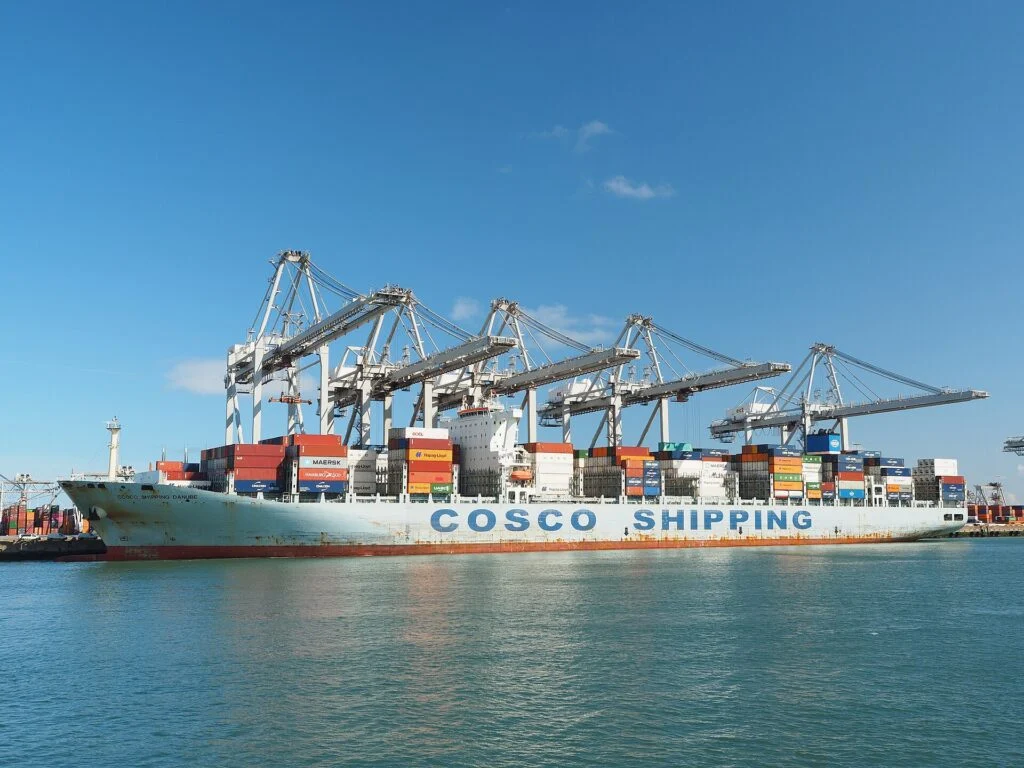
Photo: Tim Sheerman-Chase · CC BY 2.0 · via Wikimedia Commons