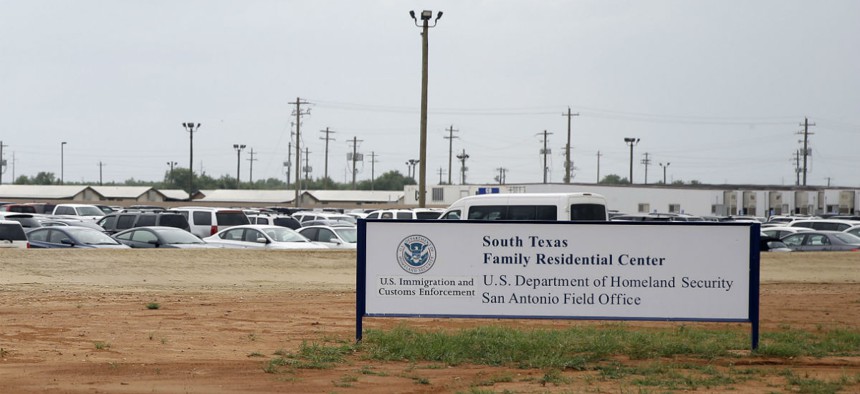
A large share of employees at the Department of Homeland Security, including ICE and Border Patrol Agents, will be required to report to work starting Saturday without knowing when they will receive their paychecks, as the agency enters a partial shutdown triggered by congressional deadlock over immigration enforcement reforms.
Beginning at 12:01 a.m. Saturday, “many employees will be required to work without pay,” a DHS spokesperson said, warning that the lapse in funding will place additional strain on workers “on the front lines of our nation.” DHS is currently the only federal department that has not secured full funding for the remainder of the fiscal year, which runs through Sept. 30.
Although the department has not released a formal shutdown plan, prior internal estimates show that during past funding lapses as many as 91 percent of DHS’s roughly 260,000 employees have been deemed essential and ordered to continue working without pay. This time, the number may be somewhat lower due to reserve funds held by certain agencies, including those involved in transportation security and immigration enforcement.
Congress recessed Thursday until Feb. 23 without reaching an agreement on proposed changes to immigration enforcement, particularly those affecting Immigration and Customs Enforcement. The stalemate effectively set the stage for the partial DHS shutdown.
Among the agencies affected are the Transportation Security Administration, the Federal Emergency Management Agency, and the United States Coast Guard.
The TSA currently has enough funding to operate through mid March. If the shutdown continues beyond that point, nearly 61,000 TSA employees will be required to work without pay. About 95 percent of the agency’s workforce is classified as essential.
“Approximately 95 percent of TSA employees are considered essential and must continue to work and protect travelers during a shutdown, without pay,” acting TSA Administrator Ha Nguyen McNeill told a House Appropriations subcommittee earlier this week. “These 61,000 public servants live and work across the country, in more than 430 commercial airports and in their communities, performing extremely demanding and challenging jobs without compensation.”
McNeill warned that prolonged uncertainty would jeopardize the agency’s ability to maintain high security standards. “The lack of funding and resource predictability will pose significant challenges to our ability to deliver transportation security at the level of excellence Americans expect and deserve,” she said, while stressing that TSA’s national security mission does not stop during a shutdown.
The Coast Guard faces similar constraints. According to Fox News, Vice Commandant Adm. Thomas Allan said the service would be forced to suspend all missions except those tied directly to national security or the protection of life and property. Pay would be halted for approximately 56,000 active duty, reserve, and civilian personnel.
At FEMA, employees may also be required to work without pay, although the agency’s disaster relief fund is expected to retain close to $7 billion, allowing it to continue disaster mitigation and response efforts in the short term.
Despite the budget impasse centering on ICE reforms, immigration agencies within DHS are not expected to immediately halt operations. In July, Congress approved roughly $175 billion through a fiscal reconciliation law aimed at strengthening border security and expanding staffing. Of that amount, ICE received about $75 billion and Customs and Border Protection was allocated roughly $64 billion.
The shutdown unfolds amid heightened public backlash over ICE operations in major metropolitan areas, particularly Minneapolis. On Friday, thousands of protesters marched through the city in a demonstration dubbed a “national blackout,” organized by migrant advocacy groups following the deaths of U.S. citizens Renée Good and Alex Pretti during encounters with immigration agents. President Donald Trump later described Pretti, a 37 year old nurse fatally shot on Jan. 25, as an “agitator and possibly an insurrectionist,” comments that further inflamed tensions.
Democrats have sharply criticized ICE’s deployment tactics, including allegations of racial profiling, the use of masks and paramilitary gear, and operations near schools, hospitals, and churches. Lawmakers have also called for the removal of DHS Secretary Kristi Noem.
In recent days, Democratic leaders formally presented the Trump administration and congressional Republicans with a package of proposed ICE reforms. The measures include banning roaming patrols based on appearance, prohibiting masks and paramilitary equipment, requiring visible identification, restricting the use of lethal force, mandating independent investigations, and requiring body cameras for agents.
The administration has rejected several of those proposals, particularly a ban on masks and a requirement that all enforcement actions be backed by judicial warrants.
As negotiations remain stalled, tens of thousands of DHS employees now face the prospect of reporting to work without pay, placing renewed pressure on Congress to resolve the funding and policy dispute before disruptions deepen across national security, transportation, and disaster response operations.
Originally published on Latin Times