How Broadcom’s $42 Billion Loan to Anthropic Mixes Chips With Financing
The chipmaker's loan exemplifies how semiconductor companies are bankrolling AI infrastructure buildout. The arrangement also raises questions about circular financing and Broadcom's mounting debt.
Reuters reported on October 1 that Broadcom has agreed to lend Anthropic up to $42 billion to finance infrastructure spending, according to Anthropic’s IPO prospectus filing. The loan, convertible into equity, reflects a broader industry pattern in which chipmakers bankroll the computing buildout required by frontier AI companies that then become their largest customers.
The arrangement combines multiple revenue streams for Broadcom: it supplies chips, leases equipment, provides financing, and becomes a potential shareholder. Broadcom’s own management expects Anthropic to become its largest XPU customer in 2027, making the semiconductor maker a central participant in the company’s infrastructure expansion. The deal is part of a wave of chipmaker financing initiatives launched since August 2026, when Nvidia announced a $500 billion financing platform with six major asset managers—Apollo Global Management, BlackRock, Blackstone, Brookfield Asset Management, Goldman Sachs, and KKR.
Anthropic’s multi-partner infrastructure buildout
The $42 billion Broadcom loan covers roughly one-third of Anthropic’s $125.2 billion five-year TPU compute commitment. Anthropic previously secured $35 billion in June 2026 through a financing platform co-established by Broadcom with Apollo Global Management and Blackstone, specifically designated for one-gigawatt chip installations. This funding pattern shows the company is assembling capital from multiple chipmakers and financial institutions simultaneously rather than relying on a single lender.
Beyond cloud services agreements, Anthropic is building custom data center infrastructure.
Anthropic’s compute commitments by partner
Of a separate $125.2 billion five-year TPU compute commitment, Broadcom’s $42 billion loan alone covers roughly one-third; combined with the earlier Apollo-Blackstone $35 billion tranche, Anthropic has now financed about $77 billion of that commitment, leaving roughly $48 billion yet to be financed.
How the financing structure works
The $42 billion loan is specifically structured for Anthropic to lease Broadcom’s chips rather than as unsecured borrowing, according to Semafor. The debt can convert into Anthropic shares, tying Broadcom’s returns to the company’s valuation as it approaches or completes its IPO. This convertible structure allows Broadcom to participate in upside if Anthropic’s valuation rises while securing fixed income through lease payments in the interim.
The arrangement echoes Nvidia CEO Jensen Huang’s DSX model — Nvidia’s term for its proprietary datacenter design — under which chipmakers position advanced chips as what Huang calls an ‘investable infrastructure asset.’ Under this model, investors buy asset-backed securities used to fund hardware and data center construction, then lease the infrastructure to end customers like Anthropic, with lease payments flowing back to repay investors. Broadcom simultaneously acts as chip supplier, equipment lessor, lender, and potential shareholder—a four-way relationship that concentrates the company’s economic exposure to Anthropic’s success.
Industry-wide pattern of chipmaker financing
Broadcom’s agreement with Anthropic is part of a coordinated shift across the semiconductor industry toward bankrolling customer purchases. Nvidia announced in August 2026 that it would partner with Apollo, BlackRock, Blackstone, Brookfield, Goldman Sachs, and KKR on a $500 billion financing initiative designed to standardize chip financing through securitization. Rather than relying on individual customer deals, Nvidia positioned itself as the anchor asset backing broader financial vehicles available to all AI companies seeking computing capacity.
These initiatives reflect a deliberate strategy by chipmakers to capture the financing market alongside hardware sales. By offering capital alongside chips, companies like Broadcom and Nvidia embed themselves deeper in customer relationships and reduce the risk that competitors’ products might be substituted. For Anthropic, access to dedicated financing from hardware suppliers reduces dependence on commercial banks and public capital markets, though it concentrates the company’s relationships with a small number of vendors.
Broadcom simultaneously acts as chip supplier, equipment lessor, lender, and potential shareholder—a four-way relationship that concentrates the company’s economic exposure to Anthropic’s success.
Wall Street skepticism and collateral concerns
Broadcom’s financing initiative comes as Wall Street expresses skepticism about how much specialized AI chips are worth as collateral. According to reporting from BNN Bloomberg, lenders doubt whether advanced processors can reliably serve as long-term collateral backing tens of billions in debt. Nvidia originally proposed guarantees as low as 25 percent of residual value, but banks have demanded stronger protections and backing from customer revenue streams.
The disagreement centers on how long chips maintain utility and value. Nvidia claims its GPUs have a useful lifespan of up to ten years, but according to BNN Bloomberg, banks typically underwrite GPUs using a three-to-four-year depreciation schedule. Lenders prefer contracts backed by investment-grade customers’ revenues rather than chip residual value alone, and they are demanding higher interest rates and larger financial cushions from deals. Anthropic itself acknowledges potential conflicts of interest in its IPO prospectus, flagging that pricing and hardware selection decisions could be influenced by Broadcom’s dual role as supplier and lender.
Broadcom’s concentration and existing debt burden
Broadcom carries $59.6 billion in gross fixed-rate debt while simultaneously taking on the $42 billion commitment to Anthropic and operating the co-established $35 billion financing platform, according to 24/7 Wall Street. Broadcom stock trades at approximately 45 times trailing earnings, reflecting market expectations about the company’s growth tied to AI infrastructure buildout. The semiconductor maker has only six customers for its XPU computing chips, with Anthropic expected to become the largest within the next year.
This concentration creates asymmetric risk: Broadcom’s leverage increases as Anthropic’s computing needs grow, but the company’s ability to diversify customer relationships is constrained by the specialized nature of its chip business. Should Anthropic’s capital expenditure plans slowdown or the company encounter difficulties, Broadcom’s exposure through debt, equity upside, and supplier relationships would create compounding losses rather than being offset by multiple independent revenue streams.
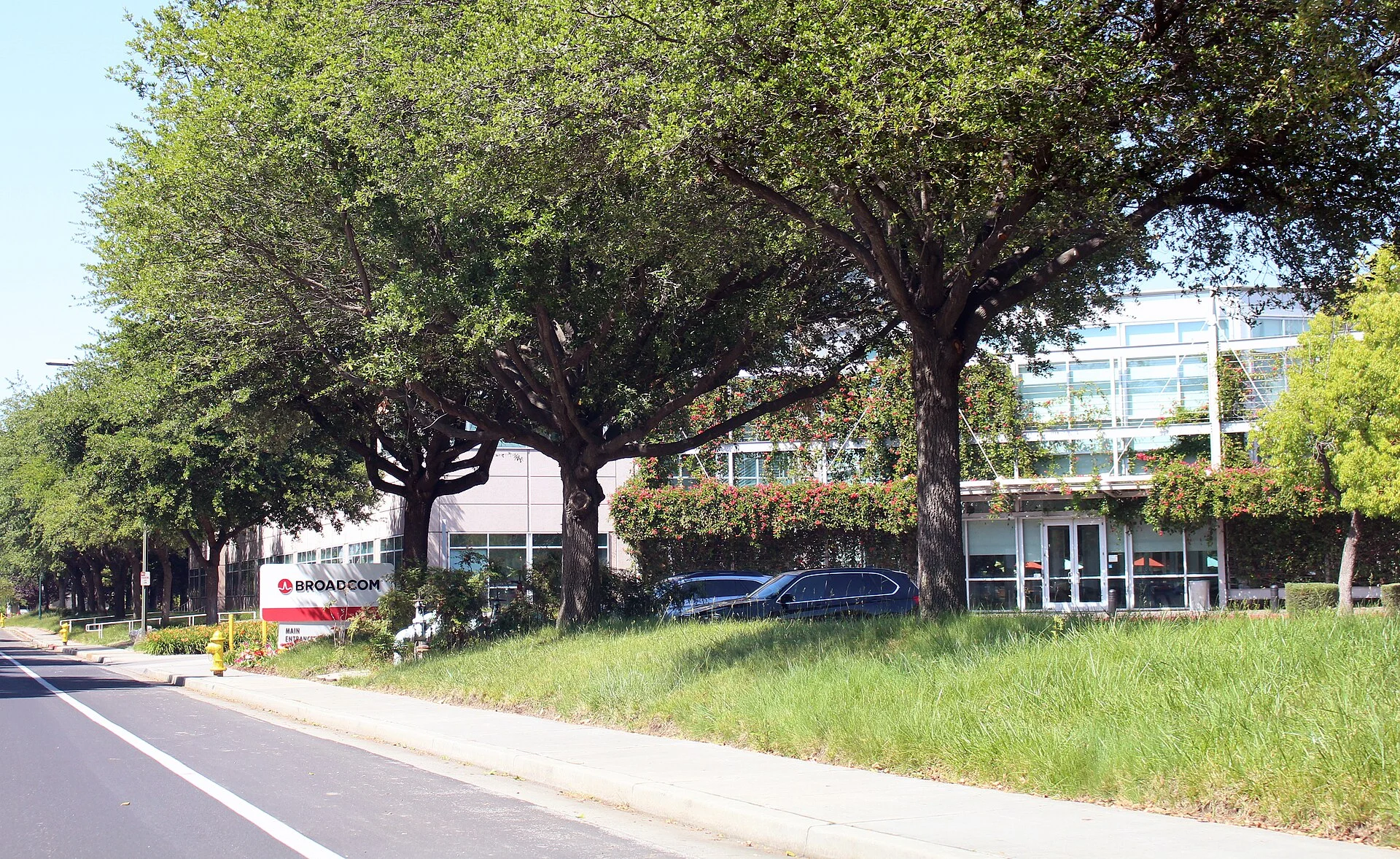
Photo: Coolcaesar · CC BY-SA 4.0 · via Wikimedia Commons